
A few minutes of unrecorded work may not look serious. Neither may a missed lunch correction, an outdated job description, or a bonus left out of an overtime calculation. When the same error repeats across employees and pay periods, however, it can lead to underpayments, payroll corrections, employee complaints, agency investigations, and damaged trust.
Lift HCM works with employers that want to connect payroll, timekeeping, and HR processes so these gaps are easier to see and correct. Most wage and hour mistakes do not begin with an intent to underpay anyone. They often begin with disconnected systems, inconsistent manager practices, or policies that have not kept pace with the workforce.
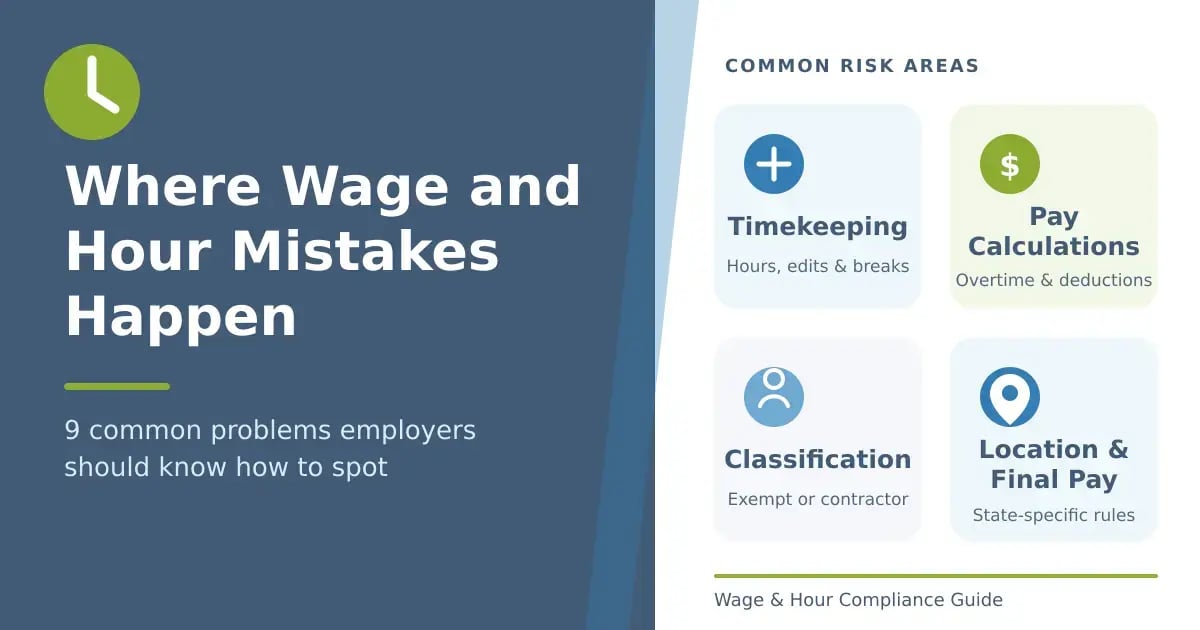
This guide explains nine common wage and hour mistakes, why they create risk, and what employers can review before a small issue becomes a larger problem.
Key Takeaways
The most common wage and hour mistakes include unpaid off-the-clock work, incorrect overtime calculations, employee misclassification, incomplete time records, improper break deductions, unlawful payroll deductions, late final pay, and failure to account for state or local rules.
- Paying an employee a salary does not automatically make the employee exempt from overtime.
- Employers generally must pay for work they allow or have reason to know is being performed, even when it was not approved in advance.
- Federal law creates a baseline, but state and local requirements may be more protective.
- Connected payroll and timekeeping systems can improve accuracy, but they do not replace proper policies, manager training, and legal review.
Table of Contents
What Counts as a Wage and Hour Mistake?
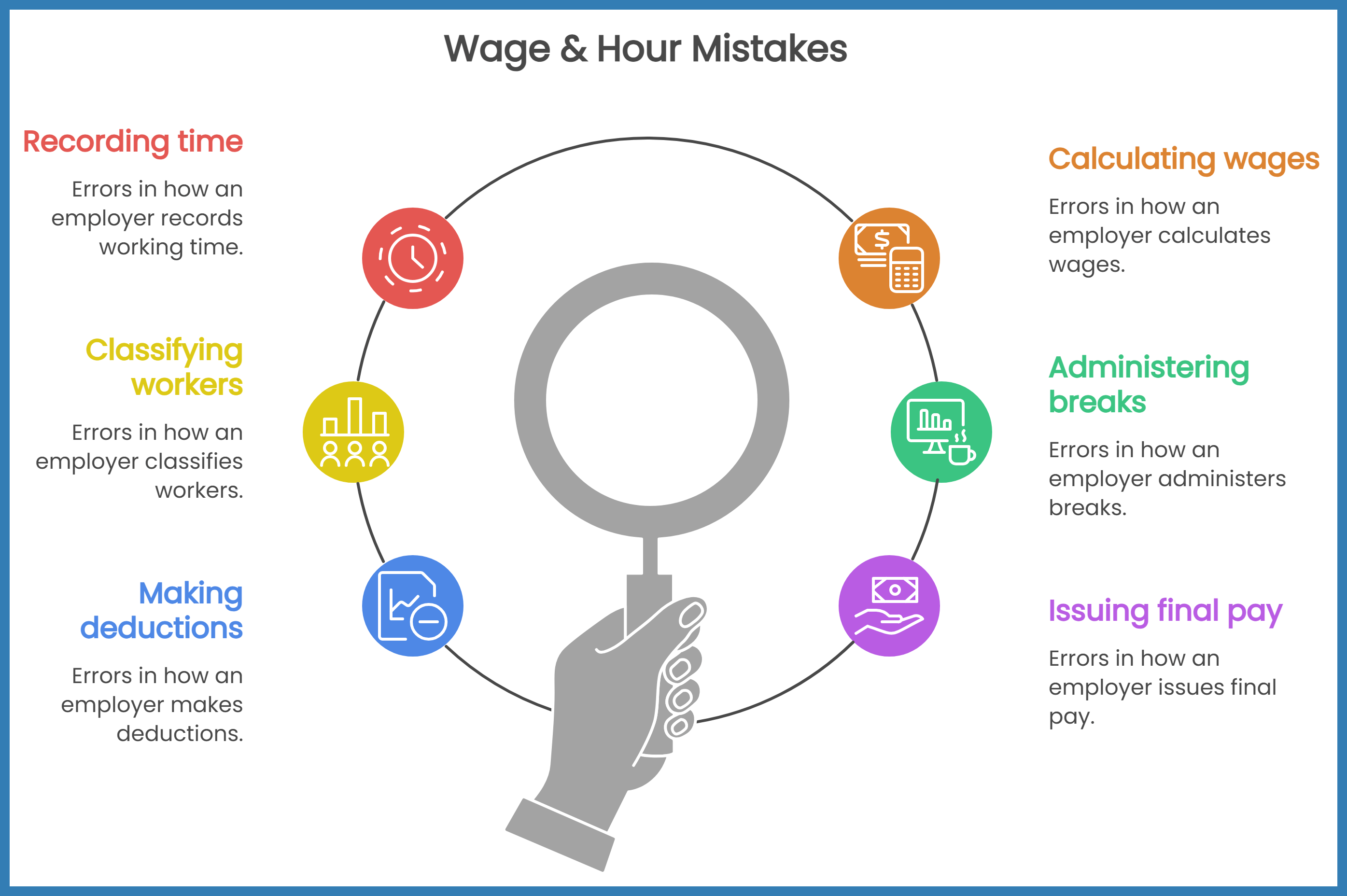
Wage and hour mistakes are errors in how an employer records working time, calculates wages, classifies workers, administers breaks, makes deductions, or issues final pay. They can affect minimum wage, overtime, recordkeeping, and other pay requirements.
The federal Fair Labor Standards Act, or FLSA, establishes minimum wage, overtime, recordkeeping, and youth-employment standards for covered employment. Covered, nonexempt employees generally must receive at least one and one-half times their regular rate for hours worked over 40 in a workweek. Employers must also review the laws that apply where each employee works because state or local requirements may be more protective. The U.S. Department of Labor's FLSA guide provides an overview of the federal requirements.
The following nine mistakes deserve particular attention because they can repeat silently from one pay period to the next.
1. Allowing Off-the-Clock Work
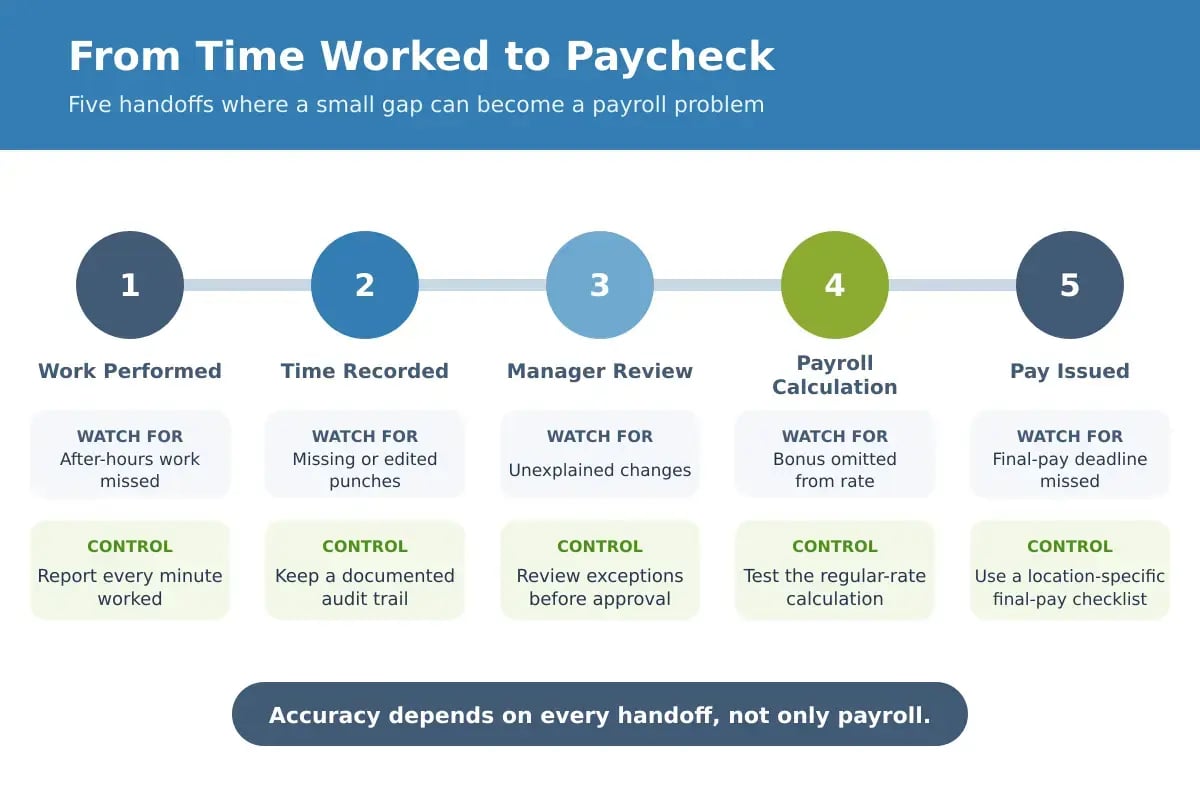
Off-the-clock work happens when a nonexempt employee performs job duties without recording the time. It can include opening a workstation before clocking in, answering messages after clocking out, completing paperwork at home, or finishing a task during an unpaid meal period.
Under the FLSA, work that an employer allows or has reason to believe is being performed generally counts as hours worked, even if the employer did not request it. A policy that prohibits unauthorized overtime may help manage behavior, but it does not by itself remove the obligation to pay for compensable work. The Department of Labor explains this distinction in Fact Sheet #22 on hours worked.
Managers are often the first line of defense. They should not tell employees to clock out and finish a task, ignore after-hours messages they expect employees to answer, or discourage employees from reporting corrections.
2. Calculating Overtime From the Wrong Rate
Overtime mistakes can happen even when an employer correctly identifies which employees worked more than 40 hours. The error may be using the employee's base hourly rate when the regular rate should include other compensation.
The regular rate generally reflects compensation for employment, subject to specific statutory exclusions. Nondiscretionary bonuses, commissions, shift differentials, and certain other payments may affect the calculation. The Department of Labor's Fact Sheet #56A explains the regular-rate framework, and Fact Sheet #56C addresses bonuses.
Employers should also make sure all hours worked across departments, locations, or pay rates flow into the same workweek calculation. Separate systems can hide overtime when each location or department views only its own hours.
3. Assuming Salaried Employees Are Exempt
A salary is a method of pay, not an automatic overtime exemption. Exempt status depends on the requirements of the applicable exemption, which may include how the employee is paid and the employee's actual job duties.
Job titles alone do not determine whether an exemption applies. An “assistant manager,” for example, may not qualify for an executive exemption if the employee's real duties do not satisfy the test. The Department of Labor's Fact Sheet #17A summarizes commonly used exemptions and links to the specific duties tests.
Review classifications when a role is created, when duties change, and when regulations or state requirements change. An outdated job description should not be the only evidence supporting a classification decision.
4. Treating a Worker as a Contractor Based Only on a 1099 or Agreement
Calling a worker an independent contractor does not settle the worker's legal status. Neither does issuing Form 1099, allowing the worker to request contractor status, or signing a contractor agreement. The relationship must be evaluated under the tests that apply to the specific law and jurisdiction.
Federal contractor-classification guidance is also an area employers need to monitor. As of this article's October 9, 2026 review date, the Department of Labor has published a 2026 proposed rule that could change the federal analysis under the FLSA. State unemployment, workers' compensation, tax, and wage laws may use different tests.
Employers should have qualified counsel review uncertain relationships, especially when a worker performs core business functions, works primarily for one organization, or operates under significant company control.
5. Relying on Incomplete or Inconsistent Time Records
Payroll can only be as accurate as the time data entering it. Missing punches, undocumented edits, separate spreadsheets, inconsistent rounding, and delayed approvals can all cause paid hours to differ from actual hours worked.
The FLSA does not require one specific timekeeping system, but covered employers must keep accurate records for covered, nonexempt workers. Required information includes hours worked each day, total hours worked each workweek, pay rates, additions and deductions, and wages paid. Federal payroll records generally must be retained for at least three years, while records used to calculate wages generally must be retained for two years, according to DOL Fact Sheet #21. Other federal, state, local, or industry rules may require longer retention.
Employers should give employees a simple way to report a missed punch or incorrect entry. Every manager edit should include a reason, date, and audit trail.
6. Deducting Breaks That Employees Did Not Take
Automatic meal deductions can create recurring underpayments when the system deducts time regardless of what happened. If an employee works through lunch, answers calls, monitors a workstation, or is otherwise not fully relieved of duty, the time may be compensable under federal law.
The FLSA does not generally require employers to provide meal or rest breaks. When employers offer short rest breaks, usually 20 minutes or less, the time generally must be counted as hours worked. Bona fide meal periods, typically 30 minutes or more, generally do not have to be paid when the employee is completely relieved of duty. State and local rules may require breaks or impose different standards.
Illinois employers have an additional rule to review. Subject to coverage and exceptions, the Illinois One Day Rest in Seven Act generally requires a meal period of at least 20 minutes for every 7.5-hour shift, beginning no later than five hours after the shift starts. Additional meal periods may be required for longer shifts. The Illinois Department of Labor's ODRISA guidance explains the requirements.
An employer using automatic deductions should provide a clear, prompt way to cancel the deduction when a meal was missed or interrupted. Managers should be trained not to discourage corrections.
7. Making Improper Payroll Deductions
Payroll deductions can create wage and hour problems when they are unauthorized, poorly documented, or reduce an employee's pay below a required wage level. Common trouble spots include uniforms, equipment, cash shortages, benefit changes, advances, overpayments, and final-paycheck deductions.
Federal law limits certain deductions when they cut into minimum wage or overtime obligations. The Department of Labor explains these restrictions in Fact Sheet #16. State laws may require written authorization or impose stricter limits.
In Illinois, the Wage Payment and Collection Act generally prohibits deductions from wages or final compensation without employee consent unless an exception applies. Payroll and benefits teams should reconcile deduction files after enrollments, status changes, and terminations. A lawful deduction can still become an operational error if it continues after an employee cancels coverage or repays an advance.
8. Missing Final-Pay Requirements
Final-pay deadlines vary by state and sometimes by whether the employee resigned or was discharged. Other questions may include whether earned commissions, bonuses, expenses, or unused vacation must be included.
Errors often begin with delayed communication. A manager may end employment without giving payroll enough time to calculate the final check or verify the employee's work location and remaining compensation.
9. Applying One State's Rules to the Entire Workforce
Federal law is only part of wage and hour compliance. States and cities may have higher minimum wages, daily overtime, break requirements, wage-statement rules, deduction restrictions, reporting-pay requirements, or different final-pay deadlines.
The employee's work location is a critical part of the analysis. This becomes harder when an employee moves, works remotely in another state, travels regularly, or splits time between locations. Payroll and HR need a reliable process for identifying where work is performed and escalating location changes before the next payroll.
Do not assume that a policy compliant at company headquarters works everywhere. Create a jurisdiction matrix for the states and cities where employees work, assign an owner for updates, and document how rule changes reach payroll and managers.
Explore the broader payroll issues that arise when employees work in multiple states.
Which Wage and Hour Controls Should Employers Prioritize?
Start with controls that affect many employees or repeat every pay period. The table below is a practical review tool, not a ranking based on enforcement statistics.
|
Risk Area |
What to Check |
Useful Control |
|
Off-the-clock work |
Pre-shift, post-shift, remote, and interrupted-break work |
Manager training and an easy correction process |
|
Overtime calculations |
Hours across locations and compensation included in the regular rate |
Consolidated workweek data and payroll review |
|
Exempt classifications |
Actual duties, salary basis, and applicable federal and state tests |
Documented classification review |
|
Contractor status |
The real working relationship under each applicable test |
Legal review and centralized approvals |
|
Timekeeping |
Missed punches, edits, rounding, and approval patterns |
Audit trails and exception reports |
|
Breaks |
Missed, short, or interrupted meal periods |
Employee attestation and deduction-correction workflow |
|
Deductions |
Authorization, wage floors, and state restrictions |
Deduction register and reconciliation |
|
Final pay |
Work state, deadline, PTO, commissions, and deductions |
Location-specific termination checklist |
|
Recordkeeping |
Required hours, rates, additions, deductions, and retention |
Documented retention schedule |
How Can Employers Reduce Wage and Hour Risk?
Employers can reduce wage and hour risk by building controls around the moments where pay data is created, changed, approved, and transmitted. The goal is not to depend on one annual audit. It is to make unusual activity visible before payroll closes.
Use this checklist as a starting point:
| Control Area | What To Review |
|---|---|
| Time Records |
|
| Overtime Accuracy |
|
| Worker Classification |
|
Payroll And State Rules |
|
Manager Accountability |
|
Connected systems can reduce duplicate entry and make exception reports easier to use. They do not replace legal review, sound policies, correct configuration, or manager accountability.
Q&A: Wage and Hour Mistakes
Does Unauthorized Overtime Still Have to Be Paid?
Generally, yes. If a covered, nonexempt employee performs work that the employer requires, allows, or has reason to believe is being performed, the time generally must be counted and paid. An employer may enforce a policy requiring advance approval, but discipline and wage payment are separate issues.
Are Salaried Employees Always Exempt From Overtime?
No. Salary alone does not determine exempt status. The employee must satisfy the requirements of an applicable exemption, which may include salary and duties tests. State rules may differ from federal rules.
Do Employers Have to Pay for Meal Breaks?
Under federal law, a bona fide meal period generally does not have to be paid when the employee is completely relieved of duty. Short rest breaks, usually 20 minutes or less, generally count as paid working time when offered. State and local break rules may provide additional protections.
How Long Should Employers Keep Time and Payroll Records?
Under federal FLSA guidance, payroll records generally must be kept for at least three years, while records used to calculate wages generally must be kept for two years. Employers should also review state, tax, benefits, contractual, and industry-specific retention requirements, which may be longer.
How Often Should Employers Audit Wage and Hour Practices?
There is no single audit schedule that fits every employer. A business with hourly employees, multiple pay rates, frequent bonuses, remote workers, or operations in several states may need more frequent reviews. Employers should base the cadence on risk and use payroll exception reports between formal audits.
Can Timekeeping Software Prevent Wage and Hour Mistakes?
Timekeeping software can improve record accuracy, approval workflows, and visibility into exceptions. It cannot prevent managers from encouraging off-the-clock work, fix an incorrect exemption decision, or determine which law applies without proper setup and oversight.
Build Better Controls Before a Small Error Repeats
Wage and hour risk often grows through repetition. One missed time edit, incorrect deduction, or overtime error can affect multiple employees and pay periods when the underlying process is not corrected.
The most effective response is to connect accurate time records with payroll, define who reviews exceptions, train managers, and maintain state-specific procedures. Employers should also involve qualified legal or compliance professionals when classification, deductions, final pay, or conflicting jurisdictional rules are unclear.
At Lift HCM, we help employers bring payroll, timekeeping, and HR administration into a more connected process with clearer data and responsive support. If you want to reduce manual steps and improve visibility into the information that drives payroll, contact Lift HCM to discuss your current process.
This information is for educational purposes only and is not intended to replace legal counsel. Wage and hour requirements vary by jurisdiction and circumstance. Consult the applicable federal, state, or local labor agency or a qualified attorney to confirm the requirements for your organization.
Topics:









.png?width=1536&height=1024&name=Create%20a%20background%20that%20reads%2c%20How%20Long%20to%20Keep%20P%20(1).png)