
Hiring should be exciting, but for many small business owners and HR managers, background checks feel like a legal minefield. Questions about forms and adverse actions often turn a simple step into a source of anxiety, especially since a single paperwork error can lead to federal lawsuits.
FCRA litigation has continued to climb, with lawsuits up more than 30% year-over-year through 2025 compared to 2024, even as federal regulatory activity at the CFPB slowed significantly. Private plaintiffs have stepped in where regulators have stepped back, and employers remain the primary target.
At Lift HCM, we help businesses create efficient, legally sound hiring processes. This guide explains employment background check compliance in plain English, covering federal laws, compliant workflows, 2026 updates, and "Ban-the-Box" requirements to help you grow your team with confidence.
Key Takeaways
Employers must provide a standalone FCRA disclosure, collect written authorization, and follow the required adverse action process if a background check report may affect the hiring decision.Criminal records should be reviewed individually using job-related criteria, including the nature of the offense, how much time has passed, and whether the record relates to the role.
In many jurisdictions, criminal history questions must wait until after an interview or conditional job offer. In 2026, Illinois employers also face new obligations tied to the Clean Slate Act and AI screening tools.
Table of Contents
What Is Background Check Compliance for Employers?
Background check compliance means following the federal, state, and local rules that apply when you screen job candidates. These rules often control what you must tell candidates, when you can order a report, how you can use the information, and what steps you must take before making a negative hiring decision.
The main federal law employers need to understand is the Fair Credit Reporting Act, or FCRA. The FCRA applies when an employer uses a third-party Consumer Reporting Agency, or CRA, to prepare a background report for employment purposes. That report may include criminal records, driving records, employment verification, education verification, credit history, or other screening information.
The FCRA is enforced by federal agencies, including the Consumer Financial Protection Bureau (CFPB) and the Federal Trade Commission. Employers can also face private lawsuits from candidates or employees if the process is handled incorrectly. The risk is not only whether the background check was accurate. Many lawsuits happen because the employer used the wrong form, skipped the notice process, or made a decision too quickly.
For employers, background check compliance should be treated as a repeatable hiring process, not a one-time paperwork task. A complete hiring compliance program covers more than background checks, I-9 and E-Verify compliance is another area where small employers commonly run into avoidable legal exposure.
When Does the FCRA Apply to Employment Background Checks?
The Fair Credit Reporting Act (FCRA) applies when you use a third-party vendor to gather background information for employment purposes. This is the trigger point many employers miss. If a manager checks a reference in-house, the FCRA usually does not apply. But if your business pays a screening company to prepare a report, the FCRA process generally applies.
The FCRA can apply to more than full-time employees. It may also apply when screening part-time employees, temporary workers, independent contractors, and volunteers if the screening is used for employment-related purposes.
Here is a simple way to think about it:
|
Screening Type |
FCRA Triggered? |
Common Risk |
|
Criminal search through a vendor |
Yes |
Missing standalone disclosure |
|
Driving record through a vendor |
Yes |
Missing written authorization |
|
Employment or education verification |
Yes |
Disclosure bundled into application |
|
Credit report through a vendor |
Yes |
Used where state law restricts it |
|
Outsourced social media screening |
Yes |
Protected information appears in report |
|
In-house reference checks |
Usually no |
Inconsistent questions |
|
DIY Google search |
Usually no |
Bias or privacy risk |
|
Contractor screening through a vendor |
Yes |
Employers forget FCRA still applies |
Even when the FCRA does not apply, employers still need to be careful. Informal online searches can reveal protected information, such as race, religion, disability, pregnancy, or age. If a candidate is rejected after a hiring manager views that information, the employer may face discrimination concerns.
The regulatory environment for hiring is shifting on multiple fronts in 2026. Pay transparency laws are another area where state and local rules are multiplying quickly, and many of the same jurisdictions leading on Ban-the-Box are also passing salary disclosure requirements.
What Are the FCRA Background Check Requirements?
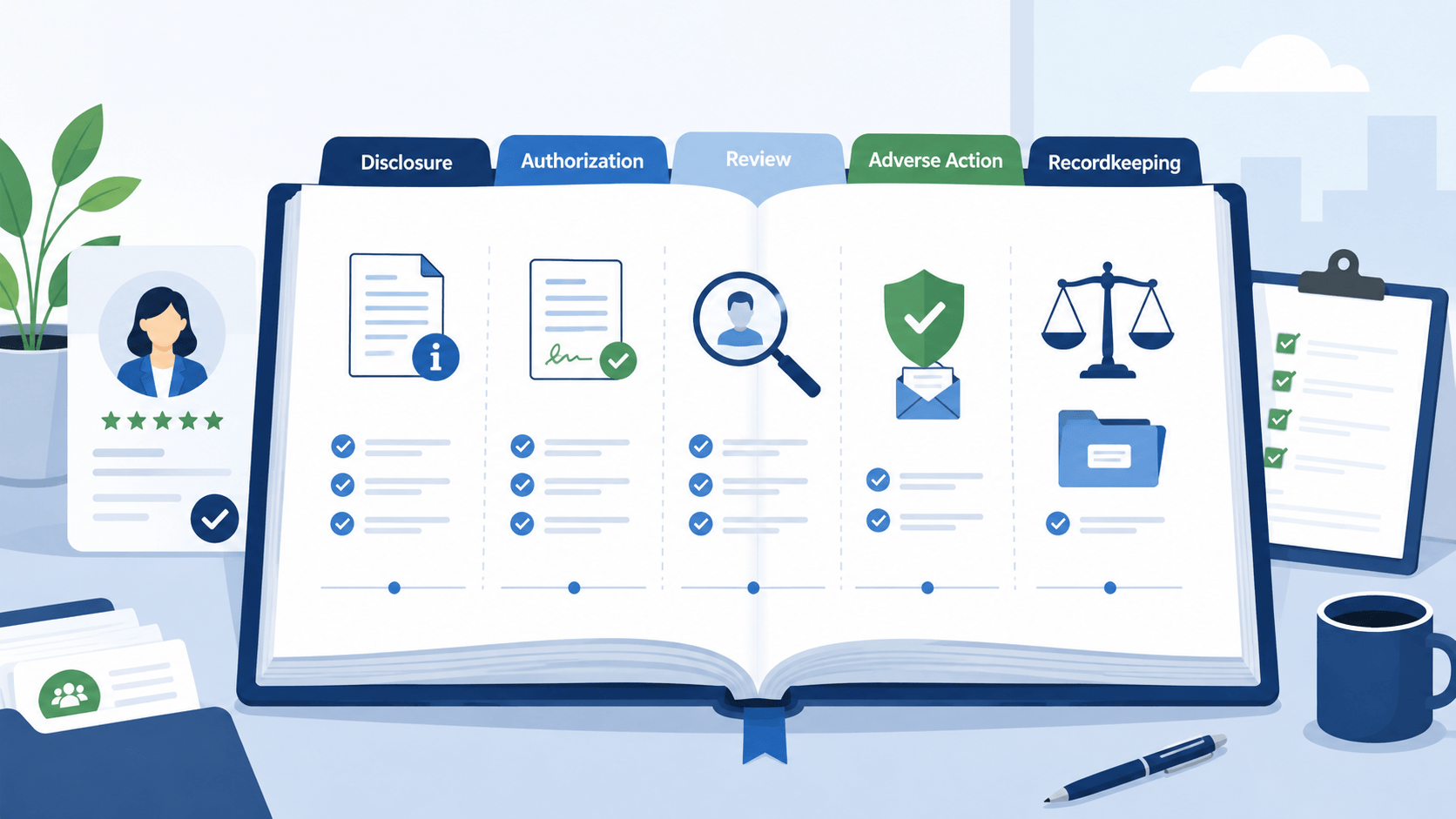
The FCRA background check requirements are specific. Employers should follow them before ordering the report, while reviewing the report, and before making any negative decision based on the report.
The basic requirements include:
- Provide a standalone disclosure.
The candidate must receive a clear written notice that a background check may be obtained for employment purposes. This disclosure should stand alone and should not be buried inside the job application, handbook, liability waiver, or other paperwork. - Get written authorization.
The candidate must give written permission before the employer orders the background check. - Use the current Summary of Rights when required.
Employers must use the updated CFPB “Summary of Your Rights Under the Fair Credit Reporting Act” when providing required notices. Mandatory use of the updated notice began March 20, 2024. - Follow the adverse action process.
If the employer may reject the candidate, withdraw an offer, or take another negative action because of the report, the employer must follow the pre-adverse and final adverse action process. - Apply the process consistently.
Candidates applying for the same role should be screened using the same criteria. Selective or inconsistent screening can increase discrimination risk.
The most common employer mistake is combining the FCRA disclosure with extra language. Even well-intentioned additions can create problems if they make the disclosure no longer “standalone.”
What Is the Adverse Action Process?
The adverse action process is the required set of steps an employer must follow before making a final negative hiring decision based on a background check report. This process gives the candidate time to review the report, identify mistakes, and dispute inaccurate information.
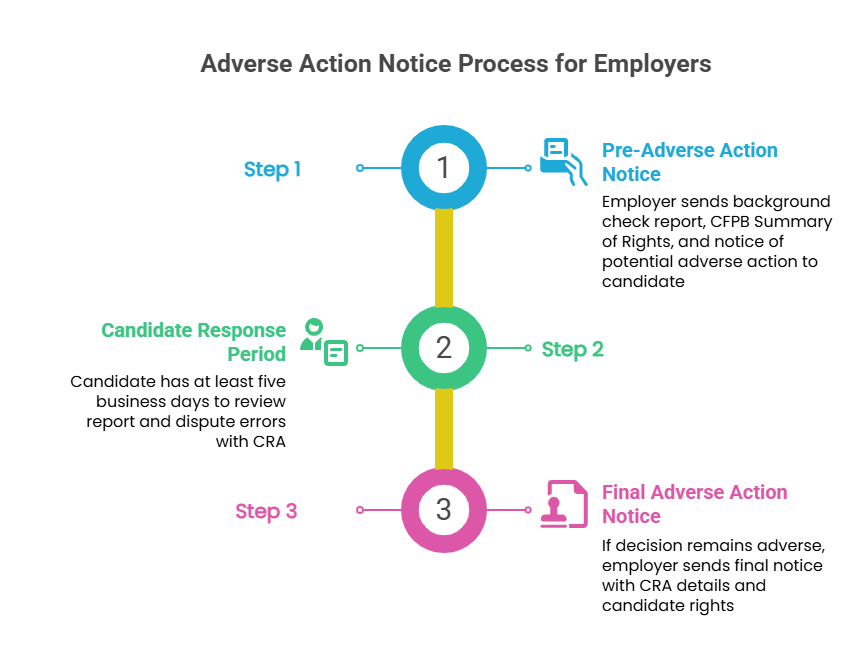
Step 1: Send the Pre-Adverse Action Notice
Before making a final decision, the employer should send the candidate:
- A copy of the background check report.
- The current CFPB Summary of Rights.
- A notice explaining that the employer is considering adverse action.
This notice should not say the decision is final. It should make clear that the employer is reviewing the information and giving the candidate time to respond.
Step 2: Give the Candidate Time to Respond
The FCRA does not give one exact waiting period, but many employers use at least five business days as a practical standard. This gives the candidate time to review the report and dispute errors with the CRA.
Step 3: Send the Final Adverse Action Notice
If the employer still decides not to move forward, the final adverse action notice should include:
- The final decision.
- The name, address, and phone number of the CRA.
- A statement that the CRA did not make the hiring decision.
- Notice of the candidate’s right to request another free copy of the report.
- Notice of the candidate’s right to dispute inaccurate or incomplete information.
The CFPB has emphasized that workers have the right to know what is in their file and dispute inaccurate or incomplete information. Employers should not skip this process just because they believe the report is correct. (Consumer Financial Protection Bureau)
What Are Ban-the-Box Laws?
Ban-the-Box laws are fair-chance hiring rules that limit when employers can ask about an applicant’s criminal history. The “box” refers to the checkbox on job applications that asks whether the applicant has a criminal record.
The goal is to help employers evaluate candidates based on qualifications first. These laws do not always stop employers from conducting background checks. Instead, they usually delay criminal history questions or background checks until later in the hiring process, such as after an interview or after a conditional job offer.
Ban-the-Box laws started mainly in public-sector hiring, but many states, counties, and cities have expanded them to private employers. National tracking shows that nearly 40 states, the District of Columbia, and more than 150 cities and counties have adopted some type of Ban-the-Box or fair-chance hiring policy, with new states joining the list as recently as fall 2025.
However, coverage varies by location, and not every law applies to private employers. For a state-by-state breakdown of what applies where, see our background check laws by state guide.
Most Ban-the-Box laws focus on timing:
|
Hiring Step |
What Employers Should Watch |
|
Initial application |
Criminal history questions may be prohibited. |
|
Interview stage |
Some laws allow questions after the applicant is selected for an interview. |
|
Conditional offer stage |
Stricter laws may require employers to wait until after a conditional offer. |
|
Background check review |
Employers may review relevant convictions, but must follow FCRA and anti-discrimination rules. |
|
Final decision |
Employers should document the reason for any decision based on criminal history. |
At the federal level, the Fair Chance to Compete for Jobs Act generally limits when covered federal agencies and contractors can ask about criminal history. Covered employers usually must wait until after a conditional offer, unless an exception applies.
Common exceptions may include law enforcement roles, certain financial or security positions, jobs where the law disqualifies individuals with specific convictions, or positions requiring a fidelity bond.
What Background Check Laws Apply to Illinois Employers?
Illinois employers need to pay close attention to state and local rules. Under the Illinois Job Opportunities for Qualified Applicants Act, an employer or employment agency may not ask about, consider, or require disclosure of an applicant’s criminal record until the applicant has been found qualified for the position and notified that they have been selected for an interview. If there is no interview, the employer must wait until after a conditional offer is made.
In practical terms, Illinois employers should avoid criminal history questions on the initial job application. Hiring managers should also avoid informal conversations about criminal history before the legally allowed point in the process.
Illinois Clean Slate Act: What Employers Need to Know Before June 30, 2026
Illinois employers should be aware of a significant change taking effect very soon. Governor Pritzker signed the Clean Slate Act (HB 1836) into law on January 16, 2026. The first phase of the law takes effect June 30, 2026.
The Clean Slate Act establishes automatic criminal record sealing for eligible nonviolent offenses. It is estimated to affect roughly 1.74 million Illinois adults. For employers, this means that records previously visible on a background check may no longer appear once the law takes effect.
The practical impact on hiring decisions is real. If a background check is ordered before June 30 and a record appears, employers should consider whether that record may be subject to sealing shortly after. Decisions made on records that are later sealed could create legal exposure. Employers should review their screening timelines and consult their background check vendor about how the Clean Slate Act will affect report results going forward.
Illinois employers using AI-assisted hiring tools face new compliance duties in 2026. Illinois House Bill 3773, effective January 1, 2026, amends the Illinois Human Rights Act to make clear that existing anti-discrimination rules apply to AI used in employment decisions. If your ATS, background check platform, or other hiring software uses AI to score, rank, or filter candidates, it must comply with Illinois anti-discrimination law. You’re responsible for the outcomes of vendor tools, not just internal processes. If you use AI-assisted screening, confirm with your vendor how they test for bias and what documentation they can provide.
Illinois employers should also remember that city and county rules may be stricter than state law. For example, employers in Chicago or Cook County may have additional fair-chance hiring obligations. This is especially important for businesses hiring across multiple locations.
Because Ban-the-Box laws are highly local, employers should review the rules by state, county, and city before updating job applications or screening workflows.
How Can Employers Stay Compliant in 2026?
Employers can reduce background check risk by building a consistent, documented process. The goal is to make sure every candidate is treated fairly and every hiring manager follows the same steps. Lift HCM's recruiting and applicant tracking system helps structure that workflow from application through hire.
Start with your forms. Confirm your FCRA disclosure is standalone, your authorization is clear, and your Summary of Rights is current. Then review your workflow. Make sure background checks are not being ordered too early in Ban-the-Box locations.
Next, review how your team handles criminal records. Employers should not automatically reject candidates because a record appears. Instead, they should consider job-related factors, such as the nature of the offense, how much time has passed, and whether the record relates to the position.
Employers should also review vendor tools carefully. If your background check provider or hiring platform uses AI-assisted scoring, ranking, or filtering, your team should understand how that tool works. Employers may still be responsible if a vendor tool creates unfair or discriminatory hiring outcomes.
Helpful Ban-the-Box Resources for Employers
Because Ban-the-Box rules are highly local, employers should not rely on one national rule. A business may need to follow state, county, and city requirements at the same time.
Useful resources include:
|
Resource |
Best Use |
|
Accurate Ban the Box Interactive Map |
Checking private-employer rules by jurisdiction. (Accurate) |
|
Illinois Department of Labor |
Reviewing Illinois-specific Ban-the-Box requirements. (Illinois Department of Labor) |
|
For Research and Advocacy |
Tracking national fair-chance hiring adoption. (National Employment Law Project) |
|
National Conference of State Legislatures |
Monitoring broader criminal record and reentry legislation trends. (NCSL) |
Frequently Asked Questions About Background Check Compliance
Can I reject a candidate because they have a criminal record?
Not automatically. Employers should review whether the record is job-related and consistent with business necessity. A blanket rule that rejects every candidate with a criminal record can create legal risk.
Can I ask about criminal history on a job application?
It depends on your location. Many Ban-the-Box laws prohibit criminal history questions on the initial application. In Illinois, employers generally must wait until the applicant has been selected for an interview, or until after a conditional offer if there is no interview.
Does the FCRA apply to independent contractors?
It can. If you use a third-party CRA to screen a contractor for employment-related purposes, the FCRA process may apply.
Are social media background checks covered by the FCRA?
If a third-party company prepares a social media screening report, the FCRA generally applies. If your team searches manually, the FCRA may not apply, but discrimination and privacy risks still exist.
What is the difference between pre-adverse and final adverse action?
The pre-adverse action notice tells the candidate you are considering a negative decision and gives them time to respond. The final adverse action notice communicates the final decision after that waiting period.
Do employers need to review background check forms every year?
Yes. Forms, notices, laws, and vendor processes can change. An annual review helps employers catch outdated documents, inconsistent workflows, and new state or local requirements.
From Confusion to Confidence in Your Hiring Process
Background check compliance can feel overwhelming, especially when federal, state, and local rules overlap. In the past, many employers treated background checks as a simple administrative step. Today, they require a clear process, current forms, fair review standards, and careful documentation.
Now, employers need to understand when the FCRA applies, how adverse action works, when Ban-the-Box laws limit criminal history questions, and how Illinois rules may affect hiring workflows. Employers also need to watch new risks tied to AI-assisted screening and inconsistent manager practices.
Lift HCM helps businesses create hiring workflows that are easier to manage and more consistent, with HR administration tools built to support compliance tracking, standardized procedures, and accurate employee record.
Ready to make your 2026 hiring process airtight? Contact a Lift HCM expert today for a brief, no-pressure consultation. We'd love to show you what a smarter, more compliant hiring process looks like.








.png?width=1536&height=1024&name=Create%20a%20background%20that%20reads%2c%20How%20Long%20to%20Keep%20P%20(1).png)