

You are highly motivated to hire the best talent, but lately, job postings feel like walking a legal tightrope. You may be asking: What salary range do I have to post? Do I need to include benefits? Does this apply to my remote roles?
The confusion stems from a simple truth: pay transparency laws are no longer a coastal trend—they're a nationwide compliance reality. In 2026, 17 states and multiple municipalities have active pay transparency laws, with 8 more states considering legislation, affecting an estimated 65% of U.S. employers. These jurisdictions require employers to disclose pay ranges in job postings and internal advancement notices, maintain records that substantiate pay decisions, and in some states, report aggregate pay data to regulators.
At Lift HCM, we work with HR managers and payroll leaders across restaurants, hospitality businesses, auto repair shops, and service companies to transform complex regulatory challenges into standardized, compliant, and defensible HR operations. This guide gives you a definitive, practical roadmap to pay transparency compliance. You'll walk away with a clear understanding of who must comply, how to build a working multi-state posting strategy, and a risk-control checklist to secure your compensation practices.
Table of Contents
- What Pay Transparency Laws Require and Who Must Comply
- Understanding Coverage Thresholds and Jurisdictional Scope
- Pay Transparency Laws by State: Quick Reference 2026
- State Differences and a Multi-State Posting Strategy That Works
- Illinois Pay Transparency Law: Employer Requirements Breakdown
- Creating Compliant Job Postings: Template and Best Practices
- Implementation Checklist, Pay Data Reporting, and Risk Controls
- Pay Transparency Compliance FAQs
- Transform Pay Transparency from Compliance Risk to Competitive Advantage
What Pay Transparency Laws Require and Who Must Comply
While there's no single federal pay transparency law, state and local rules are proliferating rapidly across the United States. These laws share a common goal: closing wage gaps and promoting fair compensation by giving applicants and employees access to critical pay information. For employers, this means a fundamental shift in recruiting, compensation, and HR documentation practices. Understanding the core requirements and coverage thresholds is the first essential step toward building a compliant hiring process that protects your organization from fines, lawsuits, and reputational damage.
The Three Core Pay Transparency Requirements
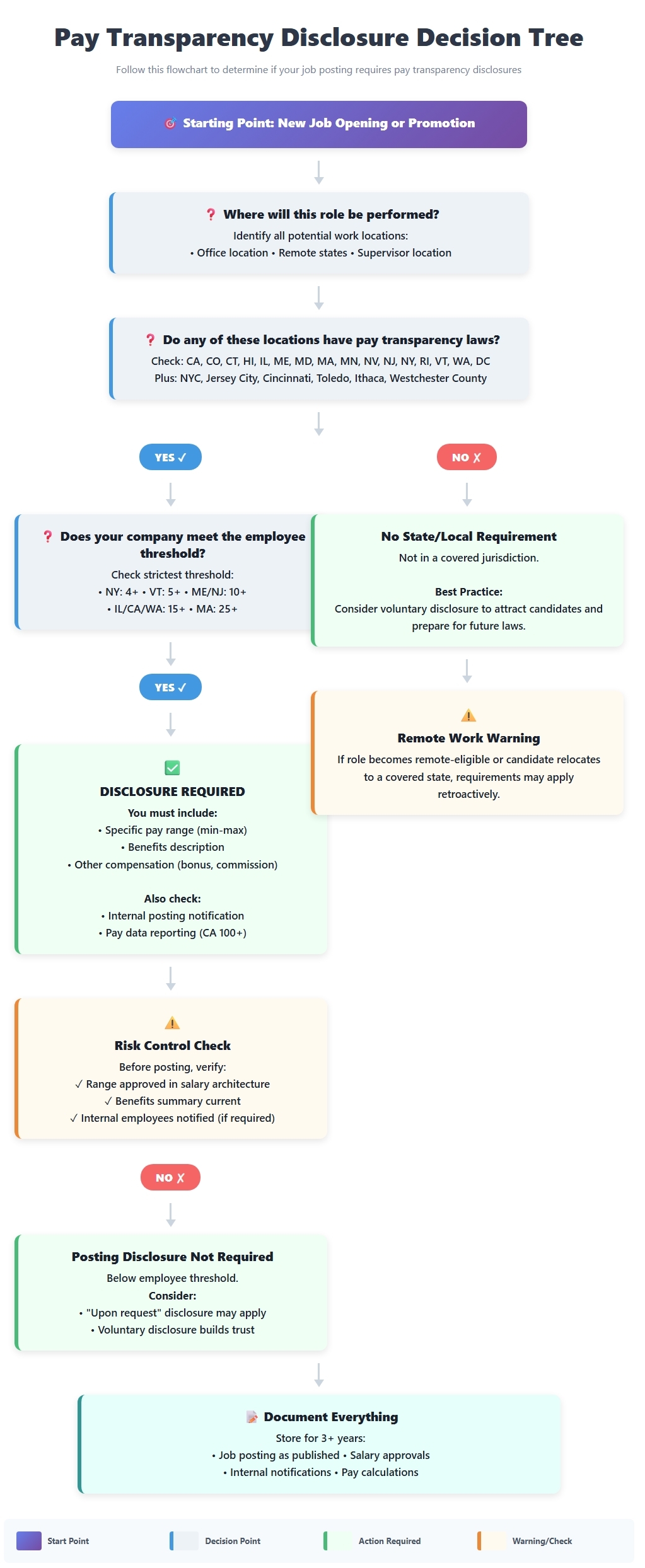
Pay transparency laws generally fall into three core categories that dictate what must be disclosed and when disclosure is required. Each category creates specific compliance obligations for HR teams and hiring managers:
- Job Posting Disclosures: Employers must list a good-faith estimate of the minimum and maximum salary or hourly wage they reasonably expect to offer for the position. Many states, including Colorado and Washington, also require a general description of benefits and other compensation such as bonuses, commissions, or stock options.
- Disclosure Upon Request: Even in states without mandatory posting rules, many laws require employers to disclose the pay scale to a job candidate upon request (often before or after an interview) or to a current employee when they apply for a promotion or transfer. Connecticut, Nevada, and Maryland follow this "upon request" model.
- Salary History Bans: Closely related to pay transparency, many states now prohibit employers from asking job applicants about their past or current pay. This is intended to break the cycle where historical pay discrimination follows workers throughout their careers, perpetuating wage gaps across gender and racial lines.
Understanding Coverage Thresholds and Jurisdictional Scope
The first step to compliance is determining if and how a law applies to your organization. The rules differ in meaningful ways:
Employer Size: Some laws apply to all employers (e.g., Colorado); others trigger at a set headcount (e.g., California at 15+ employees, Illinois at 15+ employees, Massachusetts at 25+ employees).
Scope of Disclosure: Disclosure scope varies widely:
- External Job Postings: Required in leading transparency states (CA, CO, IL, NY, WA).
- Internal Opportunities: Colorado, Illinois, and New York State specifically mandate the disclosure of pay and advancement opportunities for internal promotions or transfers.
- Upon Request: States like Connecticut and Nevada require disclosure only when the candidate or employee asks for it.
Remote Roles Complicate Jurisdiction: The rise of remote work has intensified the jurisdictional analysis. Some states assert coverage if the job could be performed in-state, or if the employee reports to a supervisor or office located in that state (e.g., Illinois). You must assume that if an applicant could potentially work from a covered state, the law applies to that posting.
To set a reliable baseline, track authoritative sources and re-check them quarterly. For a comprehensive national view, see the National Conference of State Legislatures' updates on pay transparency. For a concrete view of a mature framework, review Colorado's Equal Pay for Equal Work Act guidance.
Pay Transparency Laws by State: Quick Reference 2026
Before building your compliance strategy, you need to know which states have active laws. Use this comparison chart to quickly assess requirements across all covered jurisdictions.
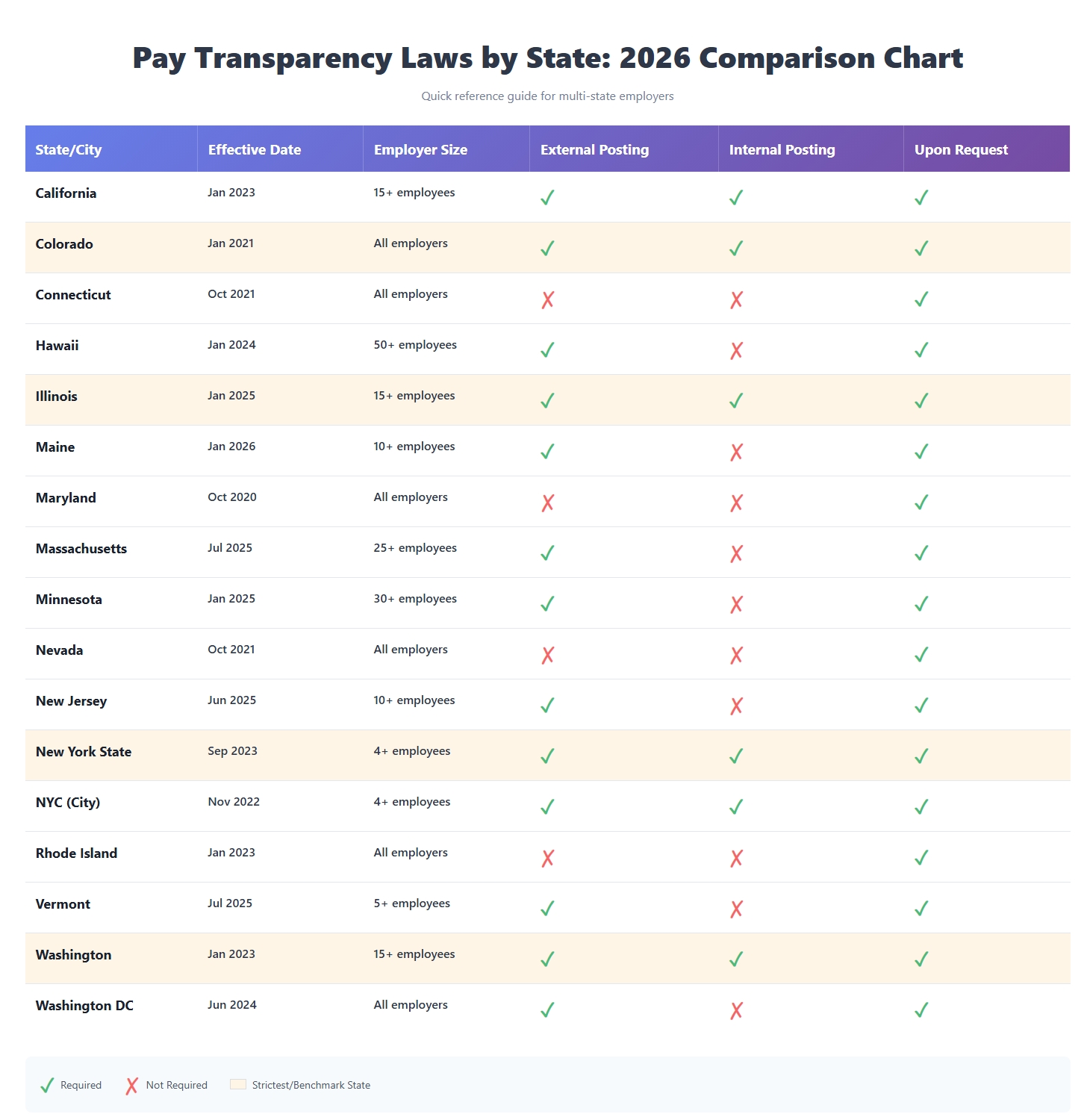
Note: This chart summarizes major state and local pay transparency laws as of January 2026, covering 17 jurisdictions (15 states plus New York City and Washington, DC). Maine’s law took effect January 1, 2026. Always consult legal counsel for specific compliance questions, especially for remote roles that may trigger multiple state requirements.
Key Takeaways from the Chart:
- Strictest benchmark states: Colorado, Illinois, New York State, California, and Washington require both external AND internal posting disclosures, making them ideal models for your baseline compliance template.
- Employee thresholds create compliance triggers: New York State's 4+ employee threshold means even very small businesses must comply, while other states phase in requirements at 15, 25, or 50+ employees.
- "Upon request" is nearly universal: Even states without posting mandates typically require disclosure when candidates or employees explicitly ask for pay information.
For the most current legislative status and pending bills, consult the National Women's Law Center's Salary Range Transparency tracker, which provides free real-time updates on state legislation and implementation dates.
State Differences and a Multi-State Posting Strategy That Works
Managing pay transparency laws across multiple states can feel overwhelming. Trying to create a unique job posting for every single jurisdiction is inefficient and risky. The smarter, more defensible approach is to unify your compliance by adopting a strategy that meets the strictest common denominator.
Turning the Patchwork into a Multi-State Matrix
A successful multi-state posting strategy starts with a detailed matrix. This tool helps HR and recruiting teams quickly identify the core requirements for every jurisdiction where you plan to hire.
For each state (and applicable major city/county, like New York City or Jersey City), define:
|
Requirement |
Example |
|
Coverage Thresholds |
15+ employees in state |
|
Where Disclosures Required |
External postings, internal notices, upon request |
|
What Must Be Included |
Pay range, benefits summary, application deadline |
|
Remote Role Treatment |
Covered if reporting to in-state supervisor |
State Examples:
- Colorado (Strictest Benchmark): Requires compensation and benefits in all job postings and mandates transparency in internal promotional opportunities. Also requires notification of all employees of internal job openings.
- California (Data Reporting Benchmark): Requires pay scales in job postings for most employers (15+ employees) and uniquely mandates annual pay data reporting for larger employers (100+ employees).
- Illinois: Requires pay and benefits disclosure for employers with 15+ employees and, like Colorado, requires employers to notify all employees of promotion opportunities within 14 days of the external posting.
Illinois Pay Transparency Law: Employer Requirements Breakdown
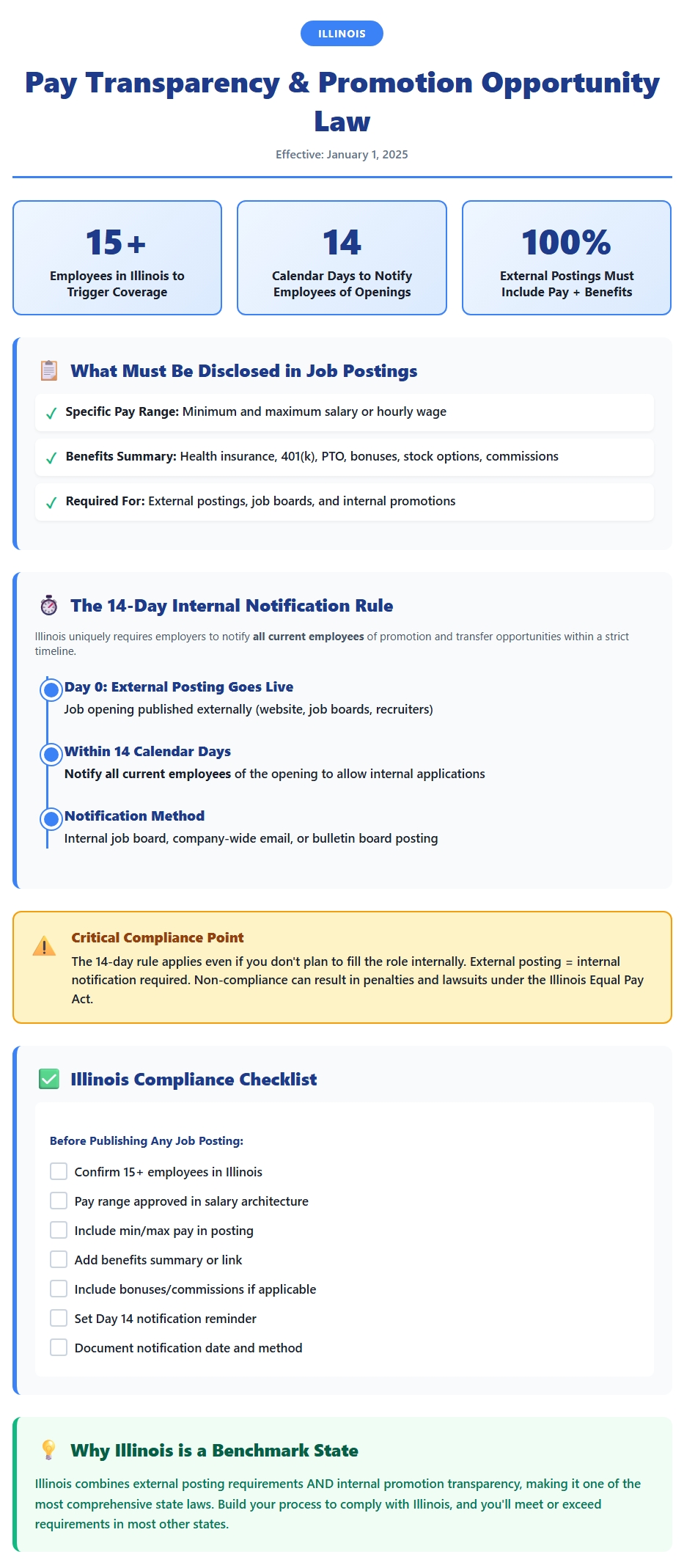
As an Illinois-based provider, Lift HCM has deep expertise in the state’s pay transparency rules, making Illinois a key benchmark for multi-state strategies. Mastering these requirements—especially the often-missed 14-day internal notification rule—helps Midwest employers design systems that satisfy multiple state laws and avoid significant legal risk.
💡 Illinois Key Requirements at a Glance
Employer Threshold: The law applies to employers with 15 or more employees located in Illinois. Count includes full-time, part-time, and temporary workers.
External Posting Disclosures: Employers must include the specific pay range (minimum and maximum salary or hourly wage) and a general description of the benefits and other compensation (bonuses, stock options, commissions) in all job postings, whether on your website, third-party job boards, or recruitment platforms.
The 14-Day Internal Notification Rule: If you intend to fill an opening via promotion or transfer, you must notify all current employees of that opening within 14 calendar days of any external job posting or notice. This ensures current staff have fair access to growth opportunities and prevents claims of internal favoritism or discrimination.
Why This Matters: In our work with multi-location restaurant and hospitality clients expanding across state lines, we've seen the 14-day notification rule trip up even sophisticated HR teams. The most common mistake? Posting externally on a Friday afternoon and forgetting to set the internal notification deadline, which falls on a weekend two weeks later. Build calendar reminders directly into your ATS workflow to prevent this compliance gap.
Creating Compliant Job Postings: Template and Best Practices
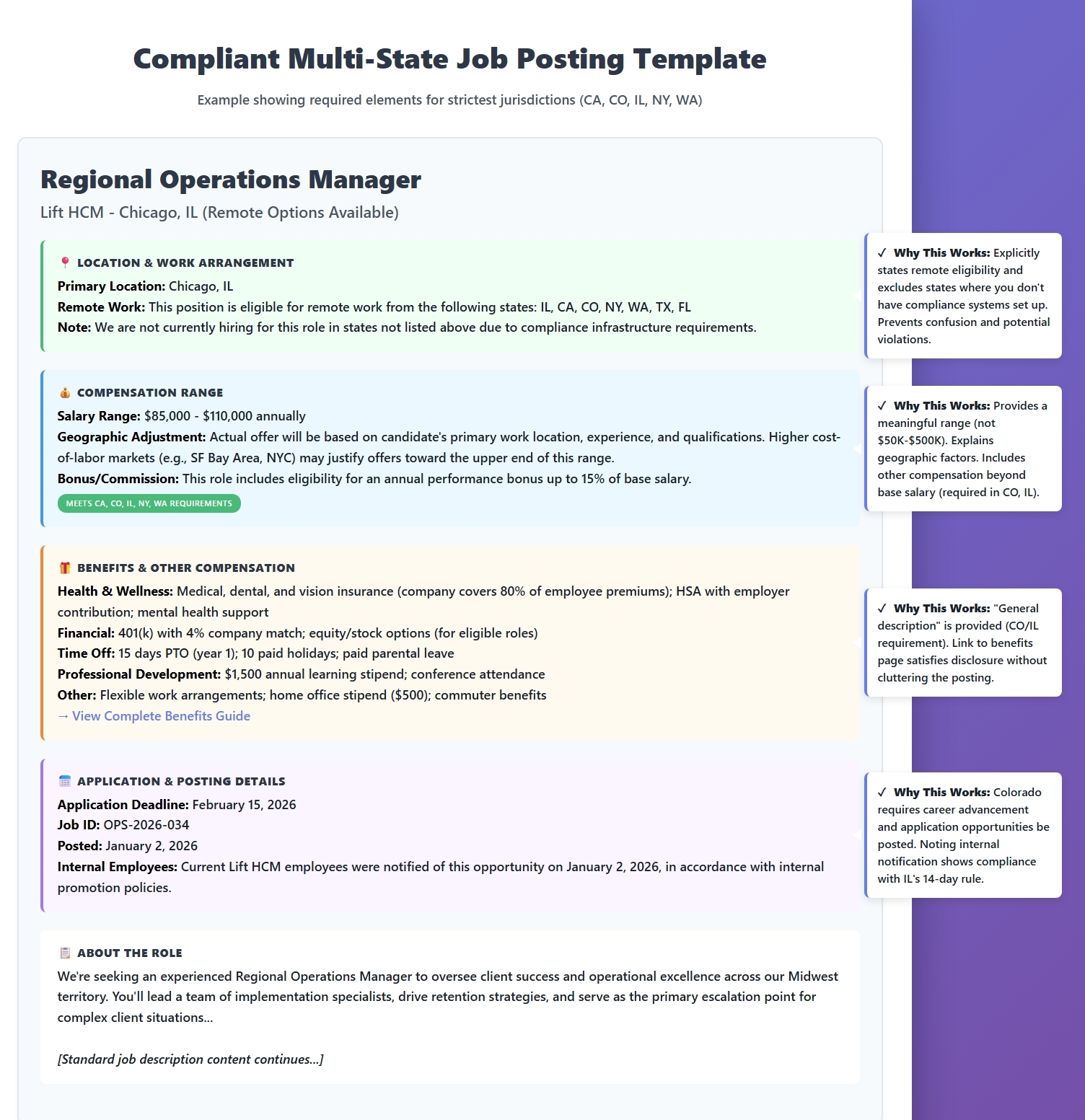
With your multi-state compliance matrix in place, the next step is to build a single, standardized posting template that follows the strictest rules—often from states like California, Colorado, Illinois, or New York. This becomes your baseline for all postings, reducing the risk of non-compliance and streamlining recruiting. A strong template includes all required disclosures in a clear, candidate-friendly format that builds trust and transparency from the first interaction. Your aim is a structure that meets the toughest legal standards while still functioning as an effective tool to attract qualified candidates.
Essential Elements of a Compliant Job Posting
Your standardized posting template should include these critical components to ensure full compliance across all major pay transparency jurisdictions:
- Job Title and Location(s): Clearly state the primary work location(s) and remote eligibility. For remote roles, explicitly list which states you're hiring from or exclude states where you lack compliance infrastructure.
- Specific Pay Range: The range must be a good-faith estimate specific to the job, level, and primary location. Avoid meaningless spreads like "$50,000 to $500,000" which fail the good-faith test and create legal risk. Include an explanation of geographic adjustments if applicable.
- High-Level Benefits Summary: A general description of all benefits and other compensation (bonuses, commissions, etc.). A common, compliant method is to include a link to a publicly accessible benefits overview page on your website.
- Application Window and Timeline: Include the application deadline if required by the most stringent state (Colorado requires clear timelines for promotional opportunities).
- Remote Role Strategy: For remote roles, pre-calculate and post the specific ranges for major hiring geographies. If you deliberately exclude certain jurisdictions due to compliance complexity, clearly state that in the posting (e.g., "This remote role is not available to residents of [state list]").
- Internal Notification Statement: For states like Illinois, include language confirming that current employees were notified of this opportunity within the required timeframe, demonstrating compliance with internal posting requirements.
⚠️ The Bottom Line for HR Teams
For HR and recruiting teams, compliance means clarity and consistency. You need a standardized salary architecture (bands or ranges tied to levels and locations) and a documented method for setting those ranges. Without this foundation, you're guessing—and guessing creates legal risk.
Implementation Checklist, Pay Data Reporting, and Risk Controls
Compliance with pay transparency laws is ultimately an operational challenge. It requires integrating compensation rigor directly into your talent systems (HCM and ATS) and establishing defensible documentation practices.
Step-by-Step Implementation Process
- Create and Publish Salary Architecture: Formalize and document your salary ranges by job level, family, and location. Crucially, include the rationale for range setting (market data, geographic differentials, etc.).
- Configure Posting Templates: Configure your Applicant Tracking System (ATS) or HCM platform to require pay range and benefits fields. Lock publishing functionality unless these required, compliant fields are complete.
- Build a Jurisdiction Logic Layer: Implement logic in your ATS that automatically applies the correct posting language based on the job location and remote eligibility, cross-referenced with your multistate matrix.
- Train Managers and Recruiters: Conduct mandatory training on compliant conversations about pay, including what can and cannot be promised, and how to respond accurately when candidates request pay information.
- Establish a Recordkeeping Plan: Store digital copies of all job postings, the internal range approvals, and relevant candidate communications for at least the longest applicable record retention period (many states require 3+ years). This documentation is crucial in audits or complaints.
Essential Risk Controls for Pay Transparency Compliance
Beyond basic compliance with posting and reporting requirements, implement these risk controls to strengthen your overall pay equity posture and prevent issues before they escalate into legal claims:
- Automated Posting Audits: Use your HCM or ATS to automatically flag postings that are missing required pay ranges or use ranges that deviate too far from the approved salary architecture. Set up weekly audit reports for compliance teams.
- Internal Equity Reviews: Conduct periodic internal equity reviews (at least annually, preferably semi-annually) to detect pay compression, unexplained outliers, or patterns that suggest potential discrimination before they lead to legal complaints or high turnover.
- Single Source of Truth for Salary Data: Centralize your official salary ranges in your HCM system. Ensure all managers and recruiters reference this single, secure source to prevent deviations, shadow ranges, or informal negotiations that create equity issues.
💡 Compliance as Competitive Advantage: When you standardize salary ranges, use compliant templates, and centralize compensation records in your HCM, you don’t just stay within the law—you strengthen pay equity, speed up hiring, and build candidate trust. In a tight talent market, clear pay transparency becomes a differentiator that attracts stronger candidates and shortens time-to-fill.
Pay Transparency Compliance FAQs
Q: How does pay transparency affect my ability to negotiate pay? A: Pay transparency requires you to post a good-faith range, which sets clear boundaries for negotiation. While you can still negotiate within the posted range based on experience or skills, you should generally not exceed the maximum of that range without updating the posting, especially in strict states like California. Documenting all negotiation factors is crucial.
Q: Do I need to post a salary range for internal transfers or promotions? A: Yes, in many leading jurisdictions, including Colorado, Illinois, and New York State, you must disclose the pay range for internal advancement opportunities. Even where not legally required, doing so aligns with the spirit of transparency and promotes internal equity.
Q: What if a remote job can be done from multiple states with different laws? A: Adopt the rule of the strictest applicable jurisdiction. If the job can be performed from a state with a mandatory disclosure law (like Washington or New York), the posting must include the required information (pay range, benefits) for that location. If you exclude certain states from the hiring process, state that explicitly in the job posting.
Q: What is a "good faith" pay range? A: A "good faith" pay range is one that the employer honestly expects to pay for the position at the time of posting. It must be a meaningful range, not one so wide (e.g., "$50,000 to $500,000") that it offers no real information. It should be based on factors like the job's actual salary architecture, budget, and market data.
Q: What's the biggest compliance mistake employers make? A: From our work with multi-state service companies, the most common mistake is treating pay transparency as a "legal checkbox" rather than an operational system. Employers post ranges without documenting the methodology, leading to inconsistent offers that create internal equity issues and expose them to discrimination claims. The fix: build your salary architecture first, then post jobs.
Transform Pay Transparency from Compliance Risk to Competitive Advantage
We've resolved the confusion surrounding pay transparency laws with a clear path forward: moving from reacting to a legal patchwork to proactively establishing a single, standardized, and defensible multi-state compliance strategy. You came here facing legal risk, fear of non-compliance, and the operational headache of managing compensation across dozens of disparate state and local rules. You need a system that ensures every job posting and compensation decision is legally sound, internally consistent, and attractive to top talent in competitive markets.
Lift HCM is your strategic Human Capital Management partner. Our integrated solutions help automate compliance with evolving pay transparency laws, streamline pay data reporting, and maintain the documentation needed to support internal equity and defend compensation decisions. We help restaurants, hospitality businesses, auto repair shops, and multi-state service companies build scalable, compliant compensation systems—without added administrative burden or legal risk.
Ready to transform your pay transparency compliance into a source of competitive advantage?

Topics:








.png?width=1536&height=1024&name=Create%20a%20background%20that%20reads%2c%20How%20Long%20to%20Keep%20P%20(1).png)