

The deposit went out four days late. Or the 1099 went to the wrong address. Or a contractor you have used for three years starts to look, in hindsight, a lot like an employee. Most payroll mistakes are quiet at the time they happen. What makes them expensive is that the price is set by statute, it climbs on a schedule, and by the time you hear about it the cheapest window has usually closed.
Lift HCM has handled payroll and tax filing for small and mid-sized employers since 2005, across restaurants, hospitality, auto repair, professional services, and other industries where the payroll calendar does not pause for anything. We spend a good share of our time on the question employers ask after something has gone sideways: how bad is this, actually.
This article answers that question with the published numbers. What the IRS charges for a late deposit. What an incorrect W-2 or 1099 costs per form. When a business tax problem can reach an owner personally. What state wage and hour rules add on top. Every figure here comes from the IRS, a state labor department, or a named study, and the sources are listed so you can check them yourself.
Key Takeaways
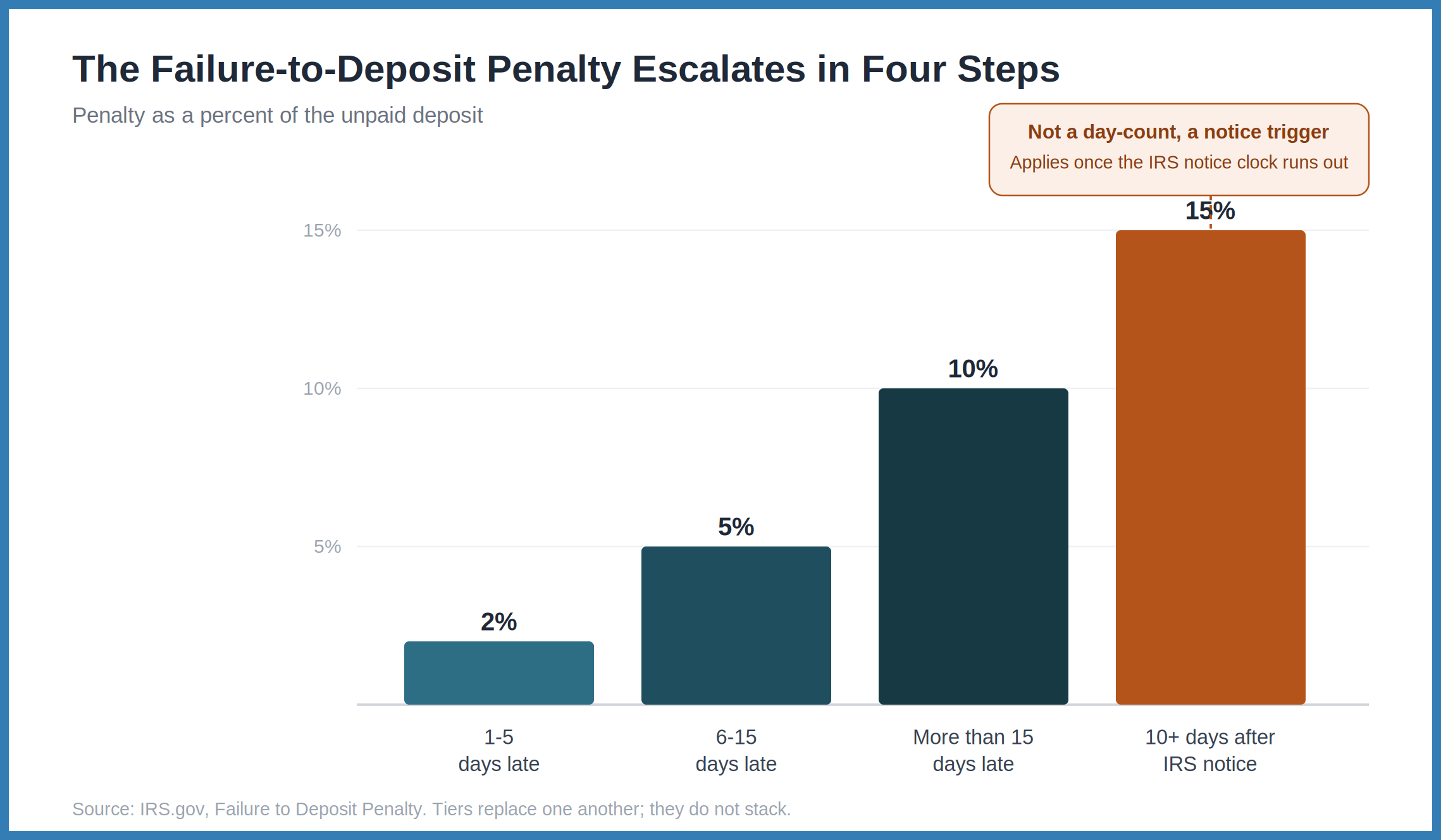
- Late payroll tax deposits carry penalties of 2, 5, 10, or 15 percent of the unpaid deposit depending on timing. The tiers replace each other rather than stacking.
- The 15 percent tier is not about how many days late you are. It applies once a deposit stays unpaid more than 10 days after the IRS sends its first notice.
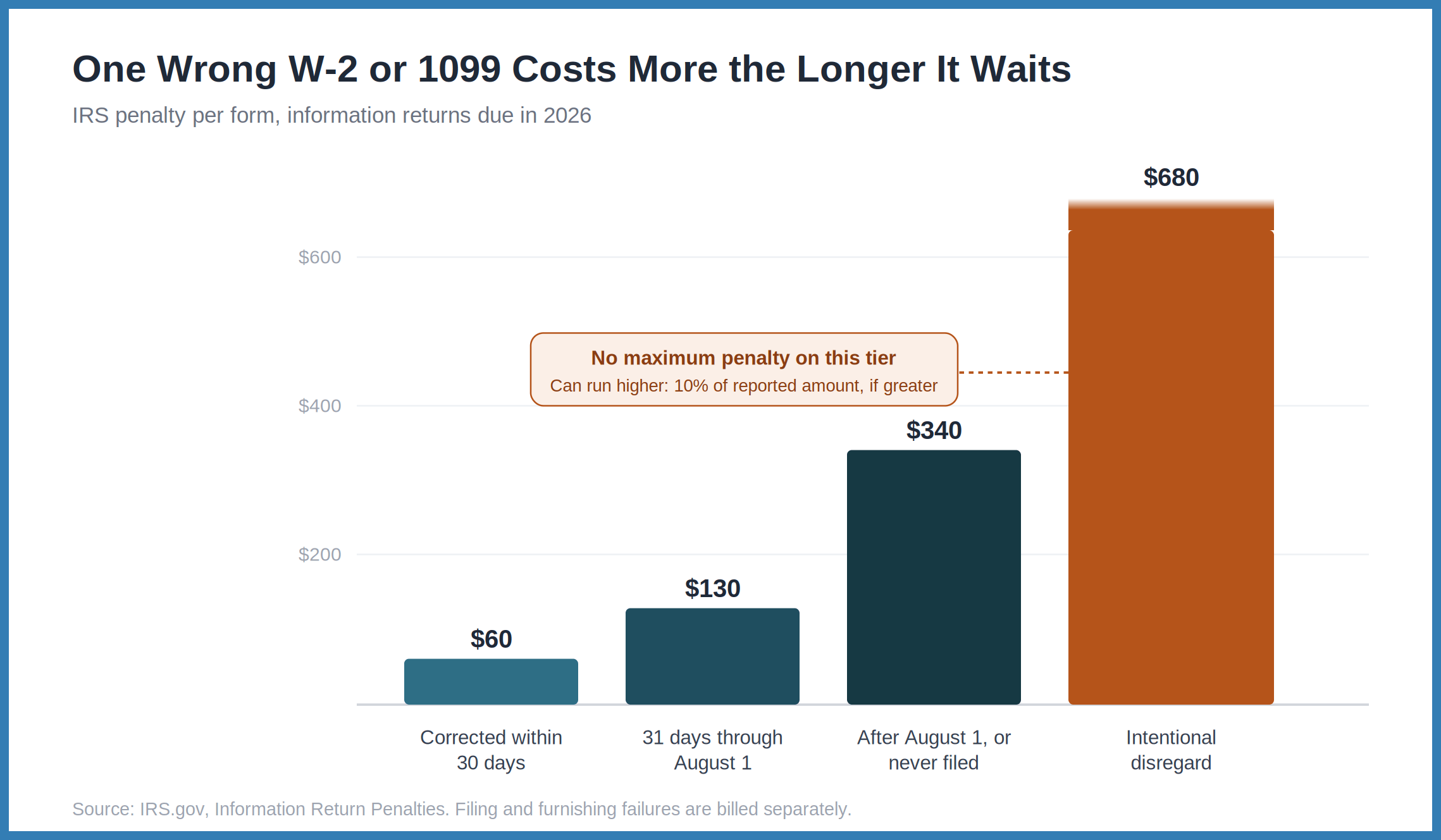
- For information returns due in 2026, penalties run $60, $130, or $340 per form based on how quickly you correct, and $680 per form for intentional disregard with no cap.
- Failure to file with the IRS and failure to furnish the statement to the worker are separate penalties, so one bad form can generate two.
- Under the Trust Fund Recovery Penalty, an owner, officer, or employee with authority over payroll can be held personally liable for the full withheld amount.
- Pay errors carry a retention cost as well. In a Workforce Institute at Kronos survey, 49 percent of workers said two paycheck problems would send them job hunting.
Table of Contents
What Does the IRS Charge for a Late Payroll Tax Deposit?
The penalty is a percentage of the deposit you did not make on time, and it escalates in four steps. The IRS publishes the schedule directly.
IRS Failure to Deposit Penalty (Source: IRS.gov)
|
How late the deposit is |
Penalty on the unpaid deposit |
|
1 to 5 calendar days |
2% |
|
6 to 15 calendar days |
5% |
|
More than 15 calendar days |
10% |
|
More than 10 calendar days after the date of your first notice, or the day you receive a notice demanding immediate payment |
15% |
Three things about this schedule surprise employers regularly.
- The tiers do not add up. The IRS states this plainly: if a deposit is more than 15 days late, the penalty is 10 percent, not 2 plus 5 plus 10.
- The last tier is not about calendar lateness at all. It is triggered by the notice. A deposit can sit well past 15 days at 10 percent and only move to 15 percent once the IRS has written to you and 10 more days have passed.
- The penalty also applies to depositing the wrong way. Employment tax deposits are required to be made by electronic funds transfer, and a payment sent by another method can draw a penalty even when the money arrives on time.
Interest runs on top of the penalty, and it accrues until the balance is paid in full. That is why a deposit problem that would have been inexpensive in week one becomes materially more expensive by the time it surfaces on a notice.
Can a Payroll Tax Problem Reach You Personally?
Yes, under specific circumstances, and this is the part of payroll compliance most owners have never been told about. The Trust Fund Recovery Penalty allows the IRS to collect unpaid withheld taxes from an individual rather than only from the business.
The IRS describes it this way: a person responsible for withholding, accounting for, or paying over these taxes who willfully fails to do so can be held personally liable for a penalty equal to the full amount of the unpaid trust fund tax, plus interest. Two elements have to be present. The person has to be a responsible person, and the failure has to be willful.
Both terms are broader than they sound. According to the IRS, a responsible person can be a corporate officer, a partner, a sole proprietor, or an employee of any form of business, and a trustee or agent with authority over the funds of the business can also be held responsible. On willfulness, the IRS says it means voluntarily, consciously, and intentionally, and specifically that you are acting willfully if you pay other expenses of the business instead of the withholding taxes.
That last clause is the one worth sitting with. An owner in a cash crunch who pays the food supplier and the landlord first, intending to catch up on withholding next month, has arguably met the IRS definition. The penalty is equal to the unpaid trust fund portion, and the IRS notes it may be assessed against several individuals even though the total is collected only once. This is a legal determination that depends entirely on specific facts, so anyone who thinks it might apply to them should be talking to a tax attorney or CPA rather than reading further on the internet.
What Does an Incorrect W-2 or 1099 Cost Per Form?
It depends on how fast you fix it, and the penalty roughly doubles at each step. These are the amounts for information returns due in calendar year 2026.
IRS Information Return Penalties, Returns Due 2026 (Source: IRS.gov)
|
When you correct it |
Penalty per form |
|
Up to 30 days late |
$60 |
|
31 days late through August 1 |
$130 |
|
After August 1, or not filed at all |
$340 |
|
Intentional disregard |
$680, with no maximum |
Two details change the math more than the table suggests. First, filing the return with the IRS and furnishing the statement to the worker are governed by separate code sections, and they are penalized separately. A single form that is both filed late and delivered late can generate two penalties rather than one. Second, annual maximums apply for most failures, and they are lower for small businesses, but there is no maximum at all for intentional disregard.
These amounts are adjusted for inflation and have moved almost every year. Older articles quoting figures in the $50 to $260 range are describing a schedule from several years ago. If you are still sorting out which forms your business needs and when, our W-2 vs. 1099 compliance checklist walks through the filing requirements for each. And if 10 or more information returns are involved, electronic filing is mandatory, a detail covered in our guide to the IRS e-filing threshold. Before relying on any number, including this one, check the current General Instructions for Certain Information Returns for the year you are filing.
What Happens Financially When a Worker Is Misclassified?
Misclassification is expensive because it is never one bill. Treating someone as a contractor when the relationship functions like employment can produce, at the same time, unpaid employment taxes going back across the years the arrangement existed, interest on those amounts, information return penalties on every form that was filed wrong or not filed at all, and potential state exposure through unemployment insurance and workers' compensation. Our breakdown of how to classify a worker correctly covers the tests employers get wrong most often.
The per-form penalties above are the piece employers tend to overlook, because they multiply. A worker misclassified for three years is at minimum three forms, and the amount owed depends on how long the problem goes uncorrected rather than on how the original decision was made.
State treatment varies enough that national summaries mislead. Illinois is a good illustration. The state has an Employee Classification Act with its own penalty structure, but it applies to the construction industry specifically rather than to employers generally. The Illinois Department of Labor investigates construction misclassification directly and routes complaints from other industries to the Department of Employment Security, the Department of Revenue, and the Illinois Workers' Compensation Commission. A restaurant group or an auto repair shop in Illinois still has real classification exposure. It simply arrives through a different door. Our Illinois employer compliance guide covers the full set of state-specific rules employers in Illinois are working under in 2026.
Classification turns entirely on the facts of the working relationship, and the tests differ between the IRS, state revenue agencies, and state labor departments. That combination makes it one of the few payroll questions where the right move is a conversation with employment counsel or your CPA before anything changes.
How Do State Wage and Hour Rules Add to the Total?
They add a second penalty structure that operates independently of anything federal, with its own definitions and its own math. For a broader look at how these obligations stack up nationally, see our wage and hour compliance guide. The detail that catches employers is usually not the rule itself but how the violations are counted.
Illinois is a useful example because the counting is explicit. Under the One Day Rest in Seven Act, covered employees are entitled to at least 24 consecutive hours of rest in every consecutive seven-day period. Employees who work seven and a half continuous hours are entitled to a meal period of at least 20 minutes, beginning no later than five hours into the shift, with an additional 20 minute meal period for every additional four and a half hours worked.
Amendments effective January 1, 2023 (Public Acts 102-0828 and 102-1012) raised the penalties considerably, replacing what had been a petty offense fine of roughly $25 to $100 per offense. As published by the Illinois Department of Labor, the current structure is:
- Employers with fewer than 25 employees: damages of up to $250 per offense payable to the employee, plus a penalty of up to $250 per employee per offense payable to the Department.
- Employers with 25 or more employees: both figures rise to $500.
A separate amendment (Public Act 103-1082) signed March 21, 2025 left those amounts unchanged but added anti-retaliation protections and an enforcement mechanism. Employers may not take adverse action against an employee for exercising rights under the Act, complaining to the employer or the Department, or participating in an investigation or proceeding. There is no private right of action. Complaints go to the Illinois Department of Labor, which can investigate, assess penalties and fees, and pursue an action through the Attorney General.
One exclusion matters for employers with organized workforces. Employees whose meal periods are set through collective bargaining have always been outside the meal period requirement, and the 2023 amendments extended that treatment to the day of rest requirement for employees whose work hours, days of work, and rest periods are established through the collective bargaining process. The exclusion is narrower than it sounds: the Illinois Department of Labor has stated that if an agreement is silent on meal periods or days of rest, ODRISA applies anyway regardless of union status. For the fuller set of 2026 changes Illinois employers are tracking, see our Illinois employment law changes guide.
What Do Payroll Errors Cost in Turnover?
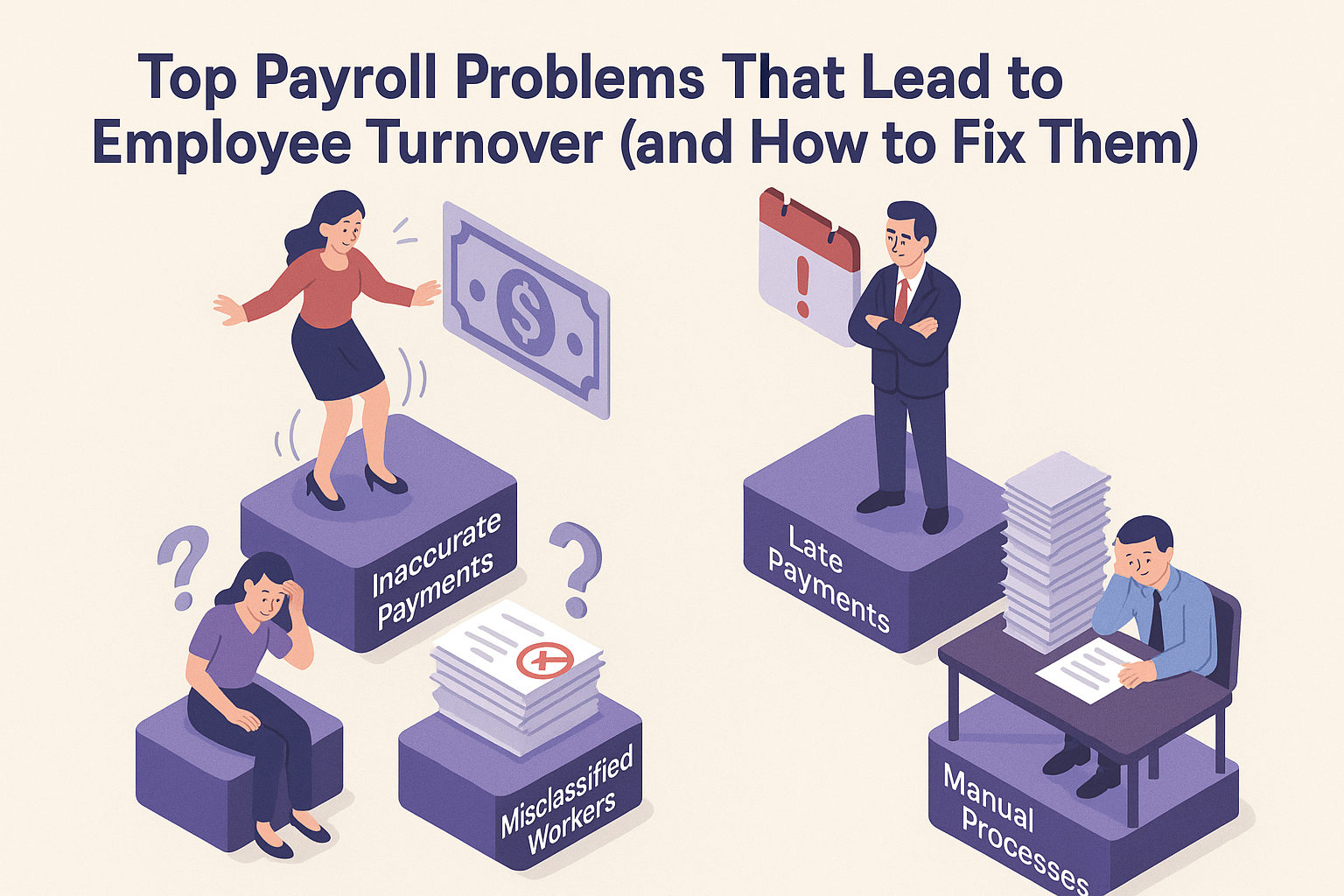
More than most employers assume, and the cost does not appear on any notice. In a Workforce Institute at Kronos survey of more than 1,000 U.S. employees, 49 percent said they would begin looking for a new job after just two problems with their paycheck, such as being paid late or incorrectly. Roughly a quarter said one mistake would be enough. We break down the fuller pattern, and how to catch it early, in Top Payroll Problems That Lead to Employee Turnover.
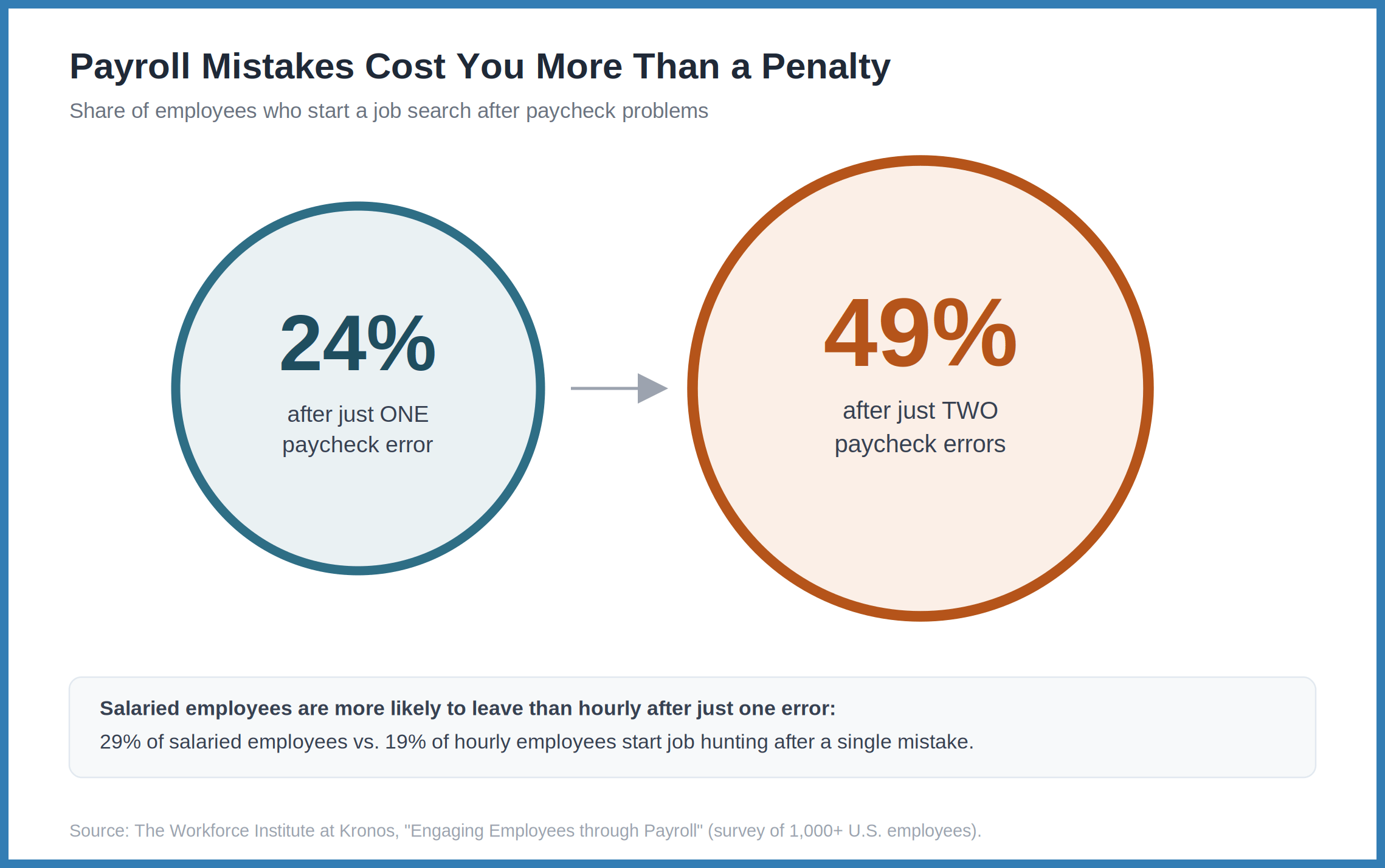
One finding runs against intuition and is worth knowing if you employ both salaried and hourly staff. Salaried employees in that survey were more likely than hourly employees to start a job search after a single payroll problem, 29 percent compared with 19 percent. Parents were also more likely than non-parents to start looking after the first error.
That research was published in 2017, so treat it as evidence of how people respond to pay errors rather than as a current measurement of the labor market. The underlying dynamic has not changed. A paycheck is the most concrete promise an employer makes, and the second time it is broken it stops reading as an accident.
How Can You Lower Your Penalty Exposure?
Most penalty exposure comes from a small number of recurring failure points, and each has a fairly boring control that addresses it.
- Know your deposit schedule and confirm it annually. Schedules are assigned based on prior payroll volume and can change as you grow, which means the calendar that was right last year may not be right now.
- Deposit electronically, every time. The requirement to use electronic funds transfer is its own penalty trigger independent of timing.
- Collect a Form W-9 at onboarding rather than at year end, and verify the name and taxpayer identification number before the filing run. Correcting a form within 30 days costs a fraction of correcting it in September.
- Do not let a notice sit. The escalation to the highest deposit penalty tier is driven by the notice date, so the days after one arrives are the most expensive days in the whole sequence.
- Review contractor relationships once a year against how the work is actually performed now, since these arrangements drift toward employment without anyone deciding that they should.
- Confirm you are registered for withholding and unemployment in every state where you have an employee, including anyone who has moved and not mentioned it. Our multi-state payroll tax compliance guide covers what registration actually requires state by state.
None of this eliminates risk, and none of it substitutes for advice about your specific situation. What it does is remove the failures that come from nobody owning the calendar.
Frequently Asked Questions
What is the penalty for paying payroll taxes late?
The IRS failure to deposit penalty is 2 percent of the unpaid deposit at 1 to 5 calendar days late, 5 percent at 6 to 15 days, and 10 percent beyond 15 days. It rises to 15 percent once the deposit remains unpaid more than 10 days after the first IRS notice, or on the day you receive a notice demanding immediate payment. The tiers replace one another rather than accumulating, and interest is charged on top.
How much is the penalty for a late 1099 in 2026?
For information returns due in 2026, $60 per form if corrected within 30 days, $130 if corrected between 31 days and August 1, and $340 after August 1 or if never filed. Intentional disregard is $680 per form with no maximum. Filing with the IRS and furnishing the copy to the recipient are penalized separately.
Can the IRS come after me personally for my company's payroll taxes?
It is possible. The Trust Fund Recovery Penalty allows the IRS to assess the unpaid withheld taxes against a responsible person who willfully failed to pay them over. The IRS defines responsible persons broadly enough to include officers, partners, sole proprietors, employees, and agents with authority over company funds, and treats paying other business expenses ahead of withholding taxes as evidence of willfulness. Because this is a fact-specific determination with serious consequences, it is a question for a tax attorney or CPA.
Which payroll mistake is the most expensive?
Misclassification usually carries the widest exposure, because one determination can trigger back employment taxes, interest, per-form information return penalties, and state consequences at the same time, across every year the arrangement was in place. A single late deposit is more common but far smaller in isolation.
Do payroll penalties get reduced if it was an honest mistake?
The IRS provides for penalty relief in some circumstances, including reasonable cause, and the information return penalty structure is explicitly designed to reward fast correction. Interest generally continues to accrue even where a penalty is abated. Whether relief is available in a given case depends on the facts and on documentation, which makes it worth raising with your tax advisor rather than assuming either way.
How to Reduce Payroll Penalties Before They Cost Your Business
Payroll penalties are unusual among business risks in that the price list is public. The IRS publishes the deposit tiers and the per-form amounts. State labor departments publish theirs. Almost nothing about this is a surprise, which means almost all of it is manageable in advance.
What makes these costs feel unpredictable is that the expensive version and the inexpensive version of the same mistake are separated only by time. A correction inside 30 days and a correction in September are the same error. The difference is who noticed, and how quickly.
A practical next step, and a small one: pull your deposit schedule, confirm it still matches your current payroll volume, and check that every state where you have an employee is one where you are actually registered. Those two checks take an afternoon and cover a meaningful share of the exposure described here.
Lift HCM handles payroll tax filing and compliance for small and mid-sized employers nationwide, with a named team you can reach directly rather than a support queue. If you are working through a notice, a classification question, or a multi-state registration you are not sure about, our payroll tax specialists can help you understand what you are looking at and what your options are.
Disclaimer
This article is provided for general informational purposes only and does not constitute legal, tax, or accounting advice. Penalty amounts, filing requirements, and state regulations change frequently, and federal penalty amounts are adjusted for inflation annually. Figures cited reflect published guidance at the time of writing. Verify current amounts against primary sources and consult qualified legal or tax counsel regarding your specific circumstances.
Topics:


.png?width=1536&height=1024&name=Create%20a%20background%20that%20reads%2c%20How%20Long%20to%20Keep%20P%20(1).png)