
A final paycheck sounds simple until an employee resigns, is terminated, or is laid off and HR has to determine when the employee’s remaining wages are legally due. Final paycheck deadlines vary by state, separation type, and in some cases PTO or vacation payout policy. Get the timing wrong, even by a day, and a routine offboarding can turn into a wage claim.
At Lift HCM, we work with employers across the country who run into this exact question the moment they hire in a new state, or the moment a termination catches them off guard. It is rarely about bad intentions. It is about a patchwork of state rules that nobody has time to memorize.
This article walks through what triggers a final paycheck obligation, how timing rules differ by state and separation type, what Illinois specifically requires, and how to build an offboarding process you can trust, so you can stop guessing and start handling every separation with confidence.
Informational Disclaimer: This guide is for general informational purposes and reflects publicly available state labor law information as of July 2026. Wage and hour laws change frequently and vary by jurisdiction and circumstance. Confirm current requirements with your state labor department or qualified employment counsel before making payroll decisions.
Key Takeaways
- Separation Dictates Speed: Final paycheck timing depends heavily on both the state and whether the separation was voluntary (resignation) or involuntary (termination or layoff).
- Varying Timelines: Some states require immediate payment on the employee's last day or within a few hours, while others grant until the next scheduled payday.
- The Illinois Standard: Illinois requires final pay by the next regularly scheduled payday, regardless of separation type, which is a major contrast to states like California.
- PTO Follows Separate Rules: Unused vacation or PTO payout mandates are governed independently from basic final paycheck timing and vary significantly by state.
- Penalties Add Up Daily: Noncompliance triggers statutory penalties in most states. Confirm current penalty structures with your state labor department before relying on static figures.
Table of Contents
What Counts as a Final Paycheck?
A final paycheck must include all wages earned but not yet paid through an employee's last day worked. At a minimum, this covers regular hourly wages, salaries, overtime, and shift differentials. Depending on the specific state law and your company's written policies, it may also include:
- Earned commissions
- Vested bonuses
- Accrued but unused vacation or PTO balances
- Owed business expense reimbursements
Final Pay vs. Severance Pay
Final pay and severance get confused often, so it is worth separating them early. Final pay is a strict statutory requirement under state and federal wage laws. Severance is generally not required by law unless it was promised in written employment agreements, collective bargaining contracts, or has become an established, consistently applied company policy.
Does Final Paycheck Timing Depend on Why the Employee Left?
Final paycheck deadlines range from immediate payment on the employee's last day to the next scheduled payday, depending on the state and whether the separation was voluntary or involuntary.
Yes, and this is the single biggest variable across state labor laws. Most states draw a hard line between a voluntary resignation and an involuntary termination (firing or layoff), with involuntary separations facing significantly tighter deadlines.
- Voluntary Resignations: The most common rule nationally is to issue payment by the next regularly scheduled payday. However, a handful of states shorten that window if the employee gives a specific amount of advance notice (such as 72 hours).
- Involuntary Terminations: A smaller, stricter group of states require same-day or near-immediate payment when an employee is let go. This is the exact moment where out-of-state employers most often get caught off guard.
Which States Require Immediate Final Payment?
Several states require same-day, next-business-day, or ultra-short-window final payments after an involuntary termination. These are the states where an automated payroll process is critical to avoiding heavy waiting-time penalties.
The table below outlines ten states with accelerated final pay requirements for involuntary separations:
|
State |
Deadline for Involuntary Termination |
Legal and Compliance Notes |
|
California |
Immediate, at time of termination |
Labor Code Section 201; includes accrued vacation; waiting-time penalties under Section 203 can total up to 30 days of wages. |
|
Massachusetts |
Day of discharge |
Strict enforcement; employees may recover treble (triple) damages for unpaid final wages. |
|
Montana |
Within 4 hours, or end of business day |
Among the fastest, most literal same-day deadlines nationally; a written policy may extend timing, but not past the next payday or 15 days. |
|
Missouri |
Immediate, upon written demand |
Applies specifically to involuntary discharge; no accelerated deadline for resignations. |
|
Utah |
Within 24 hours |
Requires rapid coordination with payroll processing providers. |
|
Colorado |
Immediate |
Due at the time of discharge; if payroll is handled off-site, within 24 hours of the start of the next business day for the accounting unit. |
|
Oregon |
End of the next business day |
Frequently missed in multi-state employer guides; includes all earned wages. |
|
Connecticut |
Next business day |
Standard terminations are due the next business day; layoffs may follow the next-payday rule. |
|
Nevada |
Immediate, upon involuntary termination |
Due immediately under NRS 608.020; waiting-time penalties begin to accrue after a short grace period. Resignations are due by the next payday or within 7 days, whichever is earlier (NRS 608.030). |
|
Texas |
Within 6 calendar days |
Regulated by the Texas Workforce Commission; counts calendar days, not business days. |
The Federal Baseline
By contrast, a few states have no state-specific final paycheck statutes at all. In these jurisdictions, the federal Fair Labor Standards Act (FLSA) baseline applies, which simply requires payment by the next regularly scheduled payday, regardless of separation type. Alabama, Florida, Georgia, and Mississippi fall into this category.
Most other states fall somewhere into the next regular payday category. If your workforce spans multiple states, treat this regional breakdown as a starting point, not a substitute for confirming active state-level rules.
For a deeper dive into surrounding compliance topics, see our comprehensive guides on Pay Stub Requirements by State and the 2026 Minimum Wage by State Employer Guide.
The Full 50-State Final Paycheck Deadline Table
The table below shows the minimum timing requirement for every state and the District of Columbia, split by resignation and involuntary termination. Employers can always pay sooner. In this table, "next payday" means the next regularly scheduled payday. Where a state has no specific statute, the FLSA next-payday baseline applies.
|
State |
Resignation |
Involuntary Termination |
|---|---|---|
|
Alabama |
No state law (next payday under FLSA) |
No state law (next payday under FLSA) |
|
Alaska |
Next payday, at least 3 working days after quitting |
Within 3 working days |
|
Arizona |
Next payday |
Within 7 working days or next payday, whichever is first |
|
Arkansas |
Next payday (double wages if unpaid 7 days past payday) |
Next payday (double wages if unpaid 7 days past payday) |
|
California |
Within 72 hours, or at separation if 72 hours notice was given |
Immediately, at time of termination |
|
Colorado |
Next payday |
Immediately if payroll staff are working; otherwise within 6 hours of the next workday's start, or 24 hours if payroll is off-site |
|
Connecticut |
Next payday |
Next business day if fired; next payday if laid off |
|
Delaware |
Next payday, or 3 days after the last day, whichever is later |
Next payday, or 3 days after the last day, whichever is later |
|
District of Columbia |
Next payday or 7 days after resigning, whichever is earlier (4 days if the employee handled money) |
Next business day if fired; next payday if laid off (4 days if the employee handled money) |
|
Florida |
No state law (next payday under FLSA) |
No state law (next payday under FLSA) |
|
Georgia |
No state law (next payday under FLSA) |
No state law (next payday under FLSA) |
|
Hawaii |
Next payday, or at separation if a full pay period's notice was given |
Immediately, or the next working day |
|
Idaho |
Next payday or within 10 working days, whichever is first (48 hours on written request) |
Next payday or within 10 working days, whichever is first (48 hours on written request) |
|
Illinois |
At separation if possible, no later than the next payday |
At separation if possible, no later than the next payday |
|
Indiana |
Next payday (or within 10 days of a demand if whereabouts are unknown) |
Next payday (or within 10 days of a demand if whereabouts are unknown) |
|
Iowa |
Next payday |
Next payday |
|
Kansas |
Next payday |
Next payday |
|
Kentucky |
Next payday or within 14 days, whichever is later |
Next payday or within 14 days, whichever is later |
|
Louisiana |
Next payday or within 15 days, whichever is earlier |
Next payday or within 15 days, whichever is earlier |
|
Maine |
Next payday, or within 2 weeks of a demand |
Next payday, or within 2 weeks of a demand |
|
Maryland |
Next payday |
Next payday |
|
Massachusetts |
Next payday (or the first Saturday after quitting if there is no set payday) |
Immediately, on the day of discharge |
|
Michigan |
As soon as the amount can, with due diligence, be determined |
As soon as the amount can, with due diligence, be determined |
|
Minnesota |
Next payday at least 5 days out (up to 20 days in some cases) |
Within 24 hours of the employee's demand |
|
Mississippi |
No state law (next payday under FLSA) |
No state law (next payday under FLSA) |
|
Missouri |
No state law (next payday under FLSA) |
Immediately, upon written demand |
|
Montana |
Next payday or within 15 days, whichever is sooner |
Immediately (within 4 hours or end of business day) |
|
Nebraska |
Next payday or within 2 weeks, whichever is sooner |
Next payday or within 2 weeks, whichever is sooner |
|
Nevada |
Next payday or within 7 days, whichever is sooner |
Immediately (NRS 608.020); penalties begin after a short grace period |
|
New Hampshire |
Next payday (within 72 hours if a pay period's notice was given) |
Within 72 hours |
|
New Jersey |
Next payday |
Next payday |
|
New Mexico |
Next payday |
Within 5 days for fixed wages; within 10 days for task-based or variable amounts |
|
New York |
Next payday |
Next payday |
|
North Carolina |
Next payday |
Next payday |
|
North Dakota |
Next payday |
Next payday |
|
Ohio |
Next payday or within 15 days, whichever is sooner |
Next payday or within 15 days, whichever is sooner |
|
Oklahoma |
Next payday |
Next payday |
|
Oregon |
Within 5 business days or next payday if under 48 hours notice; last day worked if 48+ hours notice |
End of the next business day |
|
Pennsylvania |
Next payday |
Next payday |
|
Rhode Island |
Next payday |
Next payday; immediately (within 24 hours) if the business liquidates, merges, or relocates out of state |
|
South Carolina |
Within 48 hours or by the next payday, not to exceed 30 days |
Within 48 hours or by the next payday, not to exceed 30 days |
|
South Dakota |
Next payday (may hold until company property is returned) |
Next payday (may hold until company property is returned) |
|
Tennessee |
Next payday or within 21 days, whichever is later |
Next payday or within 21 days, whichever is later |
|
Texas |
Next payday |
Within 6 calendar days |
|
Utah |
Next payday |
Within 24 hours |
|
Vermont |
Next payday (or the following Friday if there is no set payday) |
Within 72 hours of discharge |
|
Virginia |
Next payday |
Next payday |
|
Washington |
Next payday |
Next payday |
|
West Virginia |
Next payday |
Next payday |
|
Wisconsin |
Next payday |
Next payday |
|
Wyoming |
Next payday |
Next payday |
What Are Illinois Employers' Final Paycheck Obligations?
Illinois requires final compensation to be paid in full at the time of separation, if possible, but no later than the next regularly scheduled payday, regardless of whether the employee quit or was terminated. This mandate is governed by the Illinois Wage Payment and Collection Act (820 ILCS 115/5). Unlike California or Colorado, Illinois does not impose a shortened, immediate window specifically for involuntary terminations.
Final compensation under the Illinois Act is defined broadly and includes:
- Regular wages and salaries
- Earned commissions
- Earned bonuses
- The monetary equivalent of earned, accrued vacation or general PTO balances
Illinois-Specific Details Worth Flagging
- Commissions and Bonuses: Earned commissions and bonuses are part of final compensation and are generally due on the next regularly scheduled payday. When an amount cannot be calculated until after separation, it must still be paid once it becomes determinable. Confirm timing for your specific pay schedule with the Illinois Department of Labor (IDOL).
- Sick Pay and Holidays: Accrued sick leave and holiday pay are not required to be paid out in the final paycheck unless your company's written handbook or employment contract explicitly promises it.
- Company Equipment Holds Prohibited: Illinois does not allow employers to withhold or delay a final paycheck over unreturned company equipment (like laptops, keys, or uniforms), unlike a very small number of other states.
- Wage Claim Lookback: Employees have up to one year from the date final compensation was due to file an official wage claim with the Illinois Department of Labor.
Because Illinois applies the same next-payday deadline to both resignations and terminations, it offers a more forgiving logistical timeline than coastal states. However, tracking late-earned commissions and accrued vacation payout calculations remains where local businesses most frequently run into legal trouble.
Do Employers Have to Pay Out Unused PTO?
There is no overarching federal obligation under the FLSA to pay out unused PTO when an employee leaves. Instead, PTO payout requirements depend entirely on state law and your company's explicit written agreements. Nationally, states fall into a few distinct categories:
Mandatory regardless of policy: A small number of states, including California, Colorado, Montana, Nebraska, and North Dakota, treat accrued vacation as earned wages that must be paid out no matter what your policy says. Use-it-or-lose-it policies are also prohibited in these states.
Mandatory only if your written policy provides for it: States including Massachusetts, Minnesota, and several others require payout only if the employer's own policy promises it. In other words, if you have documented that unused vacation is paid out, you are bound to it.
Employer's choice: In most other states, employers can choose not to pay out unused PTO at termination, as long as that is clearly documented in a written policy distributed to employees in advance.
📌 Where Illinois Fits: Illinois is a notable middle case. The state does not require employers to offer vacation at all, and it permits use-it-or-lose-it policies (with fair notice and a real opportunity to use the time) as well as reasonable accrual caps. But under the Illinois Wage Payment and Collection Act, any vacation an employee has already earned must be paid out at separation, and a policy cannot force forfeiture of that earned time. Treat earned Illinois vacation as wages, even if your handbook is silent on payout.
What Happens If an Employer Misses the Deadline?
Missing a final paycheck deadline exposes an employer to statutory penalties, interest on the unpaid balance, and potential civil lawsuits. For example, under California Labor Code Section 203, a willful failure to pay on time triggers "waiting-time penalties" equal to the employee's regular daily wage for every day the check is late, up to a maximum of 30 calendar days. In Massachusetts, noncompliance can lead to mandatory treble damages (three times the amount of wages owed) plus attorney fees.
|
State |
Potential Penalty Exposure for Late or Incomplete Final Pay |
|
California |
Waiting-time penalties can equal one day of wages for each day final pay is late, up to 30 calendar days. |
|
Massachusetts |
Wage violations can trigger treble damages, meaning three times the unpaid wage amount, plus attorney fees. |
|
Colorado |
Late or unpaid wages may expose employers to wage-claim penalties, possible additional damages, attorney fees, and state enforcement action. |
|
Montana |
Employers may face wage claims, penalties, interest, and agency enforcement for missed final-pay deadlines. |
|
Missouri |
If a discharged employee makes a proper demand and the employer does not pay, wages may continue as a statutory penalty, subject to Missouri's rules and limits. |
|
Utah |
If final wages are not paid within the required timeframe, wages may continue from the due date until paid, subject to statutory limits. |
|
Oregon |
Late final pay can trigger penalty wages, often calculated as the employee's regular wage for a limited number of days, depending on the circumstances. |
|
Connecticut |
Employers may face civil penalties, unpaid wage liability, and state labor department enforcement for late or unpaid wages. |
|
Nevada |
Late final pay can trigger continuing wage penalties for a limited period, in addition to unpaid wages and potential enforcement. |
|
Texas |
Failure to pay final wages on time may result in a wage claim through the Texas Workforce Commission and liability for unpaid wages. |
|
Illinois |
Employers may face wage claims through the Illinois Department of Labor, damages, statutory penalties, and attorney fees for unpaid final compensation. |
Because penalty structures and calculation methods vary by state and are subject to frequent regulatory updates, avoid relying on static guesswork. Always confirm active penalty structures directly with the state's labor department or your employment counsel before communicating specific compliance consequences internally.
How Can Employers Build a Compliant Offboarding Process?
Most final paycheck violations are completely unintentional. They happen because offboarding workflows are managed manually or handled inconsistently across separate departments and remote locations. To reduce your company's wage and hour risk, implement these structural safeguards:
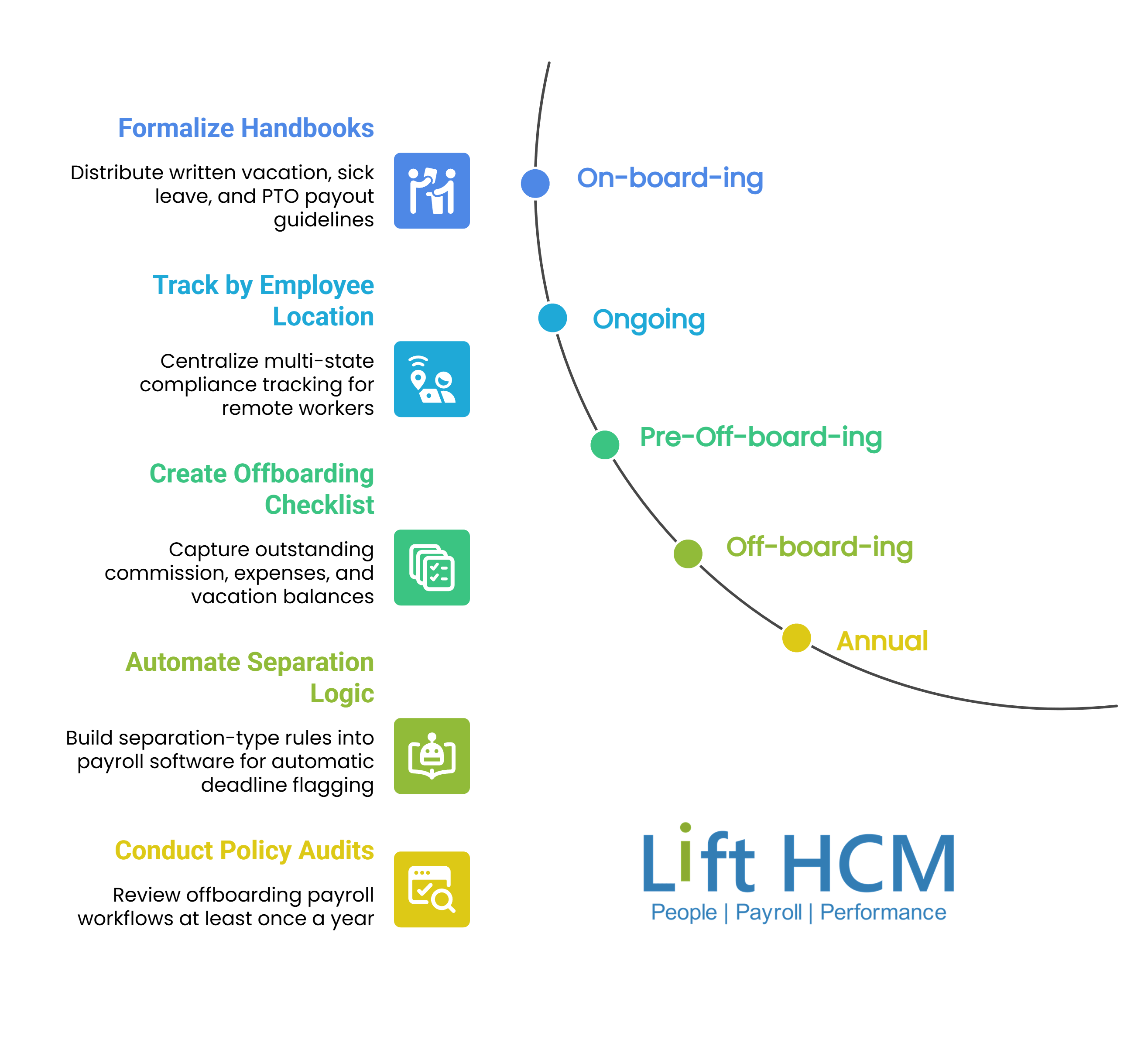
Automate Separation Logic: Build separation-type rules directly into your payroll software so that involuntary terminations automatically flag accelerated, state-mandated deadlines.
Formalize Your Handbooks: Clearly document your vacation, sick leave, and PTO payout guidelines in a written employee handbook distributed during onboarding. Vagueness is an employer's biggest liability.
Track by Employee Location: Remember that the controlling labor law is determined by where the employee physically works, not where your corporate headquarters is located. Centralize multi-state compliance tracking if you manage remote workers.
Create an Offboarding Checklist: Establish a standard checklist that captures outstanding commission structures, pending expense reimbursements, and pro-rated vacation balances before the last day of work.
Conduct Annual Policy Audits: Review your offboarding payroll workflows at least once a year. State wage laws shift more frequently than most operational leaders expect.
Frequently Asked Questions
Does final paycheck timing depend on why an employee left?
Yes. Many states set a much faster, sometimes immediate deadline for involuntary terminations (firings or layoffs) compared to voluntary resignations, which are typically due by the next regularly scheduled payday.
What is the final paycheck deadline for employers in Illinois?
Under the Illinois Wage Payment and Collection Act (820 ILCS 115/5), employers must pay final compensation in full at the time of separation if possible, but no later than the next regularly scheduled payday, regardless of the separation reason.
Which states require immediate final payment after an involuntary termination?
States including California, Colorado (if payroll is handled on-site), Missouri (upon demand), and Nevada require immediate final payment on the employee's last day. Montana requires payment within 4 hours or by the end of the business day.
Do employers have to pay out unused PTO when an employee leaves?
Federal law does not require it. State laws dictate whether PTO must be paid out. Some states mandate it like earned wages, others mandate it only if your company policy explicitly promises it, and some leave it entirely up to employer discretion. Illinois requires payout of vacation an employee has already earned, even where the policy is silent.
Simplify Your Multi-State Compliance
Managing final paycheck rules across multiple states takes more than a good-faith effort. Each state can have different timelines, PTO payout rules, tax considerations, and termination requirements, which makes manual tracking difficult to sustain as your workforce grows.
A repeatable payroll process helps your team respond quickly and consistently when an employee leaves, whether the separation is planned or unexpected. With the right system in place, employers can flag state-specific deadlines, account for earned wages and PTO, and reduce the risk of costly wage and hour mistakes.
Lift HCM’s payroll and tax management solutions are designed to help employers simplify these complex workflows and stay aligned with the rules that apply where their employees work. If your team is expanding, hiring across state lines, or reviewing your offboarding process, reach out to Lift HCM today to build a smarter, more compliant payroll strategy.