
Keeping up with HR compliance in 2026 can feel overwhelming, especially if your business is growing, hiring in new locations, managing multi-state employees, or adding new payroll and HR systems. One missed payroll update, outdated handbook policy, incomplete Form I-9, or inconsistent leave process can create risk for your business, your employees, and your leadership team.
At Lift HCM, we work with employers who want to simplify payroll and HR, reduce compliance risk, and build clearer processes that can keep up with growth. Most business owners and HR leaders are not ignoring compliance. They are trying to manage payroll, hiring, benefits, employee questions, and daily operations while employment rules continue to change.
This guide walks through all the areas employers most often worry about, including wage and hour rules, employee classification, HR recordkeeping, leave policies, workplace notices, benefits requirements, hiring practices, data security, and multi-state HR compliance.
Highest-Priority Areas to Review:
|
Compliance Area |
What to Review |
Why It Matters |
|
Payroll taxes |
Withholding, deposits, tax rates, wage bases, Forms W-2 and 941 |
Payroll errors can lead to penalties, notices, and employee frustration |
|
Wage and hour |
Minimum wage, overtime, time tracking, pay deductions, meal and rest breaks |
Wage mistakes can lead to back pay, audits, and claims |
|
Employee classification |
Exempt vs. nonexempt, employee vs. contractor, full-time vs. part-time |
Misclassification can affect overtime, taxes, benefits, and leave |
|
Form I-9 |
Completion, retention, reverification, storage |
Employers must verify work authorization for employees hired after Nov. 6, 1986 |
|
Leave policies |
FMLA, state paid leave, sick leave, PTO, accommodations |
Leave rules are changing quickly at the state and local level |
|
Benefits compliance |
ACA reporting, affordability, eligibility, notices |
Applicable large employers must follow ACA employer shared responsibility rules |
|
Posters and notices |
Federal, state, local, remote employee notices |
Many labor laws require employers to display or provide notices |
|
Multi-state compliance |
Payroll taxes, leave, wage rules, pay transparency, AI-related rules |
State and local requirements continue to increase in 2026 |
Table of Contents
-
What Hiring and Onboarding Compliance Items Should Employers Review?
-
What Workplace Posters and Employee Notices Should Employers Review?
-
What Technology and Data Security Items Should Employers Review?
-
Strengthening Your HR Compliance Processes in 2026 and Beyond
Why HR Compliance Gets Harder as Your Business Grows
HR compliance gets harder as companies grow because more employees, locations, pay types, benefits, and leave situations create more rules to manage. A company with 15 employees in one state may have a very different compliance burden than a company with 125 employees across five states. Once a business grows, informal processes that used to work can become risky.
Growth often brings new compliance triggers. For example, employers may become subject to the Family and Medical Leave Act when they meet coverage and employee eligibility rules, and applicable large employers under the Affordable Care Act generally include employers with 50 or more full-time employees, including full-time equivalent employees. More employees can also mean more benefit eligibility tracking, more payroll tax complexity, and more documentation requirements.
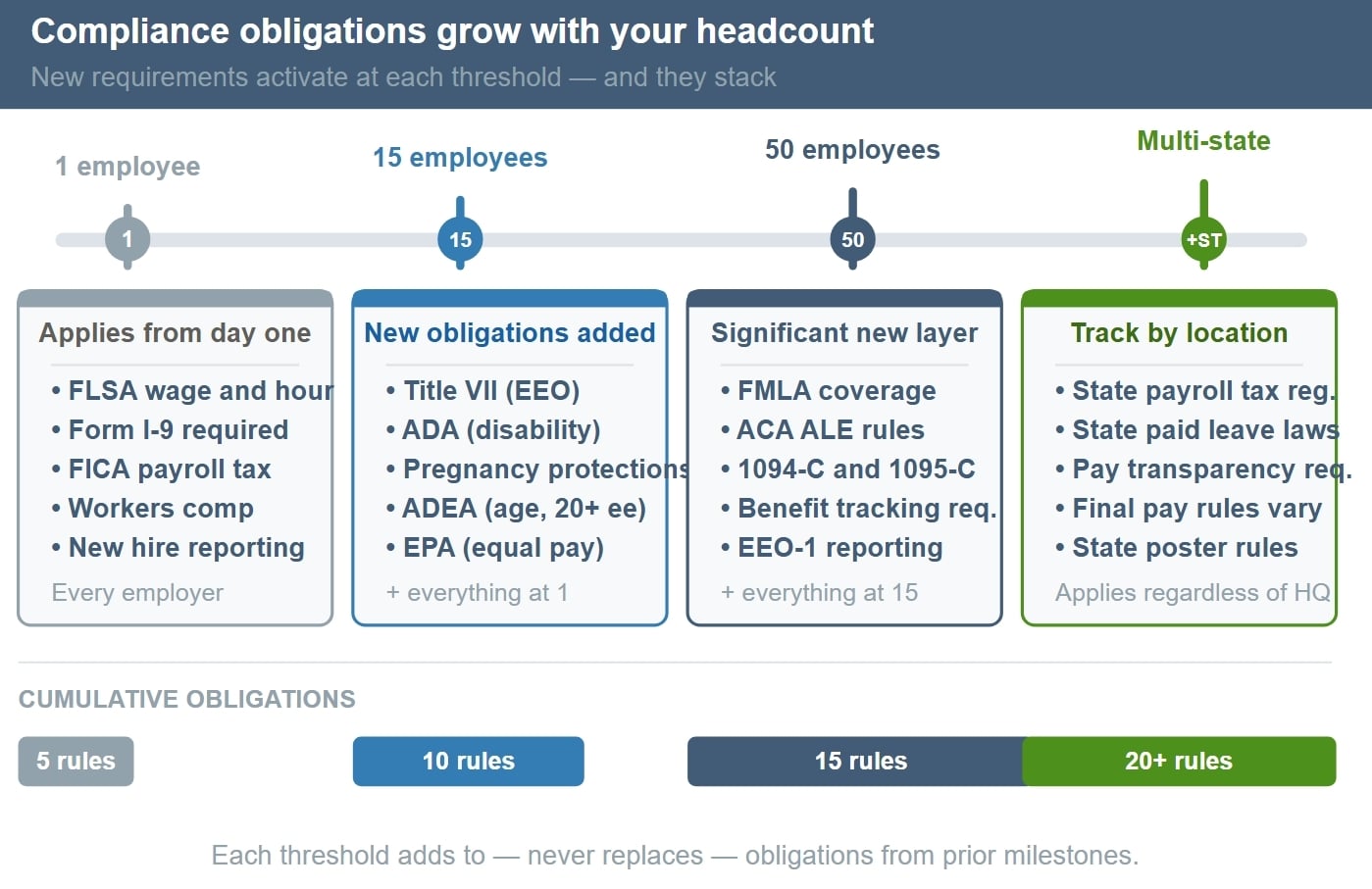
Consistency matters too. If one manager handles time off differently than another, or one location tracks time differently than another, the business may create unfairness and compliance risk. The goal is not to make HR more complicated. The goal is to create clear, repeatable processes your managers and employees can follow.
What Payroll Compliance Items Should Employers Review?
Employers should review payroll tax withholding, wage bases, deposit schedules, payroll records, tax forms, employee information, and year-end reporting. Payroll compliance is one of the highest-risk areas to review because it affects every employee and connects directly to federal, state, and local tax requirements. Even small errors can lead to employee frustration, amended filings, tax notices, or delayed reporting.
Employers should confirm Social Security and Medicare tax handling, federal income tax withholding, state withholding, unemployment tax, and local taxes where applicable. Employers should also review whether employee names, Social Security numbers, addresses, tax forms, direct deposit details, and work locations are accurate. Remote and multi-state employees can create payroll tax issues if work locations are not updated.
Here’s the truth: payroll automation can help, but it does not remove the need for review. A strong payroll compliance process should include both tax setup checks and payroll process controls.
Payroll compliance checklist
- Confirm federal, state, and local tax setup
- Review employee Form W-4 information
- Check Social Security wage base settings
- Confirm unemployment tax setup by state
- Review payroll deposit schedules
- Audit employee work locations
- Review year-end Forms W-2 and W-3 processes
- Confirm quarterly payroll filing processes
- Review off-cycle payroll and correction workflows
What Wage and Hour Rules Should Employers Check?
Employers should check minimum wage, overtime, time tracking, meal and rest break rules, pay deductions, final pay, and payroll recordkeeping. Wage and hour mistakes are common because they often happen during normal daily operations. For example, an employee may answer messages before clocking in, a manager may edit time without documentation, or a bonus may not be included correctly in overtime calculations.
The Fair Labor Standards Act sets federal minimum wage, overtime, recordkeeping, and youth employment standards for covered employers. Employers should also review state and local wage rules because some states and cities have higher minimum wages, stricter break rules, or more specific wage statement requirements.
Time tracking is one of the most important controls in wage and hour compliance. If time records are incomplete or inconsistent, employers may struggle to prove employees were paid correctly.
Wage and hour checklist
- Review minimum wage by state and local area
- Confirm overtime rules for nonexempt employees
- Check whether bonuses or commissions affect overtime
- Review meal and rest break rules
- Audit time clock edits
- Confirm final pay rules by state
- Review pay deduction practices
- Confirm wage statement requirements
- Check tipped employee rules if applicable
How Should Employers Review Employee Classification?
Employers should review whether workers are classified correctly as exempt or nonexempt, employees or independent contractors, and full-time or part-time. Classification affects overtime, payroll taxes, benefits eligibility, leave eligibility, workers’ compensation, unemployment insurance, and reporting. This makes classification one of the highest-risk areas for growing employers.
Exempt and nonexempt status deserves close attention because salary alone does not determine whether a worker is exempt from overtime. The role must meet the applicable salary and duties tests under the law.
Employers should also review independent contractor relationships carefully. If a worker functions like an employee but is treated as a contractor, the business may face tax, wage, benefit, and employment law risk.
Employee classification questions to review
|
Classification Question |
What Employers Should Review |
|
Exempt or nonexempt? |
Duties, salary basis, salary level, and overtime eligibility |
|
Employee or contractor? |
Control, independence, tax treatment, and relationship structure |
|
Full-time or part-time? |
Benefits eligibility, ACA tracking, and leave eligibility |
|
Temporary or seasonal? |
Duration, hours, benefit rules, and state requirements |
|
Remote or in-office? |
Work location, tax setup, and state labor laws |
What Employee Records Should Employers Keep and Audit?
Employers should keep accurate payroll, personnel, tax, Form I-9, benefits, leave, safety, and policy acknowledgment records. Recordkeeping matters because it helps employers prove what happened if there is a dispute, audit, agency request, or employee question. Good records also make payroll, benefits, and HR decisions easier to manage.
Under the FLSA, covered employers must keep certain records for covered nonexempt workers, including accurate employee information and data about hours worked and wages earned. The Department of Labor states that employers should preserve payroll records, collective bargaining agreements, sales records, and purchase records for at least three years, while records used for wage calculations should generally be kept for two years. Employers may have longer recordkeeping duties under other federal, state, tax, benefits, or industry-specific rules.
Form I-9 records deserve special attention. Employers should store Form I-9 files separately from general personnel files to make audits easier and limit unnecessary access.
Recordkeeping checklist
- Payroll records
- Timekeeping records
- Personnel files
- Form I-9 files
- Benefits enrollment records
- Leave documentation
- Handbook acknowledgments
- Performance records
- Safety records
- Training records
- Termination records
What Hiring and Onboarding Compliance Items Should Employers Review?
Employers should review job postings, applications, interview practices, background checks, offer letters, onboarding forms, Form I-9, E-Verify requirements, and new hire notices. Hiring compliance starts before an employee’s first day. A job posting, interview question, screening process, or background check mistake can create risk before payroll even begins.
Employers should also review whether job postings include required pay transparency information where those rules apply. If the business uses AI tools in hiring, screening, or employment decisions, employers should evaluate whether those tools create bias risk or notice requirements.
Hiring and onboarding checklist
- Review job posting language
- Confirm pay transparency rules by location
- Review interview questions
- Check background screening processes
- Review offer letter templates
- Confirm Form I-9 processes
- Check E-Verify requirements
- Review new hire reporting
- Confirm required notices
- Review onboarding policy acknowledgments
What Leave Policies Should Employers Update?
Employers should update leave policies for FMLA, paid sick leave, paid family and medical leave, PTO, disability accommodations, pregnancy-related accommodations, military leave, and state-specific leave rules. Leave compliance is more complex now because federal, state, and company policies often overlap. Employees may qualify for more than one type of leave at the same time.
Employers should also review disability and pregnancy accommodation processes. These expectations should be reflected in manager training, employee handbooks, and HR workflows.
Leave compliance checklist
- Review FMLA coverage and eligibility
- Update state paid leave policies
- Review sick leave rules by location
- Check PTO carryover and payout rules
- Review disability accommodation processes
- Review pregnancy accommodation processes
- Train managers on leave requests
- Document approvals and denials
- Track intermittent leave carefully
- Review benefit continuation during leave
What Benefits Compliance Items Should Employers Review?
Employers should review ACA status, health plan eligibility, affordability, enrollment notices, COBRA, retirement plan processes, benefit deductions, and employee communications. Benefits compliance becomes more important as companies grow because eligibility rules, waiting periods, payroll deductions, and reporting requirements become more complex. If HR, payroll, and benefits systems do not match, employees may be enrolled incorrectly or charged the wrong amount.
Applicable large employers must understand ACA employer shared responsibility rules, including when they must offer affordable, minimum-value coverage to full-time employees and dependents or potentially owe a payment, and how to handle Forms 1094-C and 1095-C.
Benefit deductions should be audited throughout the year. A common issue is when an employee’s benefit enrollment changes, but the payroll deduction does not update correctly. Employers should compare benefit enrollments, payroll deductions, carrier invoices, and employee status changes on a regular schedule.
Benefits compliance checklist
- Determine ACA applicable large employer status
- Check affordability calculations
- Review Forms 1094-C and 1095-C processes
- Confirm benefits eligibility rules
- Audit payroll deductions
- Review COBRA processes
- Check retirement plan payroll files
- Review carrier invoice reconciliation
- Confirm employee notices
What Workplace Posters and Employee Notices Should Employers Review?
Employers should review federal, state, local, remote, and industry-specific poster and notice requirements. Workplace posters may seem simple, but they are easy to overlook, especially when employees work remotely or across multiple states. Some notices must be physically posted, while others may need to be distributed electronically or included in onboarding.
A practical approach is to review posters at least annually and whenever you open a new location, hire in a new state, or move to a remote work model.
Poster and notice checklist
- Federal workplace posters
- State labor law posters
- Local posting requirements
- Remote employee notices
- FMLA poster if covered
- OSHA poster if applicable
- Equal employment opportunity notices
- Paid leave notices
- Pay transparency notices
- Industry-specific postings
How Should Employers Handle Multi-State Compliance?
Employers should handle multi-state compliance by tracking where employees work, reviewing state-specific rules, and updating payroll, leave, wage, benefits, and notice processes by location. Multi-state compliance is no longer only a concern for large national employers. Remote work, hybrid schedules, traveling employees, and hiring across state lines have made this a growing issue for small and mid-sized businesses.
Employers should not rely only on the company headquarters location. Payroll taxes, leave rules, wage statements, final pay, paid sick leave, and required notices may depend on where the employee actually performs work. A strong HR compliance process should include a way to review location changes before they create payroll or legal issues.
Multi-state compliance checklist
- Track employee work locations
- Confirm state payroll tax registration
- Review state unemployment setup
- Check local tax requirements
- Review wage and hour rules by state
- Review paid sick leave and paid family leave requirements
- Confirm final pay rules
- Review pay transparency requirements
- Review state notice requirements
- Update handbooks by state
What Technology and Data Security Items Should Employers Review?
Employers should review HR system access, employee data security, payroll permissions, audit logs, integrations, document storage, and termination access controls. HR and payroll systems contain sensitive data, including Social Security numbers, bank information, compensation, tax details, benefits elections, and personal employee records. Poor access controls can create security, privacy, and compliance risk.
Employers should also review who has access to payroll, benefits, employee records, reports, and administrative settings. Access should match the person’s role and should be removed quickly when an employee leaves the company or changes jobs. Employers should review whether integrations are sending accurate data between HR, payroll, timekeeping, benefits, accounting, and third-party systems.
Data accuracy is also part of compliance. If an employee’s work location, pay rate, tax setup, job classification, or benefits eligibility is wrong in one system, that error may flow into payroll, reporting, or benefits. A regular system audit can help catch issues before they affect employees or create reporting errors.
HR technology checklist
- Review admin access
- Remove access for terminated employees
- Check payroll approval permissions
- Review system audit logs
- Confirm multi-factor authentication
- Audit employee work locations
- Review integration error reports
- Check document storage permissions
- Review report access
- Confirm backup processes
HR Compliance Questions Employers Ask Most
What is the most important HR compliance area for employers in 2026?
The most important HR compliance area depends on the employer, but payroll, wage and hour, employee classification, leave, and recordkeeping are usually high-risk areas. These areas directly affect pay, taxes, employee rights, and audit readiness. Employers should review them regularly rather than waiting until year-end.
Do small businesses need an HR compliance checklist?
Yes, small businesses need an HR compliance checklist because many payroll, wage, tax, hiring, and recordkeeping rules apply even when a company has only a few employees. Some laws depend on employee count, but others apply much earlier. A checklist helps small businesses build good habits before compliance becomes harder.
What records should employers keep for payroll compliance?
Employers should keep payroll records, time records, wage rates, pay deductions, tax forms, employee information, and records used to calculate wages. Under FLSA guidance, payroll records should generally be preserved for at least three years, while records used for wage calculations should generally be retained for two years. State or other federal rules may require longer retention.
What makes multi-state compliance difficult?
Multi-state compliance is difficult because each state may have different rules for payroll taxes, paid leave, minimum wage, overtime, final pay, wage statements, pay transparency, and employee notices. Employers must track where employees work, not just where the company is headquartered. Remote work has made this issue more common for growing businesses.
What is the difference between payroll compliance and HR compliance?
Payroll compliance focuses on paying employees correctly, withholding and depositing taxes, filing payroll reports, and keeping wage records. HR compliance is broader and includes hiring, employee records, workplace policies, leave, benefits, postings, safety, accommodations, and employee relations. The two areas overlap because employee data often flows from HR into payroll.
Should employers use HR software for compliance?
HR software can help employers manage compliance by organizing employee records, tracking payroll data, supporting workflows, and improving reporting. However, software alone does not replace good process, accurate setup, or knowledgeable support. Employers still need clear ownership, regular reviews, and expert guidance when rules change.
Strengthening Your HR Compliance Processes in 2026 and Beyond
HR compliance has always been challenging, but it has become more complex as employers manage remote work, multi-state payroll, changing leave rules, employee classification questions, benefit requirements, and growing documentation needs. Many businesses do not struggle because they are careless. They struggle because the rules change often, and their internal processes have not always kept up.
At Lift HCM, we help employers simplify payroll and HR, strengthen compliance processes, and gain better visibility into their workforce. Our tools are designed to help businesses reduce manual work and manage risk with more confidence.
If your team is ready to review your payroll and HR compliance process, contact Lift HCM to schedule a consultation.

Compliance note: This article is for general education only and should not be treated as legal or tax advice. Employers should work with qualified legal, tax, or HR compliance advisors for guidance specific to their business.
Topics:





.jpg?width=2000&height=2000&name=header(1).jpg)
.webp?width=1080&height=1080&name=HR%20blocks(1).webp)
.jpeg?width=1024&height=1024&name=happy%20employees%20working%20together%20outside%20in%20the%20fall%20time(1).jpeg)