

Managing paid sick leave across multiple states can feel overwhelming.
If you have employees working in different locations, especially remote workers, you are likely juggling different accrual rates, carryover rules, and compliance requirements. It is not always clear which law applies, and even small mistakes can lead to penalties or employee frustration.
At Lift HCM, we have helped hundreds of businesses navigate complex payroll and HR compliance challenges, including multi-state leave laws. We understand how quickly these regulations change and how difficult it can be to keep everything aligned.
In this article, we break down multi-state paid sick leave laws in simple terms. You will learn which states require paid sick leave, how the rules differ, and how to build a compliant policy that works across your entire workforce.
Key Takeaways
- Over 20 states and dozens of cities now mandate paid sick leave, with no single federal law tying them together.
- Accrual rates, carryover rules, permitted uses, and notice requirements vary significantly by state and sometimes by city.
- Employers must apply the most generous applicable law when state and local rules overlap.
- This guide maps the key requirements for the most active states, including Illinois, California, New York, Washington, and Colorado.
- Multi-state employers should audit their policies annually and build state-specific pay code tracking into their payroll system.
Table of Contents
-
Which States Currently Mandate Paid Sick Leave? (2026 Overview)
-
What Are the Key Compliance Requirements Employers Must Follow?
-
Frequently Asked Questions About Multi-State Paid Sick Leave
-
Staying Confidently Compliant With Multi-State Paid Sick Leave
Explore Related State Compliance Topics
If you’re managing employees across multiple states, you may also find these helpful:
-
Pay Stub Requirements by State: What Employers Must Include in 2026
- Background Check Laws by State (2026): What Employers Can and Can’t Ask
- 2026 Illinois Employment Law Changes: Your Step-by-Step Implementation Guide
What Is Paid Sick Leave, and Why Does It Vary by State?
Paid sick leave is employer-provided, paid time off that employees can use for health-related and qualifying personal reasons, and it varies by state because there is no federal standard.
The United States has no federal paid sick leave mandate for private-sector employees. That gap has been filled by a growing patchwork of state and local laws, each with its own accrual rates, annual caps, eligible employee definitions, and documentation rules. For employers with workers in a single location, this complexity is manageable. For employers with remote staff, multiple offices, or plans to hire across state lines, it quickly becomes one of the most error‑prone areas of HR compliance—especially when layered on top of multi-state payroll tax rules (see Multi-State Payroll Tax Compliance: A Guide for Employers).
Why this matters for payroll: Violations of state paid sick leave laws can result in back-pay liability, civil penalties, retaliation claims, and employee relations issues if workers discover they have been under-accruing leave they were legally entitled to receive.
Which States Currently Mandate Paid Sick Leave? (2026 Overview)
As of 2026, more than 20 states and Washington, D.C. require some form of paid sick leave, with additional local laws in certain cities.
Important: Some cities, such as Chicago and New York City, have stricter local laws. Always check both state and local requirements.
|
State / Jurisdiction |
Law Name / Type |
Accrual Rate |
Annual Cap |
Notes |
|
Alaska NEW/UPDATED |
Alaska Paid Sick Leave |
1 hr / 30 hrs worked |
40 hrs |
Effective July 1, 2025. All employers with employees in Alaska. |
|
Arizona |
Earned Paid Sick Time |
1 hr / 30 hrs worked |
40-80 hrs (by size) |
Fewer than 15 employees: 40-hr cap. |
|
California NEW/UPDATED |
Healthy Workplaces, Healthy Families Act |
1 hr / 30 hrs worked |
40 hrs use / 80 hrs carry |
Front-loading available. Jan 2026: expanded safe time for crime victims. |
|
Colorado NEW/UPDATED |
HFWA |
1 hr / 30 hrs worked |
48 hrs |
Includes public health emergency leave. Jan 2026: NICU leave expansion. |
|
Connecticut NEW/UPDATED |
Paid Sick Leave Act |
1 hr / 30 hrs worked |
40 hrs |
As of Jan 1, 2026: covers 11+ employees. All employers Jan 2027. Rate updated from 1:40 to 1:30. |
|
Illinois |
Paid Leave for All Workers Act |
1 hr / 40 hrs worked |
40 hrs |
Paid leave for any reason. Chicago has stricter ordinance. |
|
Maine |
Earned Employee Leave |
1 hr / 40 hrs worked |
40 hrs |
Paid leave for any reason. Employers with 10+ employees. |
|
Maryland |
MD Healthy Working Families Act |
1 hr / 30 hrs worked |
40 hrs |
15+ employees: paid; fewer than 15: unpaid. |
|
Massachusetts |
MA Earned Sick Time Law |
1 hr / 30 hrs worked |
40 hrs |
11+ employees: paid; fewer than 11: unpaid. |
|
Michigan |
Michigan ESTA |
1 hr / 35 hrs worked |
72 hrs (2025+) |
Expanded Feb 2025. New hires: 120-day waiting period to use leave. |
|
Minnesota |
Earned Sick and Safe Time (ESST) |
1 hr / 30 hrs worked |
48 hrs |
Effective Jan 2024. Separate PFML program launched Jan 2026.
|
|
Nebraska NEW/UPDATED |
Healthy Families and Workplaces Act |
1 hr / 30 hrs worked |
40-56 hrs (by size) |
Effective Oct 1, 2025. 11+ employers. 11-19 employees: 40 hrs; 20+: 56 hrs. |
|
Nevada |
Nevada Paid Leave Law |
~1 hr / 52 hrs worked |
40 hrs |
Paid leave for any reason. Employers with 50+ employees. |
|
New Jersey |
NJ Earned Sick Leave Law |
1 hr / 30 hrs worked |
40 hrs |
Applies to all employers. |
|
New Mexico |
Healthy Workplaces Act |
1 hr / 30 hrs worked |
64 hrs |
Effective July 2022. |
|
New York State NEW/UPDATED |
NY Paid Sick Leave Law |
1 hr / 30 hrs worked |
40 or 56 hrs (by size) |
100+ employees: 56-hr cap. NYC ESSTA expanded Feb 22, 2026. |
|
Oregon NEW/UPDATED |
Oregon Sick Time Law |
1 hr / 30 hrs worked |
40 hrs paid |
10+ employees: paid. Jan 2026: blood donation added as covered reason. |
|
Rhode Island |
Healthy & Safe Families Act |
1 hr / 35 hrs worked |
40 hrs |
Effective July 2018. |
|
Vermont |
Vermont Earned Sick Time |
1 hr / 52 hrs worked |
40 hrs |
Phased in by employer size. |
|
Washington State NEW/UPDATED |
WA Paid Sick Leave |
1 hr / 40 hrs worked |
No annual cap |
Carryover required up to 40 hrs. July 2025: immigration proceedings added. |
|
Washington D.C. |
DC Accrued Sick and Safe Leave Act |
Varies by size |
Up to 56 hrs |
Tiered by employer headcount. |
Because these laws change frequently, always confirm current requirements using official state labor department sites or other authoritative HR compliance resources before updating your policies.
What Are the Key Compliance Requirements Employers Must Follow?
To stay compliant, employers must track six core elements: coverage, accrual, caps, carryover, covered reasons, and notice requirements.
1. Who Is Covered Under Paid Sick Leave Laws?
Most modern paid sick leave statutes cover full-time, part-time, and temporary employees. Some extend to seasonal workers. A few states exclude very small employers (typically fewer than 5–11 employees, depending on the state) from paid leave requirements while still mandating unpaid leave. Remote employees working from a particular state are generally covered by that state’s law, regardless of where your company is headquartered.
2. Accrual vs. Front-Loading
Most states allow two methods for providing leave:
Accrual: Employees earn leave incrementally as they work, typically 1 hour for every 30–40 hours worked. Accrual must be tracked in real time.
Front-loading: Employers deposit the full year’s allotment into an employee’s balance at the start of the year. This is simpler to administer but requires careful handling of carryover rules, especially for new hires mid-year.
3. Annual Use Caps and Accrual Caps
There are two separate caps to track in many laws:
Accrual cap: The maximum number of hours that can accumulate at any point in time.
Annual use cap: The maximum a law allows an employee to use within a single year (often 40–56 hours).
Illinois Example
Illinois makes the distinction clear by letting employees accrue more paid leave than they can actually use in a year.
Accrual cap (state level): Employees earn at least 1 hour of paid leave for every 40 hours worked, and employers may cap annual accrual at 40 hours under the Illinois Paid Leave for All Workers Act (PLAWA).
Annual use cap (state level): Even if more time carries over, employers are not required to let an employee use more than 40 hours of paid leave in any designated 12‑month period.
Carryover interaction (state level): When leave is accrued (not front‑loaded), unused hours must carry over year to year, but employers can still cap usage at 40 hours annually.
Chicago Example
Chicago highlights the concept even more clearly by setting separate rules for two leave banks and for carryover:
Accrual cap (city level): Employees earn 1 hour of Paid Leave and 1 hour of Paid Sick Leave for every 35 hours worked. Employers may cap accrual at 40 hours per 12-month period for each bank.
Annual use cap (city level): Employers may limit the use of Paid Leave to 40 hours per year (unless they choose to allow more), even if the employee has a higher balance.
Carryover interaction (city level): Employees must be allowed to carry over at least 16 hours of Paid Leave and up to 80 hours of Paid Sick Leave into the next year. This means an employee’s total balance can exceed 40 hours, but annual usage can still be capped at 40 hours.
Taken together, Illinois PLAWA and the Chicago ordinance show that employers can (1) control how much leave accrues and carries over, and (2) separately cap how many hours an employee may actually use in a 12‑month period.
4. Carryover Requirements
Most laws require that unused, accrued leave carry over from one year to the next, up to a cap. A common structure: employees carry over up to 40 hours, but may only use 40 hours in the new year. Employers who front-load the full amount at the start of each year can often bypass carryover tracking, but only if the jurisdiction explicitly permits it. Do not assume, confirm in the statute or regulations.
5. Covered Reasons for Leave
Paid sick leave laws have expanded well beyond the employee’s own illness. Most 2026-era laws cover:
- The employee’s or a family member’s physical or mental illness, injury, or medical condition
- Preventative care appointments (including routine checkups, vaccines, and dental visits)
- Caring for a family member with a serious health condition
- Closure of the employee’s workplace or child’s school/daycare due to a public health emergency
- Needs related to domestic violence, sexual assault, or stalking (for the employee or a family member)
The definition of “family member” is broadening. Many laws now include domestic partners, grandparents, grandchildren, and siblings in addition to spouses, parents, and children. A handful of states allow use for any personal health-related reason, essentially converting sick leave into general paid time off. Illinois, Maine, and Nevada provide leave for any reason, not just health-related purposes.
6. Notice, Posting, and Documentation Requirements
Every jurisdiction with a paid sick leave mandate includes notice requirements. Typical obligations include:
- Posting a state-approved notice in a conspicuous location in each workplace
- Providing written notice to employees at hire (often on a pay stub or in an offer letter)
- Reflecting leave balances on regular pay stubs or in a self-service portal
- Maintaining records of accrual, use, and balances for a minimum retention period (typically 3–4 years)
For remote workers, electronic posting, through an intranet, HRIS or HCM self-service portal, or emailed notice, is generally accepted. Check your HCM platform to confirm it can generate the required pay stub disclosures automatically.
Frequently Asked Questions About Multi-State Paid Sick Leave
Q: Does a remote employee’s home state determine which sick leave law applies? Generally, yes. Most courts and state agencies look to where the employee performs their work, not where the employer is incorporated or headquartered. If your employee works from home in Illinois, Illinois's Earned Sick Leave Law applies.
Q: Can we use our existing PTO policy to satisfy paid sick leave requirements? Yes, if your PTO policy meets or exceeds the law’s accrual rate, annual cap, covered reasons, carryover, and notice requirements. Many employers find their general PTO policies satisfy the basic accrual and cap thresholds but fall short on covered reasons or carryover, a gap analysis is essential before assuming compliance.
Q: What if our company grows and we hire our first employee in a new state mid-year? Most state sick leave laws apply as of the employee’s first day of work. You should immediately configure that state’s accrual rules in your payroll/HCM system, ensure the required state posting is accessible to the employee (electronically, for remote workers), and review your policy to confirm it covers the new state’s requirements.
Q: Do we need to pay out unused sick leave when an employee terminates? It depends on the state and how your policy is written. California requires payout of accrued, unused sick leave if it is part of a general PTO policy (not a standalone sick leave bucket). Most other states do not require payout of sick leave specifically—but check each jurisdiction you operate in.
Q: How do paid sick leave laws interact with FMLA? FMLA provides up to 12 weeks of unpaid, job-protected leave per year for qualifying reasons. Most states allow, and some require, employers to run paid sick leave concurrently with FMLA when the reason qualifies. This means an employee’s accrued paid sick leave exhausts alongside their FMLA entitlement rather than on top of it. Coordinate leave tracking between your FMLA administration process and your sick leave accrual system.
Q: What are the most common paid sick leave compliance mistakes?
- Not tracking remote employee work locations and applying the wrong state’s law
- Setting annual caps below the statutory floor for a jurisdiction
- Using “use it or lose it” language in states that prohibit it
- Failing to update required postings when laws change
- Not configuring HCM/payroll systems to reflect each state’s carryover rules
- Requiring medical documentation for short absences where prohibited
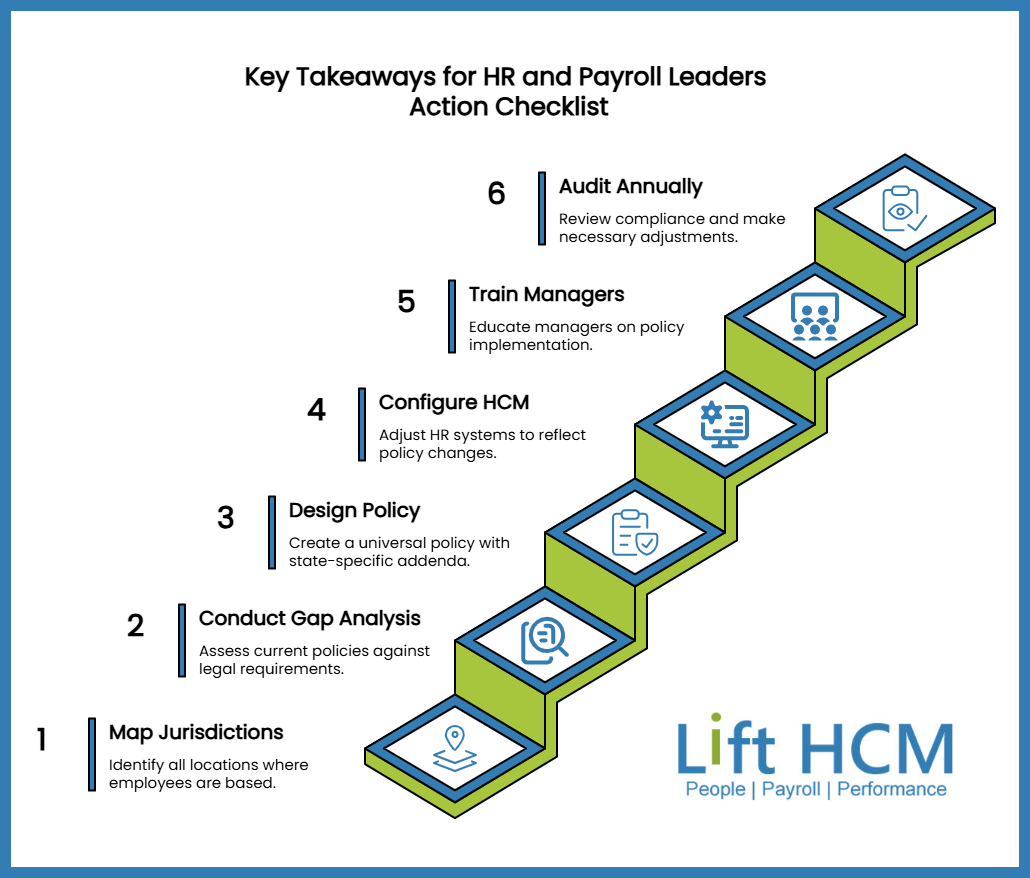
Paid sick leave compliance isn’t a one-time project, it’s an ongoing operational discipline. The good news: with a well-structured policy, properly configured technology, and a regular audit cycle, managing leave across dozens of jurisdictions becomes a predictable, manageable part of your HR calendar rather than a recurring compliance emergency.
Growing employers who treat multi-state paid sick leave as a strategic HR function, rather than a legal afterthought, build employee trust, reduce liability exposure, and position themselves to scale confidently into new markets.
Staying Confidently Compliant With Multi-State Paid Sick Leave
Managing multi-state paid sick leave is complex and time-intensive, but it doesn’t have to stay that way.
You now have a clearer picture of how these laws work, which requirements to monitor, and how to design a policy that keeps your organization compliant across locations. As your workforce grows, the complexity grows with it, but with the right systems and processes, compliance becomes a manageable routine instead of a recurring fire drill.
At Lift HCM, we help employers simplify multi-state payroll, workforce management, and compliance. From configuring your HCM and payroll rules to aligning your HR policies with changing regulations, our focus is to give you clarity, control, and confidence.
If you’re navigating multi-state compliance today or preparing to expand into new states, this is the right time to make sure your systems and policies are working together, not against you.

Topics:








.png?width=1536&height=1024&name=Create%20a%20background%20that%20reads%2c%20How%20Long%20to%20Keep%20P%20(1).png)