

If you run payroll in more than one state, or even just one state, pay stub compliance is more complicated than most employers realize. A missing deduction line, the wrong delivery format, or failing to keep records long enough can expose your business to wage claims, fines, and employee disputes that are entirely avoidable.
At Lift HCM, we work with HR managers and payroll leaders every day who are juggling exactly this kind of compliance question. They know payroll inside and out-but they can't always know every state's wage statement rules off the top of their head, especially when they're onboarding new employees, expanding to new locations, or managing a remote workforce that crosses state lines.
This article breaks down pay stub requirements for all 50 states, explains the five categories every employer needs to understand, and shows you exactly what information must appear on a compliant pay stub in 2026. We've also flagged the most significant recent legislative changes-including new requirements that took effect in Illinois in 2025 and Oregon in January 2026. By the end, you'll know exactly where your business stands-and what to do if you're not yet compliant.
This article is part of our 2026 state-by-state employer compliance series.
Table of Contents
Explore Related State Compliance Topics
If you are managing employees across multiple states, you may also find these helpful:
- Background Check Laws by State (2026): What Employers Can and Can’t Ask
- Multi-State Paid Sick Leave Compliance Roadmap for Growing Employers
What Is a Pay Stub, and Why Does It Matter?
A pay stub, also called a wage statement or earnings statement, is a document that details an employee's compensation for a specific pay period. It shows gross wages earned, taxes and deductions withheld, and the resulting net take-home pay.
Pay stubs serve multiple purposes beyond just telling employees what they earned:
- They provide employees with proof of income for loan applications, apartment rentals, and government benefits
- They help employees verify that their withholdings and deductions are correct
- They create a paper trail that protects employers against wage disputes
- They make year-end W-2 reconciliation significantly easier and reduce discrepancy risk
📋 Federal Law on Pay Stubs
The Fair Labor Standards Act (FLSA) does not require employers to provide pay stubs to employees. However, it does require employers to maintain accurate payroll records, including hours worked, wages paid, and deductions, for at least three years. Since most of that required information lives on a pay stub, generating them is effectively a best practice even where state law doesn't require distribution.
What Are the 5 Pay Stub Requirement Categories?
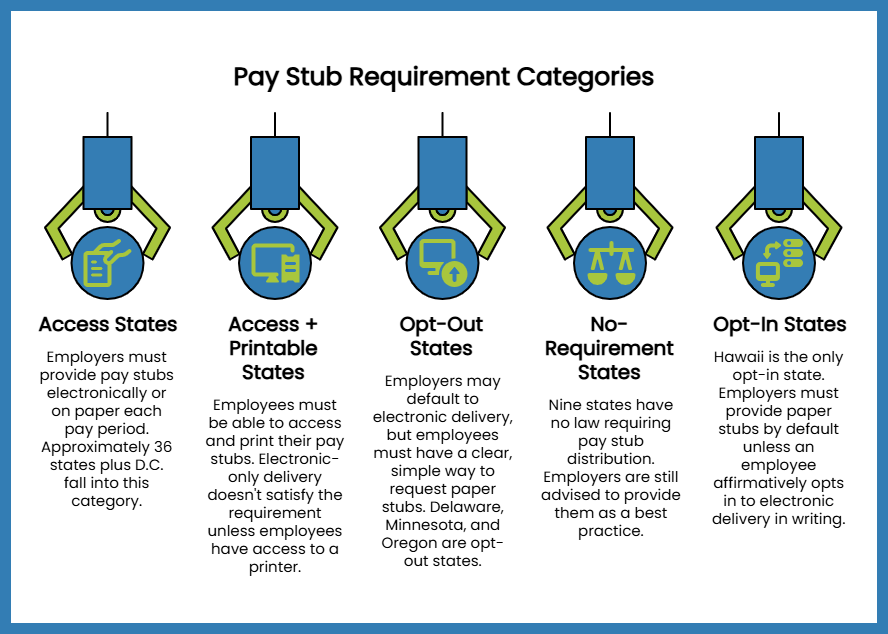
Before diving into state-by-state details, it's important to understand the five categories that describe how states regulate pay stub access and delivery:
Access States: Employers must proactively provide pay stubs to employees, either electronically or on paper, each pay period. Approximately 36 states plus D.C. fall into this category.
Access + Printable States: Employees must be able to access and print their pay stubs. Electronic-only delivery doesn't satisfy the requirement unless employees have access to a printer. Includes California, New York, Texas, Colorado, Massachusetts, Nevada, and Washington.
Opt-Out States: Employers may default to electronic delivery, but employees must have a clear, simple way to request paper stubs. Delaware, Minnesota, and Oregon are opt-out states. Once an employee opts out, the employer must switch them to paper.
No-Requirement States: Nine states have no law requiring pay stub distribution: Alabama, Arkansas, Florida, Georgia, Louisiana, Mississippi, Ohio, South Dakota, and Tennessee. Employers are still advised to provide them as a best practice, and must maintain payroll records under the FLSA.
Opt-In States: Hawaii is the only opt-in state. Employers must provide paper stubs by default unless an employee affirmatively opts in to electronic delivery in writing.
⚠️ Hawaii: The Opt-In Exception
Hawaii is the only state that requires employers to obtain employee consent before switching to electronic pay stubs. All employees must receive paper stubs by default unless they affirmatively opt in to electronic delivery — the reverse of the opt-out model. This consent must be in writing before you make any format change.
What Information Must Appear on a Pay Stub?
While specific requirements vary by state, most states that mandate pay stubs require some combination of the following standard fields:
|
Required in Most States |
Required in Select States |
|
✓ Employee name and identification |
★ Hourly pay rate(s) |
|
✓ Employer name and address |
★ Overtime hours and overtime rate |
|
✓ Pay period start and end dates |
★ Year-to-date (YTD) totals |
|
✓ Gross wages earned (before deductions) |
★ Accrued PTO / sick leave balance |
|
✓ All deductions itemized (taxes, benefits, garnishments) |
★ Piece-rate pay details (California) |
|
✓ Net pay (take-home amount) |
★ Tip credits / tip amounts (tipped workers) |
|
✓ Hours worked (for non-exempt employees) |
★ Employer identification number (EIN) |
What Changed for Illinois Employers in 2025?
Illinois employers should be aware of a significant change that took effect January 1, 2025. Under Public Act 103-0953, Illinois now requires employers to provide a pay stub to employees for each pay period-moving Illinois from a state where pay stubs were not explicitly required into the Access category.
Illinois employers must now comply with the following:
- Provide a pay stub for every pay period, either in paper or electronic format
- Include hours worked, pay rates, overtime hours and pay, gross wages, all deductions, and year-to-date totals on every stub
- Retain copies of all pay stubs for three years from the date of payment — even after an employee leaves
- Fulfill employee requests for pay stub copies within 21 calendar days
- Allow current and former employees to request pay stub copies up to two times per 12-month period
💡 Illinois Employer Tip
If you're using isolved through Lift HCM, your pay stubs are generated automatically with each payroll run and include all required fields. Employee self-service access means employees can view and download their own pay stubs 24/7-which satisfies the access requirement without extra administrative work on your end.
What Changed for Oregon Employers in 2026?
Oregon made two meaningful updates to its pay stub rules-one that has been in place and one brand new as of 2026. Oregon remains an opt-out state for delivery: employers may provide pay stubs electronically by default, but any employee can request paper copies at any time.
New as of January 1, 2026, Oregon Senate Bill 906 added a separate at-hire disclosure requirement. Under SB 906, employers must now provide all new employees at the time of hire with a written explanation of how their earnings and deductions work. This explanation must include:
- The employer's established pay period structure
- All pay rates the employee may be eligible for (hourly, salary, overtime, shift differentials, piece-rate, commission)
- A glossary or key for all payroll codes used for pay rates and deductions
- A description of all deduction types that may apply, including the purpose of each
- Any employer-provided benefits that may appear on pay statements
This explanation can be provided as a physical document, a PDF, a link through an onboarding portal, or posted in a conspicuous workplace location-and must be reviewed and updated at least annually. Oregon's Bureau of Labor and Industries (BOLI) has published a template employers can use. Civil penalties of up to $500 per instance may be assessed for noncompliance.
📌 Oregon Employer Note
The SB 906 at-hire disclosure is separate from your ongoing pay stub delivery obligations. You still need to provide pay stubs each pay period in a format employees can access. The new requirement is a one-time (and annually reviewed) explanation document-think of it as a pay stub decoder for new hires.
What Other States Changed Their Rules in 2026?
Beyond Oregon, two more states made notable pay stub changes effective January 1, 2026 that multi-state employers should have on their radar:
Colorado: Sick Leave Balance Now Required on Pay Stubs
Colorado now requires employers to include earned paid sick leave balances on every wage statement, both the amount accrued and the amount used, shown for the pay period and year-to-date. This joins California and Nevada as states with mandatory PTO/sick leave disclosure on pay stubs. If you have Colorado employees and your current stub template doesn't include this field, it needs to be added.
Massachusetts: Significantly Higher Penalties for Violations
Massachusetts increased its penalty structure for wage statement violations under M.G.L. c. 149, and 148. Willful violations now carry penalties of up to $1,000 per affected employee per pay period, with aggregate penalties capped at $25,000 per case. This is a meaningful jump from previous penalty levels and signals heightened enforcement priority, making Massachusetts one of the more consequential compliance risks for multi-state employers in the Northeast.
Pay Stub Requirements for All 50 States (2026)
Use the table below to quickly identify your state's requirements.
| State | Category | Delivery Format | Required Information | Penalties for Noncompliance |
| Alabama | No Req. | — | — | None (no state law) |
| Alaska | Access | Electronic or paper | Gross/net pay, deductions, hours | Varies / civil liability |
| Arizona | Access | Electronic or paper | Hours, pay rate, deductions | Varies / civil liability |
| Arkansas | No Req. | — | — | None (no state law) |
| California | Access+Print | Paper or electronic w/ print access | Hours, rate, gross/net, all deductions itemized, pay period dates, piece rate, last 4 SSN or employee ID | $50/employee 1st violation; $100/employee subsequent; max $4,000/employee |
| Colorado | Access+Print | Electronic w/ print capability | Hours, rate, gross/net, deductions, earned paid sick leave balance (accrued & used, pay period & YTD) | Varies / civil liability |
| Connecticut | Access | Electronic or paper | Hours, gross pay, deductions | Varies / civil liability |
| Delaware | Opt-Out | Electronic default; paper on request | Hours, gross/net, deductions | Varies / civil liability |
| Florida | No Req. | — | — | None (no state law) |
| Georgia | No Req. | — | — | None (no state law) |
| Hawaii | Opt-In | Paper default; electronic w/ written consent only | Gross/net pay, deductions | Varies / civil liability |
| Idaho | Access | Electronic or paper | Hours, pay rate, deductions | Varies / civil liability |
| Illinois | Access | Electronic or paper | Hours, pay rates, OT hours & pay, gross wages, deductions, YTD totals | Up to $500/violation; additional damages & attorney's fees possible |
| Indiana | Access | Electronic or paper | Gross pay, deductions, net pay | Varies / civil liability |
| Iowa | Access | Electronic or paper | Gross pay, deductions, net pay | Varies / civil liability |
| Kansas | Access | Electronic or paper | Deductions itemized | Varies / civil liability |
| Kentucky | Access | Electronic or paper | Gross/net, deductions, hours | Varies / civil liability |
| Louisiana | No Req. | — | — | None (no state law) |
| Maine | Access | Electronic or paper | Hours, rate, gross/net, deductions | Varies / civil liability |
| Maryland | Access | Electronic or paper | Pay rate, deductions, benefits | Up to $500/instance |
| Massachusetts | Access+Print | Electronic w/ print capability | Hours, rate, gross/net, deductions | Up to $1,000/employee per pay period (willful); aggregate cap $25,000/case |
| Michigan | Access | Electronic or paper | Gross pay, deductions, net pay | Varies / civil liability |
| Minnesota | Opt-Out | Electronic default; paper on request | Hours, rate, gross/net, deductions | Varies / civil liability |
| Mississippi | No Req. | — | — | None (no state law) |
| Missouri | Access | Electronic or paper | Gross pay, deductions | Varies / civil liability |
| Montana | Access | Electronic or paper | Hours, rate, deductions | Varies / civil liability |
| Nebraska | Access | Electronic or paper | Gross pay, deductions | Varies / civil liability |
| Nevada | Access+Print | Electronic w/ print capability | Hours, rate, gross/net, deductions, PTO balance | Varies / civil liability |
| New Hampshire | Access | Electronic or paper | Deductions itemized | Varies / civil liability |
| New Jersey | Access | Electronic or paper | Gross pay, deductions, net pay | Varies / civil liability |
| New Mexico | Access | Electronic or paper | Hours, rate, gross/net, deductions | Varies / civil liability |
| New York | Access+Print | Electronic w/ print capability | Hours, rate, gross/net, deductions (extra fields for tipped workers) | Up to $250/workday per employee; max $5,000/employee |
| North Carolina | Access | Electronic or paper | Deductions itemized | Varies / civil liability |
| North Dakota | Access | Electronic or paper | Gross pay, deductions | Varies / civil liability |
| Ohio | No Req. | — | — | None (no state law) |
| Oklahoma | Access | Electronic or paper | Deductions itemized | Varies / civil liability |
| Oregon | Opt-Out | Electronic default; paper on request | Hours, rate, gross/net, deductions; + written at-hire payroll explanation (SB 906) | Up to $500/instance for missing at-hire explanation |
| Pennsylvania | Access | Electronic or paper | Gross pay, deductions | Varies / civil liability |
| Rhode Island | Access | Electronic or paper | Hours, rate, gross/net, deductions | Varies / civil liability |
| South Carolina | Access | Electronic or paper | Deductions itemized | Varies / civil liability |
| South Dakota | No Req. | — | — | None (no state law) |
| Tennessee | No Req. | — | — | None (no state law) |
| Texas | Access+Print | Electronic w/ print capability | Gross pay, deductions, net pay | Varies / civil liability |
| Utah | Access | Electronic or paper | Deductions itemized | Varies / civil liability |
| Vermont | Access | Electronic or paper | Hours, rate, gross/net, deductions | Varies / civil liability |
| Virginia | Access | Electronic or paper | Gross pay, deductions | Varies / civil liability |
| Washington | Access+Print | Electronic w/ print capability | Hours, rate, gross/net, deductions, YTD totals, PFML premium amounts | Varies / civil liability |
| West Virginia | Access | Electronic or paper | Deductions itemized | Varies / civil liability |
| Wisconsin | Access | Electronic or paper | Gross pay, deductions | Varies / civil liability |
| Wyoming | No Req. | — | — | None (no state law) |
What Happens If You Don't Comply With Pay Stub Laws?
Noncompliance with state pay stub laws can result in serious consequences, including:
-
Civil penalties ranging from $50 to $500 per violation per pay period, depending on the state
-
Class action wage claims from groups of employees who were denied access to their records
-
Back pay liability if employees can't verify they were paid correctly
-
State labor department audits triggered by employee complaints
-
In California specifically, penalties up to $4,000 per employee for systemic violations
-
In Oregon, penalties up to $500 per instance for failure to provide the required at-hire payroll explanation
📌 Multi-State Employer Warning
If you have employees in multiple states, including remote workers, you must comply with the pay stub law of the state where the employee works, not where your company is headquartered. An employer based in Florida (no requirement) with remote employees in California (strict requirements) must still provide California-compliant pay stubs to those employees.
How Can Employers Stay Compliant With Pay Stub Requirements?
Staying compliant doesn't have to mean managing a checklist manually. Here's what proactive employers do:
- Audit your current pay stubs against the requirements for every state where you have employees, including remote workers
- Ensure your payroll system automatically generates compliant stubs and stores copies for the required retention period
- Verify your electronic pay stub delivery meets your states' format requirements (access vs. access + printable vs. opt-out)
- Obtain written consent before switching to electronic delivery in opt-out states, and maintain paper-default delivery in Hawaii unless employees have opted in
- If you have employees in Oregon, prepare your at-hire payroll explanation document and build it into your onboarding process
- Train your HR and payroll team on state-specific fields that go beyond the national baseline
Modern payroll platforms like isolved, which Lift HCM uses for all clients, enerate pay stubs automatically with every payroll run. Every required field is populated based on your employees' classification, compensation structure, and state of employment, so compliance is built in rather than bolted on.
Frequently Asked Questions: Pay Stub Requirements by State
Q: Are pay stubs required by federal law? No. The Fair Labor Standards Act (FLSA) does not require employers to provide pay stubs to employees. However, the FLSA does require employers to maintain accurate payroll records — including hours worked and wages paid — for at least three years. Pay stub requirements are set entirely at the state level, which is why they vary so significantly across the country.
Q: Which states do not require employers to provide pay stubs? Nine states have no law requiring pay stub distribution: Alabama, Arkansas, Florida, Georgia, Louisiana, Mississippi, Ohio, South Dakota, and Tennessee. Employers in these states are not legally obligated to provide employees with any documentation of their earnings, though providing pay stubs is still considered best practice — and FLSA recordkeeping requirements still apply.
Q: What information must be on a pay stub? Required fields vary by state, but most states that mandate pay stubs require: employee name and identification, employer name and address, pay period dates, gross wages earned, all deductions itemized, net pay, and hours worked for non-exempt employees. Some states require additional fields — California mandates nine specific fields including piece-rate details and the last four digits of the employee's Social Security number, while Illinois, Nevada, Washington, and Colorado require year-to-date totals or paid sick leave balances.
Q: What are the penalties for not providing pay stubs? Penalties vary significantly by state. California imposes $50 per employee for a first violation and $100 per employee for each subsequent violation, capped at $4,000 per employee. New York allows damages of up to $250 per workday per employee, capped at $5,000 per employee. Massachusetts increased its penalties in 2026 to up to $1,000 per employee per pay period for willful violations, with an aggregate cap of $25,000 per case. Illinois imposes up to $500 per violation. Maryland and Oregon each impose up to $500 per instance. States without specific dollar amounts on the books still expose employers to civil liability and wage claims.
Q: Do remote employees follow their employer's state law or their own state's pay stub law? Remote employees follow the pay stub law of the state where they work, not where the employer is headquartered. An employer based in Florida — which has no pay stub requirement — must still provide California-compliant pay stubs to any employees working in California. Multi-state employers should audit their pay stub practices for every state in which they have employees, including remote workers.
Q: Does my payroll software automatically handle pay stub compliance? Modern payroll platforms like isolved, which Lift HCM uses for all clients, generate pay stubs automatically with every payroll run and populate required fields based on each employee's classification, compensation structure, and state of employment. Employee self-service access allows employees to view and download their own stubs at any time, which satisfies the access requirement in most states. That said, employers should still audit their pay stub templates periodically — especially when hiring in new states or when state laws change — to confirm all required fields are present.
Q: How long do employers need to keep pay stub records? Most states that specify a retention period require employers to keep pay stub records for at least three years. Illinois specifically mandates three years from the date of payment, even after an employee leaves. Under the FLSA, employers must also retain payroll records for at least three years regardless of state law. Some states have longer retention requirements, so multi-state employers should apply the most stringent standard that applies to each employee's location.
The Bottom Line on Pay Stub Compliance
Pay stub laws vary significantly by state, and the consequences of getting them wrong, from employee disputes to state penalties, are real and avoidable. Whether you operate in a single state or manage a multi-state workforce, understanding your obligations is the first step toward protecting your business. With recent changes in Illinois (2025) and Oregon (2026), now is a good time to review your current pay stub process end to end.
At Lift HCM, we help small and mid-sized businesses in Illinois and across the country maintain pay stub compliance through isolved's automated payroll platform. Every pay stub is generated with the right information, in the right format, every time, without extra work from your HR team.
Interested in simplifying pay stub compliance? Contact Lift HCM to learn how we handle pay stub generation, employee self-service access, and multi-state payroll compliance automatically.
Topics:











.png?width=1536&height=1024&name=Create%20a%20background%20that%20reads%2c%20How%20Long%20to%20Keep%20P%20(1).png)