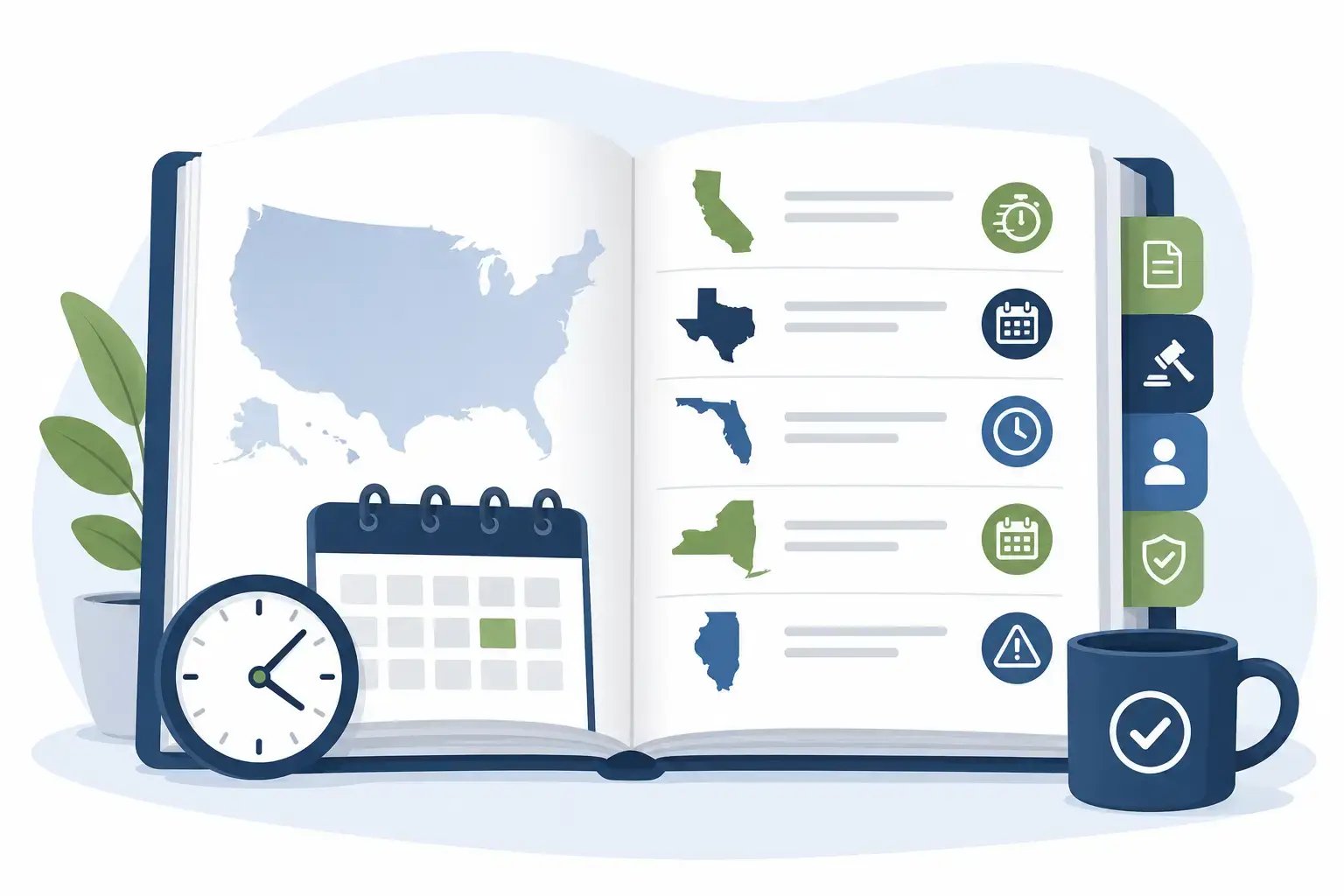

Hiring employees in more than one state can help your business find great talent, support remote work, and grow beyond one local market. But it can also make payroll more complicated very quickly. Each state may have different rules for payroll tax registration, income tax withholding, unemployment insurance, paid leave, minimum wage, overtime, wage statements, and final pay.
At Lift HCM, we work with employers that want to simplify payroll and HR while reducing avoidable compliance risk. Many businesses do not run into trouble because they are careless. They run into trouble because remote, hybrid, and multi-state work arrangements create payroll obligations that are easy to miss without the right process.
This article explains the most common multi-state payroll compliance challenges employers face, why they happen, and how to reduce risk before small mistakes turn into larger payroll, tax, or employee issues.
Key Takeaways
Multi-state payroll compliance involves navigating complex payroll tax, wage, and labor rules across different states where employees work, especially for remote and hybrid teams. Understanding and managing these challenges is crucial to avoid costly errors and ensure regulatory adherence.
- Employers face high risks in state payroll tax registration, income tax withholding, and unemployment insurance when employees work in multiple states.
- Compliance demands accurate employee work location tracking, state-specific wage and hour law adherence, and proactive workflows for remote work approvals.
- Effective management requires integrated payroll, HR, and time tracking systems, regular audits, and collaboration with qualified advisors to maintain ongoing multi-state compliance.
Table of Contents
-
What Should Employers Know About Multi-State Payroll Compliance?
-
How Do State Payroll Tax Registration Requirements Create Risk?
-
How Does Unemployment Insurance Work for Multi-State Employees?
-
What Paid Leave and Sick Leave Rules Should Multi-State Employers Watch?
-
Build a Stronger Payroll Compliance Process Before You Expand
What Should Employers Know About Multi-State Payroll Compliance?
Multi-state payroll compliance means employers must follow payroll, tax, wage, leave, and reporting rules in each state where employees work. This can include registering for state payroll taxes, withholding the correct income tax, paying unemployment insurance, following wage and hour laws, providing required notices, and handling final pay correctly.
Here are the biggest risks to review:
|
Multi-State Payroll Issue |
Why It Matters |
Risk Level |
|
State payroll tax registration |
Employers may need accounts before withholding or reporting wages |
High |
|
Income tax withholding |
Employees may owe tax based on where they live, work, or both |
High |
|
Unemployment insurance |
Employers often need to report wages to the correct state agency |
High |
|
Local taxes |
Some cities and local areas have separate payroll tax rules |
Medium to High |
|
Minimum wage and overtime |
State or local rules may be stricter than federal rules |
High |
|
Paid leave and sick leave |
Requirements can vary widely by state and local area |
Medium to High |
|
Wage statements |
States may require specific pay stub details |
Medium |
|
Final pay |
Some states require faster payment after termination or resignation |
High |
|
Remote employee tracking |
Work location changes can affect taxes, leave, and labor rules |
High |
What Is Multi-State Payroll Compliance?
Multi-state payroll compliance is the process of following payroll, tax, wage, and employment rules in every state where employees perform work. It applies when a business has employees in more than one state, including remote employees, hybrid employees, traveling employees, and employees who transfer locations. It may also apply when an employee works temporarily from another state.
For example, a company headquartered in Illinois may hire an employee who works from Indiana, Wisconsin, Texas, or California. That employee’s work location may create payroll tax, wage, leave, and reporting obligations outside the company’s home state. The employer may need to register with that state, withhold state income tax, pay state unemployment insurance, and follow that state’s labor rules.
The key point is simple: payroll compliance often follows where the employee works, not only where the company is located. This is why employee work location tracking is one of the most important parts of multi-state payroll compliance.
Why Is Multi-State Payroll Compliance Challenging?
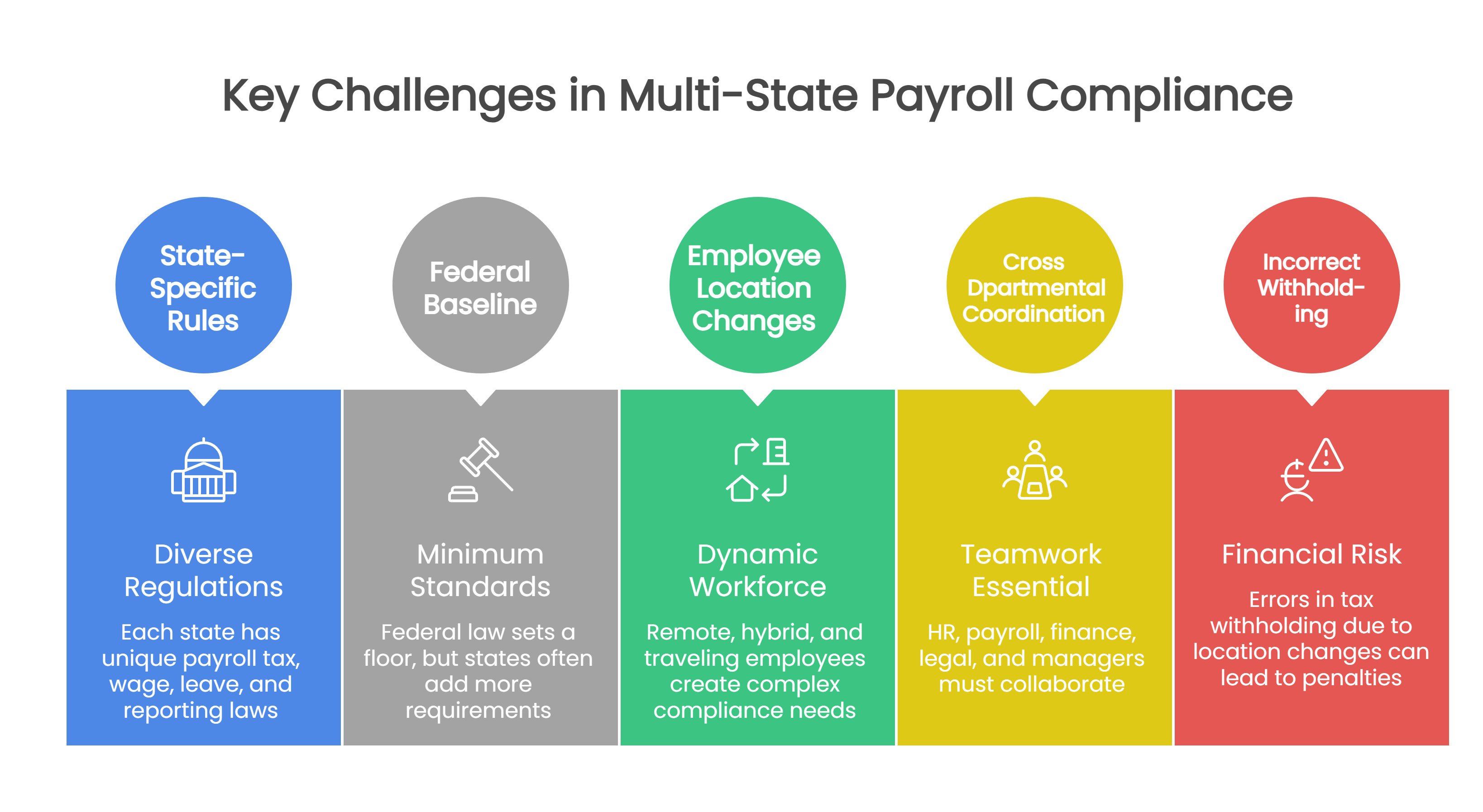
Multi-state payroll compliance is challenging because each state can set its own rules for payroll taxes, wage laws, leave requirements, notices, and reporting. Federal law creates a baseline for some employment rules, but states and local governments often add more requirements. Employers must understand which rules apply based on where employees work, where they live, where the company operates, and what type of work is being performed.
The challenge grows when employee work arrangements change often. A remote employee may move to another state. A hybrid employee may split time between a home office and a company location. A sales employee may work in several states during the year. Each of these situations can affect payroll setup, tax withholding, unemployment insurance, and labor law compliance.
Multi-state payroll also requires strong coordination between HR, payroll, finance, legal, and managers. If a manager approves a remote work arrangement but payroll is not updated, the company may continue withholding taxes for the wrong location. If HR updates an employee address but does not confirm the true work location, the payroll setup may still be wrong.
What Payroll Tax Issues Affect Multi-State Employers?
Multi-state employers may need to manage state payroll tax registration, state income tax withholding, unemployment insurance, local taxes, payroll tax deposits, and payroll reporting. The IRS explains that employers are responsible for withholding, depositing, reporting, and paying federal employment taxes, but state and local payroll rules must also be handled where applicable. If you want a deeper look at how registration, withholding, and nexus issues work across state lines, see our article Multi-State Payroll Tax Compliance: A Guide for Employers.
For 2026, federal payroll compliance still includes Social Security, Medicare, federal income tax withholding, and federal unemployment tax responsibilities. IRS Publication 15 lists the 2026 Social Security tax rate as 6.2% for both the employer and employee, with a Social Security wage base limit of $184,500, while Medicare tax is 1.45% for both the employer and employee with no wage base limit. (IRS)
State payroll tax compliance is where complexity often increases. An employee working in a new state may require the employer to register for state income tax withholding, unemployment insurance, and other state-specific programs. Some states and local areas may also have special payroll-related taxes, disability insurance rules, paid family leave contributions, or local withholding requirements.
Payroll tax items to review:
- State income tax withholding
- State unemployment insurance
- Local payroll or occupational taxes
- Disability insurance or paid leave contributions
- State payroll tax deposit schedules
- Quarterly wage reporting
- Employee work location tracking
- Resident and nonresident withholding rules
- Reciprocity agreements between states
- Remote work approval workflows
How Do State Payroll Tax Registration Requirements Create Risk?
State payroll tax registration creates risk because employers may need to register before they can correctly withhold, deposit, and report payroll taxes in a new state. This often becomes an issue when a company hires its first employee in a state where it has not operated before. It can also happen when an existing employee moves to a new state and starts working remotely.
Employers should not assume that payroll can simply continue through the company’s home state setup. In many cases, payroll tax accounts must be created with the state before wages are reported there. If registration happens late, the employer may need to correct prior payrolls, amend reports, or respond to state agency notices.
This is why remote work requests should include a payroll review before approval. HR and managers should know when a new work location creates payroll tax or labor law obligations. A simple “yes” to working from another state can create new compliance steps behind the scenes.
Best practice: Build a workflow that requires HR, payroll, and leadership review before approving an employee’s permanent work location in a new state.
How Do Income Tax Withholding Rules Vary by State?
Income tax withholding rules vary by state because some states tax wages based on where the employee works, where the employee lives, or both. Some states have no state income tax, while others require withholding for resident and nonresident employees. Some neighboring states also have reciprocity agreements that may change how withholding works.
This can be confusing for employers with hybrid or remote employees. For example, an employee may live in one state and work in another. Another employee may work remotely from a different state than the company office. A third employee may split time across multiple states. Each situation may require a different withholding setup.
Employers should also watch for states with special remote work tax rules. Some states apply “convenience of the employer” concepts, which may affect whether wages are taxed based on the employer’s location instead of only the employee’s physical work location. Multi-state tax situations can become complex, so employers should work with a qualified payroll tax or legal advisor when they are unsure.
How Does Unemployment Insurance Work for Multi-State Employees?
Unemployment insurance can become complex for multi-state employees because wages usually need to be reported to the correct state unemployment agency. The correct state may depend on where the employee performs work, where the employee is based, where direction and control occur, or other state-specific rules. Employers should not guess when work crosses state lines.
Unemployment setup also matters because state unemployment tax rates, wage bases, registration steps, and reporting requirements can vary. A company may need to register with a new state workforce agency before reporting wages for employees located there. Late setup can create filing problems, notices, or corrections.
A good payroll compliance process should flag employees who live or work outside the company’s existing states. This allows payroll to confirm whether a new unemployment account, state withholding account, or local tax setup is needed. It also helps finance plan for different state unemployment costs.
How Do Wage and Hour Laws Vary by State?
Wage and hour laws vary by state because states and local governments may have their own minimum wage, overtime, meal break, rest break, wage statement, final pay, and recordkeeping rules. The Fair Labor Standards Act sets federal standards for covered employers, including minimum wage, overtime, recordkeeping, and youth employment rules. (DOL)
Under the FLSA, covered nonexempt employees must generally receive overtime pay of at least one and one-half times their regular rate of pay for hours worked over 40 in a workweek. But employers must also check state and local rules because some jurisdictions have stricter requirements. State or local minimum wage rates may be higher than the federal minimum wage, and some locations may have different rules for breaks, deductions, or daily overtime.
This is especially important for employers with hourly employees in multiple states. A timekeeping rule that works in one state may not be enough in another. Employers should review wage and hour compliance by employee location, not just by company policy.
Wage and hour items to compare by state:
- Minimum wage
- Overtime rules
- Meal and rest breaks
- Time rounding rules
- Travel time
- On-call time
- Pay deductions
- Wage statement requirements
- Final pay deadlines
- Recordkeeping requirements
What Risks Come With Remote Employees?
Remote employees create risk when employers do not track where work is actually being performed. A remote employee’s physical work location can affect payroll taxes, unemployment insurance, wage and hour rules, leave eligibility, workers’ compensation, workplace notices, and required policies. This is why employee address and employee work location should not be treated as the same thing.
For example, an employee may have a mailing address in one state but work most of the time from another state. Another employee may temporarily work from a second home or from a different state during the summer. If the employer does not know this, payroll may withhold the wrong taxes or miss a state-specific requirement.
Remote work also creates process risk. If employees can move or work from another state without approval, payroll may not know when a new state obligation begins. Employers should create a clear remote work policy that explains when employees must report a location change and who must approve it.
Remote work payroll checklist:
- Track physical work location
- Require approval before out-of-state work
- Update payroll tax setup before the move
- Review state wage and hour rules
- Confirm workers’ compensation coverage
- Review state leave and sick time rules
- Provide required notices
- Keep address and work location fields current
- Audit remote employee locations regularly
What Paid Leave and Sick Leave Rules Should Multi-State Employers Watch?
Multi-state employers should watch paid sick leave, paid family and medical leave, PTO payout, disability leave, pregnancy accommodations, and state-specific protected leave rules. Leave rules can vary widely by state and sometimes by city or county. A company-wide leave policy may not be enough if employees work in multiple jurisdictions.
A common mistake is applying one home-state leave policy to all employees. This can create risk if another state gives employees more protected time, different accrual rules, different notice requirements, or different payout rules. Employers should review each employee’s work location and confirm which leave rules apply.
Leave compliance also depends on accurate tracking. Employers should know how time off accrues, how it is used, how balances are shown, and how leave interacts with payroll. If HR and payroll systems are not connected, leave balances and pay may not match.

How Do Wage Statements and Final Pay Rules Create Risk?
Wage statements and final pay rules create risk because state requirements can be very specific and may differ from the employer’s home-state process. Some states require pay stubs to include certain details, such as hours worked, pay rates, deductions, employer information, accrued sick leave, or pay period dates. If payroll systems are not configured by state, pay statements may be missing required information.
Final pay rules can also vary. Some states require final wages to be paid immediately after an involuntary termination, while others allow payment by the next regular payday or within a set number of days. Rules may also differ depending on whether the employee resigned or was terminated.
This is an area where managers and payroll must stay aligned. If a manager terminates an employee without notifying payroll in time, final pay deadlines may be missed. Employers should create a termination workflow that alerts payroll immediately and includes state-specific final pay requirements.
How Can Employers Avoid Multi-State Payroll Mistakes?
Employers can avoid multi-state payroll mistakes by creating a clear process for employee location tracking, state registration, payroll setup, wage rule review, and ongoing audits. The most important step is to stop treating multi-state payroll as a one-time setup. It should be managed as an ongoing compliance process.
Start by creating a list of all states where employees currently work. Then confirm whether the company is properly registered for state withholding, unemployment insurance, and any other payroll-related programs in those states. Next, review whether payroll is applying the correct state and local tax rules, wage and hour rules, paid leave rules, and final pay requirements.
Employers should also create a “new state” workflow. Before hiring in a new state or approving remote work from a new state, HR and payroll should review the compliance impact. This helps prevent late registrations, incorrect withholding, missed notices, and rushed payroll corrections.
Multi-state payroll prevention checklist:
- Keep a current list of employee work locations
- Require remote work location approval
- Confirm state payroll tax registration
- Review income tax withholding rules
- Confirm unemployment insurance setup
- Check local tax obligations
- Review wage and hour rules by state
- Configure wage statements by state
- Review paid leave and sick leave rules
- Create a state-specific termination checklist
- Audit payroll setup quarterly
- Work with qualified advisors when rules are unclear
What Systems Help Manage Multi-State Payroll Compliance?
Payroll, HR, time tracking, benefits, and reporting systems can help manage multi-state payroll compliance when they are properly configured and connected. A payroll system should support state and local tax setup, employee work locations, pay rules, deductions, reporting, and year-end forms. If you are comparing platforms, our article Best Payroll Software for Multi-State Businesses is a helpful next step because it breaks down what to look for in a system that can support multi-state payroll. But software alone is not enough. The system still needs accurate data, clear processes, and knowledgeable support.
Time tracking is especially important for hourly and nonexempt employees. Employers need accurate records of hours worked, overtime, breaks, approvals, and corrections. The Department of Labor states that employers covered by the FLSA must keep employee time and pay records.
HR systems also help by keeping employee records, policies, acknowledgments, leave balances, and work locations organized. Reporting tools can help employers spot missing data, unusual payroll changes, overtime spikes, or employees working in new locations. Integrations can reduce duplicate entry, but they should be audited regularly to make sure data moves correctly between systems.
Systems that support multi-state payroll compliance:
- Payroll and tax management
- HR administration
- Time and attendance
- Workforce scheduling
- Benefits administration
- Leave tracking
- Document management
- Reporting and analytics
- Accounting and general ledger integrations
- Employee self-service
- Payroll & Tax Management
- HR Administration
- Workforce Management & Time Tracking
- HR, Payroll & Workforce Analytics
- Integrations
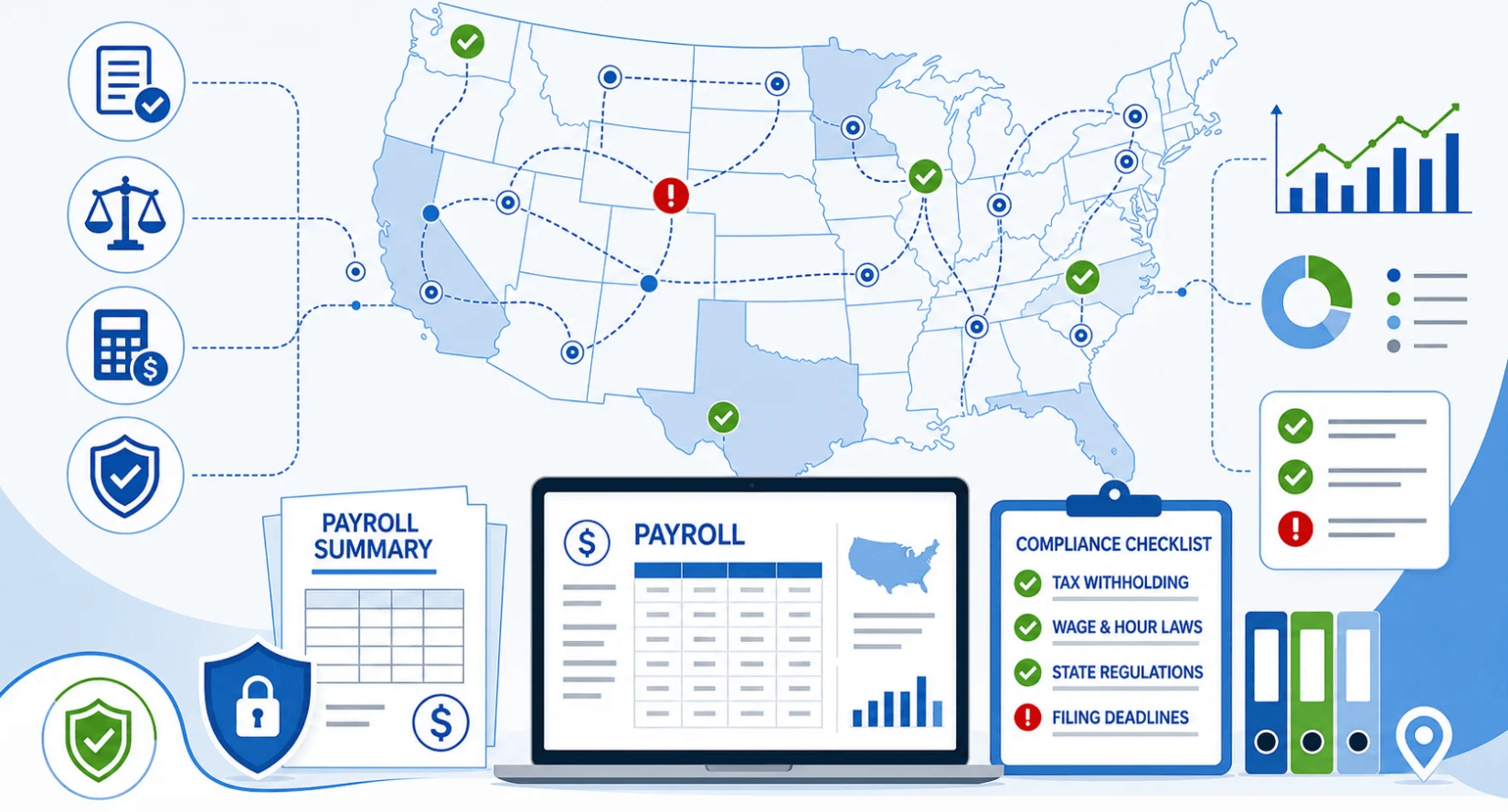
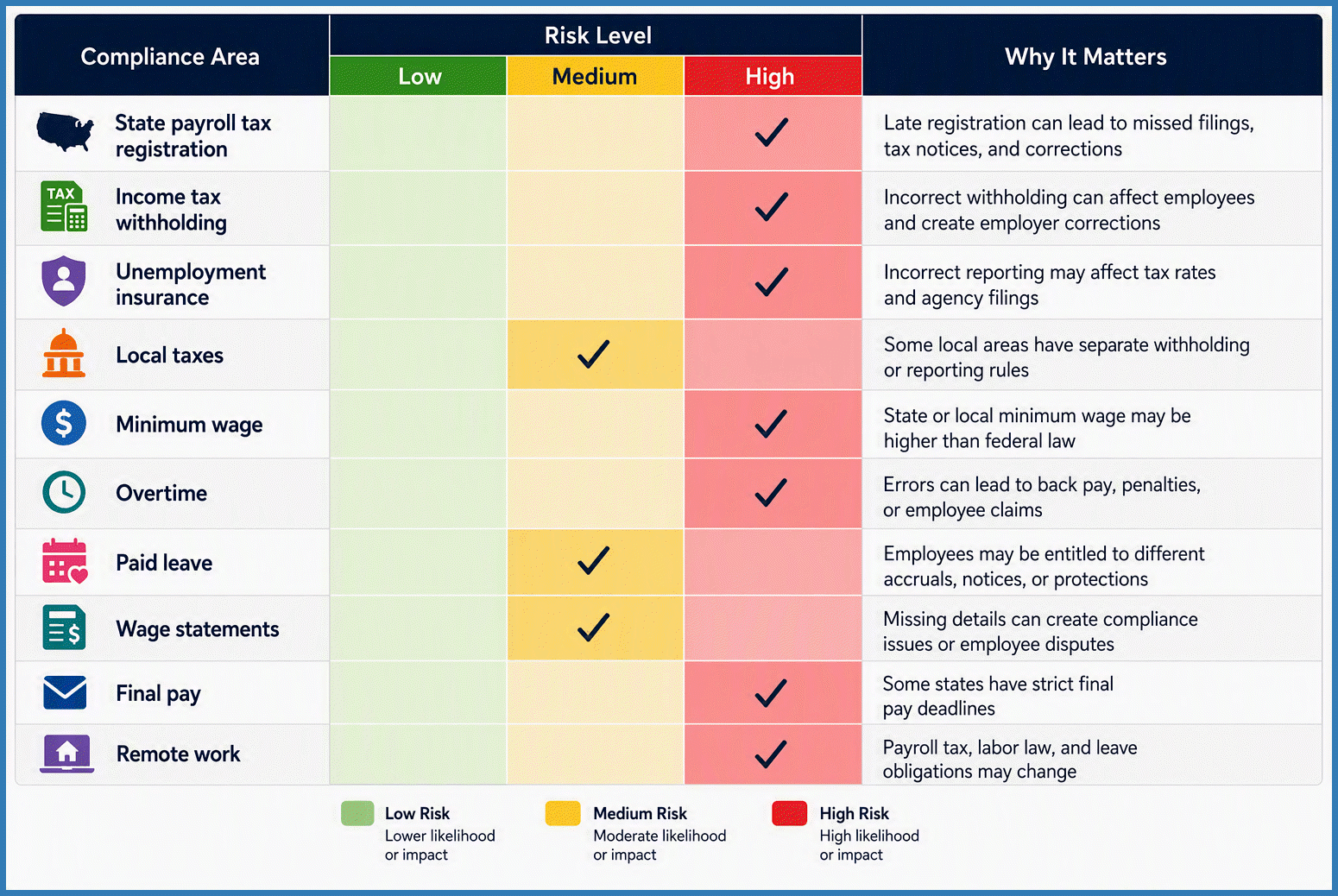
Multi-State Payroll Compliance Risk Matrix
A risk matrix can help employers identify which payroll issues need the most urgent attention. The goal is not to scare employers. The goal is to make complex requirements easier to prioritize.
What Should Employers Do Before Hiring in a New State?
Employers should review payroll tax registration, withholding, unemployment insurance, wage laws, leave rules, required notices, workers’ compensation, and payroll system setup before hiring in a new state. Hiring first and reviewing compliance later can create unnecessary cleanup work. A simple pre-hire checklist can prevent many common errors.
Before the employee starts, confirm whether the company needs new state tax accounts. Review whether the employee’s role is exempt or nonexempt under applicable rules. Confirm minimum wage, overtime, leave, final pay, and wage statement rules. Also make sure onboarding documents and workplace notices are accurate for that employee’s location.
This process does not need to be complicated, but it does need ownership. Decide who reviews new-state hiring requests, who sets up payroll tax accounts, who updates policies, and who confirms the payroll system is ready. This helps hiring teams move faster without skipping key compliance steps.
Q&A: Multi-State Payroll Compliance
Does an Employer Need to Register Payroll in Every State Where Employees Work?
An employer may need to register for payroll taxes in states where employees perform work, but the answer depends on the state and the employee’s work arrangement. Registration may include income tax withholding, unemployment insurance, paid leave contributions, or other state-specific programs. Employers should confirm requirements before hiring or approving remote work in a new state.
Which State Taxes Apply to Remote Employees?
Remote employee payroll taxes often depend on where the employee works, where the employee lives, and whether any special state rules or reciprocity agreements apply. Some situations are simple, while others can involve multiple states. Employers should review each remote employee’s work location before setting up payroll.
What Happens If Payroll Withholding Is Set Up for the Wrong State?
If payroll withholding is set up for the wrong state, the employer may need to correct payroll records, amend filings, adjust tax deposits, or respond to agency notices. Employees may also face tax filing confusion. The best way to prevent this is to track work locations and review payroll setup before an employee starts working from a new state.
How Often Should Employers Audit Multi-State Payroll?
Employers should audit multi-state payroll at least quarterly and whenever an employee changes work locations, the company hires in a new state, or state rules change. A quarterly review can help catch incorrect addresses, missing tax accounts, local tax issues, and wage rule problems before year-end.
Do Wage and Hour Rules Change by State?
Yes, wage and hour rules can change by state and sometimes by city or county. Employers should review minimum wage, overtime, meal breaks, rest breaks, pay deductions, final pay, and wage statement rules by employee location. Federal rules may set the baseline, but state or local rules may be stricter.
Can Payroll Software Solve Multi-State Compliance?
Payroll software can help manage multi-state payroll compliance, but it does not replace accurate setup, clear processes, or expert guidance. Employers still need to know where employees work, register in the right states, configure pay rules correctly, and review compliance regularly. Software works best when paired with strong payroll and HR support.
Build a Stronger Payroll Compliance Process Before You Expand
Multi-state payroll compliance has become more common because businesses now hire across state lines, support remote work, and manage hybrid teams. In the past, many employers only had to think about payroll rules in one state. Today, a single remote employee can create new payroll tax, wage, leave, notice, and reporting obligations.
Now, you understand why multi-state payroll compliance is more complex than running payroll in one location. You know how to review state payroll tax registration, income tax withholding, unemployment insurance, local taxes, wage and hour rules, paid leave, wage statements, final pay, and remote work policies. You also know that the biggest risk is often not one major mistake. It is a series of small, missed steps that add up over time.
At Lift HCM, we help employers simplify payroll and HR, reduce manual work, and build clearer processes for managing compliance across locations. Our payroll, HR administration, workforce management, analytics, and integration solutions help businesses keep employee data organized, payroll processes accurate, and teams better informed.
If your business is hiring across state lines or managing remote employees, contact Lift HCM to review how your payroll and HR process can better support multi-state compliance.