

Background checks feel like a routine part of hiring — a standard step before extending a job offer. But the legal framework governing what you can ask, when you can ask it, and what you can do with the results is anything but routine. It's a layered patchwork of federal law, state law, and local ordinances that varies dramatically depending on where your employee will work.
At Lift HCM, we work with HR teams and hiring managers every day who are trying to build fair, fast, and legally defensible hiring processes. We understand that employers want to screen candidates thoroughly, and they also want to make sure they're not accidentally violating a ban-the-box ordinance they didn't know existed, or using a criminal record that's been legally sealed. That tension is real, and this guide is designed to resolve it.
This article gives you a straight, honest look at the full background check compliance picture in 2026, what the FCRA requires, how ban-the-box laws work, what's changing this year, and exactly what to do before and after you run a background check. We'll also be specific about how Illinois law applies. By the end, you'll know how to build a process that's both thorough and legally sound.
Updated October 2026: An earlier version said Texas enacted a statewide ban-the-box law. That bill (HB 2466) did not pass. We've corrected the Texas section.
Table of Contents
-
Ban-the-Box and Background Check Laws: State-by-State Overview (2026)
-
How Should Employers Build a Compliant Background Check Process?
What Does Federal Law (FCRA) Require for All Employers?
The Fair Credit Reporting Act (FCRA) is the federal law that establishes baseline requirements for any employer that uses a third-party consumer reporting agency (CRA) to conduct employment background checks. These requirements apply nationwide, regardless of state law.
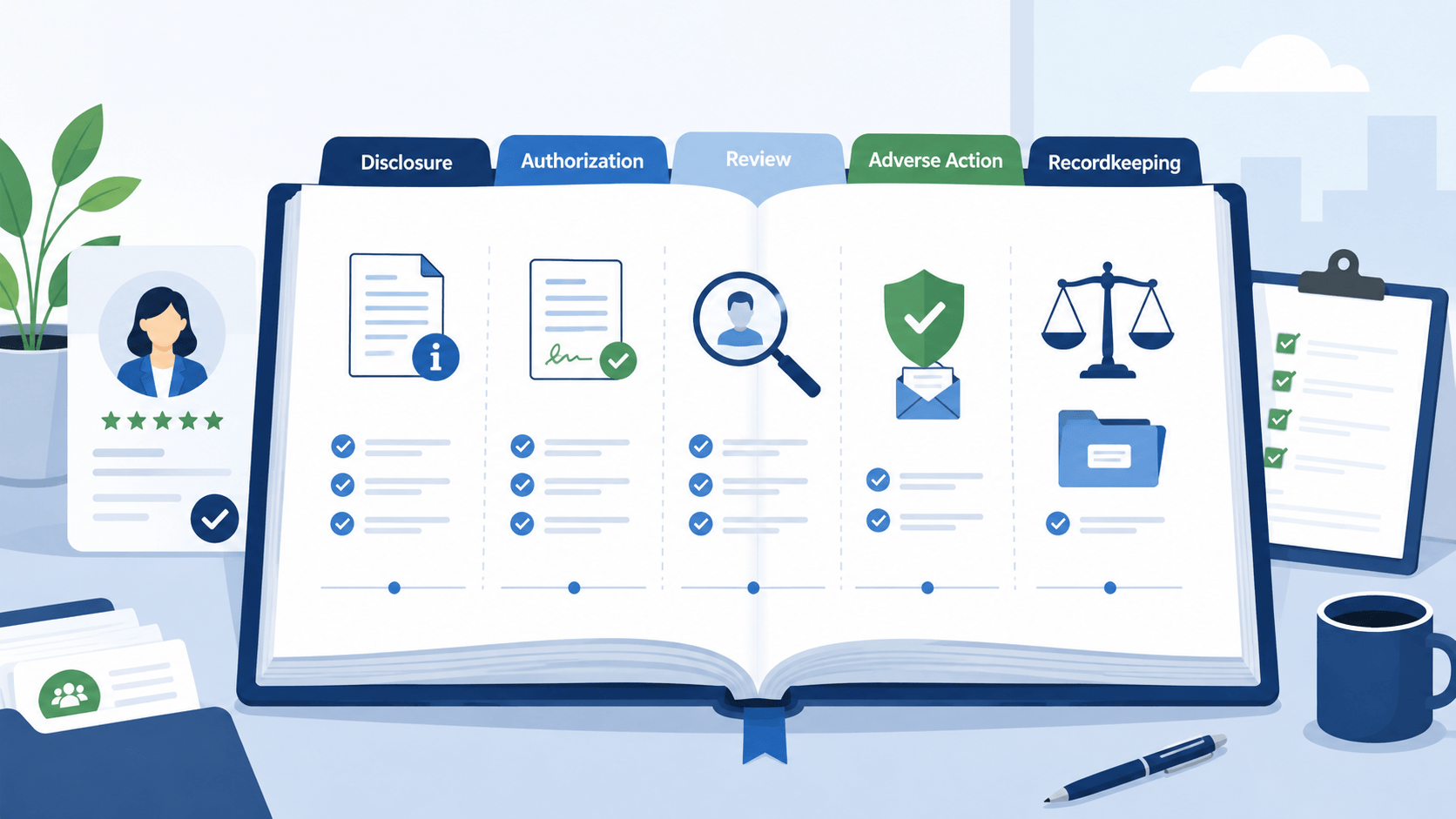
Before Conducting a Background Check
-
Provide a clear, conspicuous written disclosure to the applicant that a consumer report may be obtained for employment purposes
-
The disclosure must be a standalone document — it cannot be buried in an employment application or other paperwork
-
Obtain the applicant's written authorization to conduct the background check
Before Taking Adverse Action Based on a Report
If you intend to deny employment, rescind an offer, or take any adverse action based on background check results, the FCRA requires a two-step adverse action process:
Step 1 Pre-Adverse Action Notice: Provide the applicant with a copy of the consumer report, a summary of their FCRA rights, and a reasonable amount of time (typically 5 business days) to review and respond.
Step 2 Final Adverse Action Notice: After the waiting period, if you proceed, provide a final notice including the CRA name/address/phone, a statement that the CRA did not make the hiring decision, and the applicant's right to dispute the information.
📋 EEOC Guidance: Individualized Assessment Required
Beyond the FCRA, EEOC guidance requires employers to conduct an individualized assessment before making adverse decisions based on criminal history. This means considering the nature of the offense, how much time has passed, and whether the conviction is directly related to the job's responsibilities. Blanket "no criminal history" policies expose employers to discrimination claims.
What Is a Ban-the-Box Law?
Ban-the-box laws restrict when employers can ask about criminal history during the hiring process. The name comes from the checkbox on job applications that asked applicants to declare criminal convictions. These laws typically require employers to:
- Remove criminal history questions from job applications
- Delay any criminal history inquiry until after the initial interview, a conditional offer, or a later specified stage
- Conduct an individualized assessment before denying employment based on criminal history
As of 2026, more than 37 states and nearly 200 cities and counties have adopted some form of ban-the-box or fair chance hiring policy. The scope, timing requirements, and employer size thresholds vary significantly.
Federal Fair Chance Act
The federal Fair Chance to Compete for Jobs Act, in effect since December 2021, applies to federal agencies and to private employers with federal contracts. Covered employers may not ask about an applicant's arrest or conviction history until after a conditional job offer. Exceptions apply when another law requires an earlier background check, and for law enforcement, national security, and positions requiring access to classified information. Most private employers aren't covered by this law unless they hold federal contracts, so state and local rules usually matter more.
State and Local Laws Go Further
Many state and local ban-the-box laws apply to all employers (not just government contractors), cover smaller businesses, and impose stricter requirements on timing, notice, and remediation. Always check the law of the state or city where the employee will physically work.
Ban-the-Box and Background Check Laws: State-by-State Overview (2026)
The table below outlines background check and ban-the-box requirements for key states. Note that many states have additional local ordinances that may impose stricter requirements than the state-level law.
|
State |
Ban-the-Box? |
Timing |
Key Notes |
|
California |
Yes (employers 5+) |
After conditional offer |
Clean Slate Law (SB 731) seals eligible felonies & many misdemeanors automatically. Arrest records without conviction generally cannot be considered. |
|
Colorado |
Yes (all private employers) |
Not on initial application |
Chance to Compete Act; covers all employers since Sept. 1, 2021. Employers may state that a background check may be conducted after a conditional offer. |
|
Connecticut |
Yes (all employers) |
Not on initial application |
Erased records can't be requested or used. Clean Slate automatically erases many older misdemeanors and low-level felonies. |
|
D.C. |
Yes (employers 11+) |
After conditional offer |
Second Chance Amendment Act: automatic expungement and sealing phasing in through 2027. |
|
Florida |
No statewide law |
No state restriction |
No statewide ban-the-box. Some local ordinances may apply. FCRA still applies. |
|
Georgia |
No statewide law |
No state restriction |
Atlanta prohibits criminal-history discrimination by employers with 10+ employees. |
|
Illinois |
Yes (employers 15+) |
After interview or conditional offer |
Job Opportunities for Qualified Applicants Act. Arrest records (without conviction) prohibited. Convictions must be substantially related to position duties. |
|
Louisiana |
Partial |
After interview (public employers only) |
Public-employer ban-the-box only. Act 406 requires employers with 20+ employees to use individualized assessments and excludes non-conviction arrest records. Private employers have no application-stage timing restriction. |
|
Maryland |
Yes (5+ full-time employees) |
At first in-person interview |
Criminal Record Screening Practices Act, eff. Feb. 29, 2020. |
|
Massachusetts |
Yes (most employers) |
Not on initial application |
Can't ask about misdemeanors more than 3 years old, non-conviction arrests, or sealed records. |
|
Michigan |
No statewide law (public employers only) |
No state restriction |
Can't request or keep records of misdemeanor arrests without conviction. Clean Slate automatically sets aside eligible convictions. |
|
Minnesota |
Yes (all employers) |
After selected for interview or conditional offer |
Cannot inquire before interview. Cannot use arrest records without conviction. |
|
New Jersey |
Yes (employers 15+) |
After first interview |
Opportunity to Compete Act. Must conduct individualized assessment before adverse action. |
|
New York |
No statewide timing law |
Varies by locality |
Article 23-A individualized assessment (10+). NYC: after conditional offer (4+). Clean Slate Act automatically seals eligible records |
|
Ohio |
No statewide law |
No state restriction |
Public employers only (ORC 9.73). Cleveland/Columbus rules cover city jobs. Check Cincinnati separately. |
|
Pennsylvania |
Partial (Philadelphia) |
After conditional offer (Phila.) |
Philadelphia FCRSS (eff. Jan. 6, 2026): felony lookback 7 years, misdemeanor lookback 4 years, 10 days for applicant response before final decision. PA Clean Slate expanded sealing for certain drug felonies (eff. Feb. 2024). |
|
Texas |
No statewide law |
No statewide ban-the-box law for private employers. |
HB 2466 (2025) would have covered employers with 15+ employees but died in committee. Austin has a local fair chance hiring ordinance. Texas Business & Commerce Code limits what background check companies can report to 7 years for some records. |
|
Virginia |
Public employers only |
No state restriction for private employers |
Record-sealing law eff. July 1, 2026: automatic sealing of eligible misdemeanors; petition sealing for some Class 5/6 felonies. Employers can't require disclosure of sealed records. |
|
Washington |
Yes (15+ now; all employers Jan. 1, 2027) |
After conditional offer |
Effective July 1, 2026, for medium and large employers, with smaller employers following in 2027. Removes criminal history from applications, delays inquiry until after a conditional offer, requires individualized assessments, and applies to internal promotions. |
|
Wisconsin |
|
|
No ban-the-box for private employers, but the WFEA prohibits arrest/conviction discrimination unless substantially related to the job. |
What's Changing in Background Check Law in 2026?
Several notable developments are reshaping background check compliance in 2026 and beyond.
Philadelphia: Amended Fair Criminal Record Screening Standards (Effective January 6, 2026)
Philadelphia further narrowed what criminal history employers can consider when hiring and managing employees:
-
Misdemeanor lookback reduced from 7 years to 4 years. The felony lookback stays at 7 years.
-
Summary offenses can't be considered at all.
-
Before any final decision, employers must give written notice that identifies the criminal history relied on, explains the applicant's rights, and allows 10 days to respond with evidence of errors or rehabilitation.
-
Any adverse action taken within 90 days after an individual exercises their rights is presumed to be retaliation, unless the employer shows good faith.
-
The ordinance applies to applicants, current employees, and independent contractors.
Texas: No Statewide Ban-the-Box Law
Texas does not have a statewide ban-the-box law for private employers. House Bill 2466 was introduced in 2025 but never advanced past the House Workforce Subcommittee, and it expired when the session ended. Texas employers should still check local rules, such as Austin's fair chance hiring ordinance, and follow federal FCRA requirements and EEOC guidance on criminal records.
Washington State: Strengthened Fair Chance Hiring (Effective July 1, 2026)
Amendments to Washington's Fair Chance Act took effect July 1, 2026, for employers with 15 or more employees. Employers with fewer than 15 employees must comply starting January 1, 2027. Requirements include:
- No criminal history questions on job applications
- No criminal history inquiry or background check until after a conditional job offer
- Written notice and a waiting period before any adverse decision based on criminal history
- Coverage of current employees, including internal promotions and role changes
Virginia: Record Sealing Law (Effective July 1, 2026)
Virginia's new record-sealing law took effect July 1, 2026. Eligible misdemeanor convictions, such as petit larceny and trespass, are now sealed automatically after the required waiting period. Some Class 5 and 6 felonies can be sealed by petition. Once a record is sealed, employers can't require an applicant to disclose it, and they shouldn't consider it if it shows up on a background check report.
Pennsylvania: Expanded Clean Slate (Effective 2024)
Pennsylvania's expanded Clean Slate law (Act 36 of 2023) took effect February 12, 2024, and its automatic sealing provisions began June 11, 2024. The law now automatically seals certain lower-level drug felonies after 10 conviction-free years. It also shortened the waiting periods to 7 years for eligible misdemeanors and 5 years for summary offenses. Employers should confirm their background check vendors are filtering out newly sealed records.
⚠️ Remote Work Creates New Complexity
If you have remote employees, you must follow the background check laws of the state and city where those employees physically work — not where your company is headquartered. A company based in Texas with remote employees in California and New York must follow California and New York background check rules for those employees.
How Should Employers Build a Compliant Background Check Process?
Given the complexity of layered federal, state, and local requirements, a defensible background check process typically includes these elements:
- Use a compliant CRA: Choose a screening vendor familiar with current law, maintains updated filtering for sealed records, and produces location-specific reports based on where employees physically work.
- Map your compliance obligations by work location: The laws of the state or city where the employee physically works govern your screening process-not your headquarters location.
- Remove criminal history from applications: Even where not legally required, removing the criminal history checkbox reduces the risk of violations and demonstrates good-faith fair hiring.
- Delay criminal history inquiry to the appropriate stage: At minimum, wait until after an interview. In ban-the-box jurisdictions, wait until after a conditional offer.
- Conduct an individualized assessment before adverse action: Document consideration of the nature of the offense, elapsed time, and job-relatedness-never rely on a blanket policy.
- Follow the two-step FCRA adverse action process: Pre-adverse notice with the report, waiting period, then final adverse action notice with dispute rights.
- Train hiring managers: The most common violations happen because a hiring manager asks about criminal history informally during an interview.
- Audit your vendor: Confirm your CRA is excluding sealed, expunged, and legally non-reportable records-particularly in Pennsylvania, Virginia, California, Michigan, and D.C.
.png)
Background Check Compliance for Illinois Employers
Illinois employers must comply with several overlapping requirements:
- Job Opportunities for Qualified Applicants Act: Employers with 15 or more employees must remove criminal history inquiries from applications and delay them until after the initial interview or conditional offer.
- Illinois Human Rights Act: Arrest records that did not result in convictions generally cannot be used as the basis for employment decisions. Convictions may be considered only when substantially related to the duties of the position.
- Illinois Genetic Information Privacy Act: Employers cannot require, request, or use genetic information in employment decisions.
- Chicago Fair Chance: Chicago has additional local requirements-employers operating in Chicago should verify current Chicago ordinance requirements separately.
The Bottom Line on Background Check Compliance in 2026
Background check compliance in 2026 is more complex than it was even three years ago. Clean slate laws are sealing records that previously showed up in reports. New ban-the-box laws are raising the bar on timing and documentation. And the FCRA's adverse action process remains one of the most frequently violated compliance obligations in hiring.
The good news: most of these requirements can be systematized. With the right screening vendor, a compliant hiring workflow, trained managers, and documented individualized assessment procedures, background check compliance becomes a repeatable process rather than a legal minefield.
At Lift HCM, we help Illinois employers build compliant hiring processes that integrate with onboarding and payroll from day one. Because getting the hire right, legally and practically, starts well before someone's first paycheck.
Questions about background check compliance in Illinois or across your workforce? Contact Lift HCM, we can connect you with the right resources and review how your onboarding process handles compliance screening!








.png?width=1536&height=1024&name=Create%20a%20background%20that%20reads%2c%20How%20Long%20to%20Keep%20P%20(1).png)