

Knowing a law changed is one thing. Actually implementing it-updating your policies, training your managers, notifying your employees, and making sure your systems reflect the new requirements, is another. As we navigate further into 2026, many Illinois employers still have gaps they don’t know about.
At Lift HCM, we work alongside Illinois HR teams and business owners every day. We see firsthand where implementation breaks down — not because employers don’t care, but because the “how” is rarely spelled out alongside the “what.”
This guide doesn’t rehash what changed. It tells you exactly how to implement each 2026 Illinois employment law requirement, including what to communicate to your employees and what’s at stake if these items are still on your to-do list.
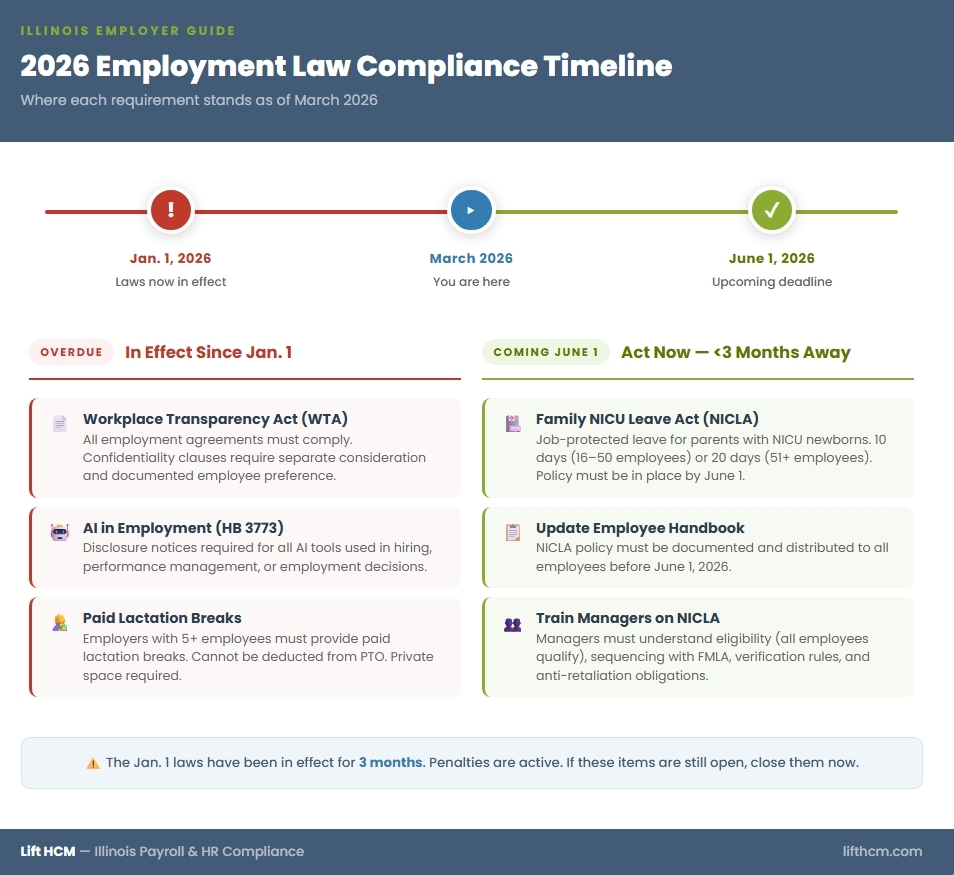
Table of Contents
-
Illinois Workplace Transparency Act (WTA): How to Bring Your Agreements Into Compliance
-
AI in Employment (HB 3773): How to Audit Your Tools and Draft Compliant Notices
-
Paid Lactation Breaks: How to Update Your Policy, Payroll, and Workspace
-
Family NICU Leave Act (NICLA): How to Get Your Policy in Place Before June 1
Illinois Workplace Transparency Act (WTA): How to Bring Your Agreements Into Compliance
📅 In Effect Since January 1, 2026
Any employment, severance, or settlement agreement signed, modified, or extended on or after January 1, 2026 must comply. Agreements that predate January 1, 2026 are not retroactively affected, but any modification triggers full compliance.
⚠️ What’s at Stake
Non-compliant confidentiality clauses may be entirely unenforceable, meaning you paid for protection you can’t use. Employees can file a Workplace Transparency Act (WTA) violation claim seeking consequential damages on top of attorneys’ fees. There is no cap on consequential damages under the Act.
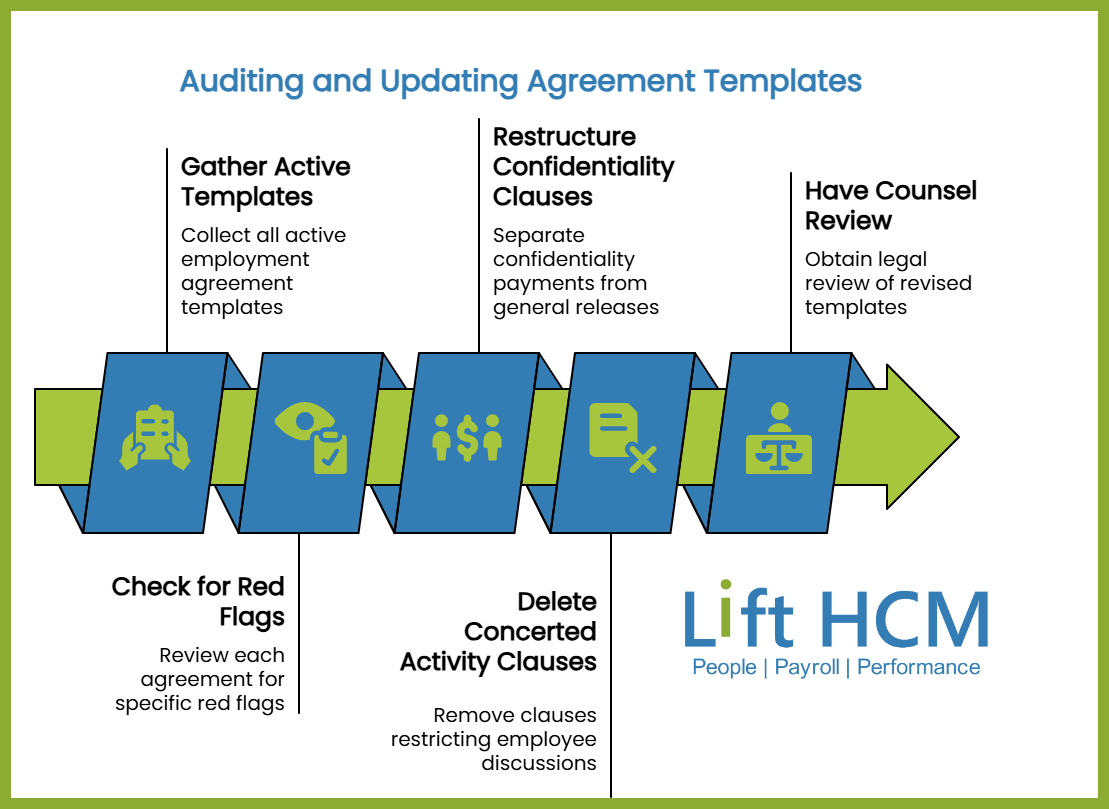
Step 1: Pull Every Active Template
Gather and audit all of your employment offer letters, separation agreements, settlement agreements, and NDAs. If your legal team or outside counsel has versions, get those too, template drift is common and creates compliance gaps you may not know exist.
Step 2: Check for These Four Red Flags
Review each agreement for:
- A confidentiality clause bundled into a lump-sum payment with no separate allocation
- Language restricting wage discussions, collective grievances, or organizing activity
- Any clause requiring application of another state's law to Illinois employees
- Any clause requiring arbitration or dispute resolution outside Illinois
Step 3: Restructure Confidentiality Clauses
For confidentiality provisions you want to keep, the payment must be restructured so the confidentiality portion has its own explicitly stated dollar amount, separate from any general release payment. The employee must also affirmatively choose the confidentiality provision in writing. A form that simply states "confidentiality is the employee's preference" without genuine employee choice won't hold up.
Step 4: Delete Concerted Activity Restrictions
Any language prohibiting employees from discussing wages, working conditions, or joining together to raise workplace concerns is void under the WTA regardless of what else the agreement says. Remove it entirely, don't try to soften or reword it.
Step 5: Have Counsel Review Before You Use Them
The cost of a legal review is far less than the cost of an unenforceable agreement or a WTA claim. Don't use revised templates until they've been reviewed.
What to Tell Your Employees
For employees signing new or modified agreements, a brief explanation satisfies the "documented preference" requirement and builds trust:
Suggested language: "As part of this agreement, there is a confidentiality provision in Section [X]. Illinois law requires that this be your documented choice-not something we can require. The confidentiality provision is supported by a separate payment of $[amount]. If you prefer not to include confidentiality, that option is available. Please let us know your preference in writing."
No company-wide announcement is required for your broader workforce, but if you've historically used NDAs in employment offers, brief your managers so they understand they cannot pressure employees to accept confidentiality terms.
AI in Employment (HB 3773): How to Audit Your Tools and Draft Compliant Notices
📅 In Effect Since January 1, 2026: Final IDHR rules are still pending as of March 2026. Don't wait for them-implement based on proposed guidance now.
⚠️ What’s at Stake: Failure to disclose AI use is a civil rights violation under the Illinois Human Rights Act, with no penalty cap. Using AI with discriminatory effects-even unintentionally-carries the same exposure as intentional discrimination.
Step 1: Inventory Every AI Tool You Use
Illinois defines AI broadly. If a tool uses any automated logic to screen, score, rank, or recommend decisions about people, it likely qualifies. Contact each vendor and ask in writing: does this product use automated filtering, scoring, or pattern recognition to process information about employees or applicants?
|
Tool Category |
Ask Your Vendor |
|
Does it automatically filter, rank, or score candidates based on any criteria? |
|
|
Video interview platform |
Does it analyze speech, tone, facial expressions, or keyword frequency? |
|
Resume parsing software |
Does it automatically extract, categorize, or weight resume data? |
|
Does it generate automated ratings, flag employees, or inform promotion decisions? |
|
|
Does it use performance or behavioral data to make scheduling recommendations? |
If the answer to any of these is yes-or “we’re not sure”-treat it as AI and proceed accordingly. Document your vendor responses in writing.
Step 2: Draft Your AI Disclosure Notices
You need two versions-one for current employees, one for applicants. Each must include which employment decisions the AI influences, what data it uses, which positions are affected, a named contact for questions, and how to request an alternative evaluation method.
Sample-Employee Notice: "[Company Name] uses automated tools in the following employment processes: [list]. These tools analyze [data types] to assist in [decision types]. Employees in [affected roles] may be subject to AI-assisted evaluations. To ask questions or request an alternative, contact [Name] at [email/phone]."
Sample-Applicant Notice: "[Company Name] uses automated tools in its hiring process, including [tool names]. These tools assist with [screening/scoring/ranking] based on [data types]. To request an alternative evaluation method, contact [Name] at [email/phone] before or during the application process."
Step 3: Build Your Calendar
This isn't a one-time task. Once your notices are drafted:
- Employees must receive AI disclosure at least once per year
- Employees must be notified within 30 days of adopting or substantially updating an AI system
- Applicant disclosures must appear in job postings before AI is used
What to Tell Your Employees
When employees receive their first AI disclosure, some will have questions. Coach your managers to keep it simple: the notice is required by Illinois law; AI tools assist your team but don't make final decisions; and if anyone is uncomfortable, they have the right to request an alternative evaluation-here's how.
A brief, matter-of-fact conversation builds more trust than a lengthy explanation.
Paid Lactation Breaks: How to Update Your Policy, Payroll, and Workspace
📅 In Effect Since January 1, 2026: Applies to employers with 5 or more employees. The key change from prior law: breaks must now be paid at the employee’s regular rate. They cannot be deducted from PTO, vacation, or sick leave.
⚠️ What’s at Stake
Requiring an employee to use PTO for lactation breaks, reducing their pay during break time, or failing to provide a compliant private space are all violations of Illinois law and can constitute discrimination under the Illinois Human Rights Act. Employees may file complaints with the IDHR or pursue civil action. Retaliation against an employee for requesting or taking lactation breaks carries additional exposure.
Step 1: Update Your Written Policy
Your employee handbook or HR policy manual must reflect the 2026 requirements. Your lactation break policy should state:
- Employees may take paid breaks to express breast milk for up to one year after childbirth
- Breaks are paid at the employee’s regular rate of compensation-up to 30 minutes per session
- Lactation breaks are separate from and cannot be deducted from any PTO, vacation, or sick leave balance
- A private, non-bathroom space is available for expressing milk-include the location
- Employees will not be retaliated against for requesting or taking lactation breaks
- To arrange lactation breaks, employees should contact HR
Step 2: Update Your Payroll and Timekeeping System
This is where many employers inadvertently fall out of compliance. Check that lactation breaks are coded as paid time-not unpaid breaks or PTO. If your system auto-deducts breaks over a certain length, add an exception. Verify that lactation break time doesn't reduce recorded hours for overtime or benefits eligibility. If you use isolved, work with your payroll provider to configure a dedicated pay code.
Step 3: Confirm Your Physical Space
Your lactation space must meet these requirements:
Private-shielded from view and free from intrusion by coworkers or the public
Not a bathroom
Has a place to sit
Has access to an electrical outlet
If your current space doesn’t meet these standards, identify a solution before an employee requests one. Scrambling after a request creates both a compliance gap and a poor employee experience.
What to Tell Your Employees
Proactive communication prevents misunderstandings and builds trust. Consider sending this to all employees — not just those who may currently need it:
Suggested language: "We want to make sure all employees are aware of our updated lactation break policy. Effective January 1, 2026, Illinois law requires that breaks taken to express breast milk are paid at your regular rate-these breaks do not come out of your PTO or sick time. You are entitled to this time for up to one year after childbirth. A private space is available at [location]. If you have questions or need to make arrangements, please reach out to [HR contact]-all conversations are confidential."
Post the updated Nursing Mothers in the Workplace notice in your workplace and distribute it digitally to any remote employees.
Family NICU Leave Act (NICLA): How to Get Your Policy in Place Before June 1
⚡Effective June 1, 2026 — Action Required Now
If you have 16 or more employees, you must have a NICLA policy in place and managers trained before June 1. An employee could request NICLA leave on June 1, so you need to be ready.
⚠️ What’s at Stake
Civil penalties of up to $5,000 per affected employee, plus actual damages and attorneys’ fees. Retaliation against an employee for requesting or taking NICLA leave carries additional liability. Because NICLA covers employees who don’t qualify for FMLA — including part-time workers and newer hires — denying leave to these employees is a common and costly mistake.
Step 1: Determine Your Leave Entitlement
Count all employees — full-time, part-time, and temporary — when determining your threshold. Unlike FMLA, NICLA has no minimum tenure or hours requirement. An employee hired last week qualifies on day one.
|
Employer Size |
NICLA Entitlement |
|
15 or fewer employees |
Not covered by NICLA |
|
16–50 employees |
Up to 10 days unpaid, job-protected leave |
|
51+ employees |
Up to 20 days unpaid, job-protected leave |
Step 2: Write Your NICLA Policy
Add a NICLA section to your employee handbook before June 1. Your policy should cover eligibility (all employees, regardless of tenure or hours), the qualifying reason (newborn in a NICU), leave duration and whether it can be taken intermittently (yes, in 2-hour minimums), how it sequences with FMLA, what verification you may request, and your anti-retaliation commitment.
On verification: you may request reasonable confirmation that a NICU stay is occurring — but you cannot ask for detailed medical records, diagnoses, or treatment information.
Step 3: Train Your HR Team and Managers
Managers are typically the first point of contact when an employee needs leave. Before June 1, make sure they know who qualifies (everyone, including part-time and new hires), that they cannot deny, delay, or discourage a NICLA request, how NICLA sequences with FMLA, and who in HR to escalate to. A 30-minute briefing is enough — just document that it happened.
What to Tell Your Employees
You're not required to proactively announce NICLA, but including it in your updated handbook satisfies your obligation. For a manager who receives a NICLA request before your policy is finalized:
Suggested language: "I'm sorry to hear about your situation — please know we're here to support you. Illinois law provides job-protected leave for parents in your situation, and we'll make sure you have access to every day you're entitled to. Let me connect you with HR so we can walk through the details and get everything documented properly."
Never ask for detailed medical information about the newborn's condition. Reasonable verification means confirming the NICU stay exists — not the diagnosis or treatment plan.
Implementation Is Where Compliance Actually Happens
Understanding what the law requires is the starting point — not the finish line. The employers who are truly protected are the ones who have updated their templates, configured their systems, trained their managers, and communicated clearly with their teams. Everything else is just good intentions.
The Jan. 1 laws have been in effect for three months. NICLA arrives June 1. If open items remain on your checklist, the window to close them quietly — before an employee files a complaint or a regulator comes knocking — is narrowing.
Lift HCM has been helping Illinois small and mid-sized businesses navigate exactly this kind of compliance complexity for years. We know the laws, we know the systems, and we know what implementation actually looks like inside a 20-person restaurant group or a regional auto repair chain. This isn't general HR advice — it's specific, operational support from a team that works in your world every day.
If you're not confident your 2026 compliance is airtight, schedule a call with our team. We'll walk through where you stand, identify any gaps, and give you a clear path forward, no guesswork, no generic checklists.

Disclaimer: This guide is for informational purposes only and does not constitute legal or tax advice. Consult a qualified employment attorney or HR compliance professional for guidance specific to your business situation.









.png?width=1536&height=1024&name=Create%20a%20background%20that%20reads%2c%20How%20Long%20to%20Keep%20P%20(1).png)