

Keeping up with minimum wage requirements is one of the most fundamental and frequently changing payroll compliance obligations employers face. With rates varying by state and updating annually, staying current is critical to avoiding costly penalties and ensuring your employees are paid correctly.
At Lift HCM, we work with employers across industries every day who are navigating exactly this. Minimum wage compliance is one of the most common pain points we hear about, especially from companies operating in multiple states. We've seen firsthand what happens when rates change and payroll doesn't get updated in time, and we've helped businesses build the processes to make sure it never happens again.
This guide covers every 2026 state minimum wage and tipped wage rate, current as of March 2026, so you have a single source of truth when managing payroll compliance across your organization.
The federal minimum wage remains $7.25/hour, but most states set higher rates. This guide covers every 2026 state minimum wage and tipped wage rate across all 50 states and DC, including four mid-year increases scheduled for Alaska, DC, Oregon, and Florida.
Table of Contents
What Is the Minimum Wage?
The federal minimum wage is the baseline hourly rate that employers must pay covered, nonexempt employees across the United States. Established by the Fair Labor Standards Act (FLSA) of 1938, it has been updated by Congress periodically over the decades. The current federal rate of $7.25 per hour has been in place since 2009, more than 15 years without a federal increase.
Each state has the authority to set its own minimum wage, provided it meets or exceeds the federal floor. When a state rate is lower than the federal rate, the federal rate applies automatically for employers covered by the FLSA. Some states also tie their rates to the Consumer Price Index (CPI) and adjust annually to keep pace with inflation.
💡 Always pay the highest applicable rate. When federal and state wages differ, the higher rate governs. If you have employees working in a city with a local ordinance, that rate may be higher still. Always check for local rates in addition to state rates for every location you operate in.
Why Minimum Wage Compliance Matters in 2026
Minimum wage compliance is one of the most fundamental payroll obligations employers face and one of the most frequently changing. With rates varying by state, city, and even employer size, staying current is not optional. Underpaying employees, even accidentally, can trigger back-pay liability, state investigations, and significant civil penalties.
The federal minimum wage of $7.25 per hour has not changed since 2009, but state legislatures and ballot initiatives have continued pushing rates higher. In 2026, the majority of U.S. workers are covered by state rates well above the federal floor. Understanding which rate applies to your business and keeping your payroll system updated is a year-round responsibility.
Federal Minimum Wage: What Employers Need to Know
Current Federal Rate: $7.25/Hour
Established under the Fair Labor Standards Act (FLSA) of 1938, the federal minimum wage sets a baseline that all covered, nonexempt employees must receive. The current rate of $7.25/hour has been in effect since July 24, 2009, making it one of the longest stretches without a federal increase in the law's history.
When a state's minimum wage is lower than the federal rate (as in Georgia and Wyoming), the federal rate automatically applies for FLSA-covered employers. Five states have no state wage law at all and default entirely to federal requirements.
Federal Tipped Minimum Wage: $2.13/Hour
For tipped employees, such as servers, bartenders, and delivery drivers, the FLSA allows employers to pay a lower tipped minimum wage of $2.13/hour, provided that tips bring the employee's total earnings to at least $7.25/hour. This difference ($5.12/hour) is called the tip credit.
📌 Important: If tips do not cover the gap, the employer must make up the difference. States have widely varying rules on tip credits. Several states prohibit them entirely (see below).
Understanding Tipped Wages & the Tip Credit
A tip credit allows employers to count a portion of an employee's earned tips toward the minimum wage obligation. Here's how the federal tip credit works, including where it is not allowed:
|
Federal Tip Credit |
States Prohibiting Tip Credits |
Employer Obligation |
|
Tipped min. wage: $2.13/hr. |
Alaska, California, Minnesota, Montana, Nevada, Oregon, Washington |
If tips do not bridge the gap, the employer must pay the difference. There are no exceptions. |
No tip credit states: Employers in Alaska, California, Minnesota, Montana, Nevada, Oregon, and Washington must pay tipped employees the full applicable minimum wage. No tip credit is permitted under any circumstances.
States With No Minimum Wage Law
Five states have no state-level minimum wage law. Employers in these states that are covered by the FLSA must pay the federal minimum wage of $7.25/hour. The federal tipped minimum wage of $2.13/hour also applies:
|
Alabama $7.25 min. $2.13 tipped |
Louisiana $7.25 min. $2.13 tipped |
Mississippi $7.25 min. $2.13 tipped |
South Carolina $7.25 min. $2.13 tipped |
Tennessee $7.25 min. $2.13 tipped |
2026 State Minimum Wage Rates: All 50 States + DC
The table below reflects all current state-level rates as of March 2026. Review the Coverage Notes column carefully. Many states include employer size thresholds or industry-specific rules that determine which rate applies to your business.
|
State |
Coverage Notes |
Min. Wage (2026) |
Tipped Min. Wage |
|
Alabama |
No state law (FLSA applies) |
$7.25 |
$2.13 |
|
Alaska |
Rate increases to $14.00/hour on July 1, 2026 |
$13.00 |
No tip credit |
|
Arizona |
|
$15.15 |
$12.15 |
|
Arkansas |
Employers with 4+ employees |
$11.00 |
$2.63 |
|
California |
General / Fast food / Healthcare |
$16.90 / $20.00 / $18.63-$24.00 |
No tip credit |
|
Colorado |
$15.16 |
$12.14 |
|
|
Connecticut |
$16.94 |
Hotels/restaurants: $6.38; Bartenders: $8.23 |
|
|
Delaware |
$15.00 |
$2.23 |
|
|
District of Columbia |
Increases to $18.40/hour on July 1, 2026; tipped wage increases to $10.30 on July 1, 2026 |
$17.95 |
$10.00 |
|
Florida |
Increases to $15.00/hour on September 30, 2026 |
$14.00 |
$10.98 |
|
Georgia |
State rate below federal (FLSA applies) |
$7.25 |
$2.13 |
|
Hawaii |
$16.00 |
$14.75 |
|
|
Idaho |
$7.25 |
$3.35 |
|
|
Illinois |
Employers with 4+ employees |
$15.00 |
$9.00 |
|
Indiana |
Employers with 2+ employees |
$7.25 |
$2.13 |
|
Iowa |
$7.25 |
$4.35 |
|
|
Kansas |
$7.25 |
$2.13 |
|
|
Kentucky |
$7.25 |
$2.13 |
|
|
Louisiana |
No state law (FLSA applies) |
$7.25 |
$2.13 |
|
Maine |
$15.10 |
$7.55 |
|
|
Maryland |
$15.00 |
$3.63 |
|
|
Massachusetts |
$15.00 |
$6.75 |
|
|
Michigan |
Employers with 2+ employees |
$13.73 |
$5.49 |
|
Minnesota |
$11.41 |
No tip credit |
|
|
Mississippi |
No state law (FLSA applies) |
$7.25 |
$2.13 |
|
Missouri |
$15.00 |
$7.50 |
|
|
Montana |
Annual gross sales over $110,000 |
$10.85 |
No tip credit |
|
Nebraska |
Employers with 4+ employees |
$15.00 |
$2.13 |
|
Nevada |
$12.00 |
No tip credit |
|
|
New Hampshire |
$7.25 |
$3.27 |
|
|
New Jersey |
6+ employees: $15.92; Seasonal/5 or fewer employees: $15.23 |
$15.92 |
$6.05 |
|
New Mexico |
$12.00 |
$3.00 |
|
|
New York |
Upstate: $16.00; NYC/Nassau/Suffolk/Westchester: $17.00 |
$16.00-$17.00 |
Food service: $10.70-$11.35; Service workers: $13.30-$14.15 |
|
North Carolina |
$7.25 |
$2.13 |
|
|
North Dakota |
$7.25 |
$4.86 |
|
|
Ohio |
Employers grossing $405,000+/year |
$11.00 |
$5.50 |
|
Oklahoma |
Non-FLSA employers with 10+ FTEs or $100K+ annual sales |
$7.25 |
$2.13 |
|
Oregon |
Standard / Portland metro / Nonurban (through June 30, 2026; see mid-year note) |
$15.05 / $16.30 |
No tip credit |
|
Pennsylvania |
$7.25 |
$2.83 |
|
|
Rhode Island |
$16.00 |
$3.89 |
|
|
South Carolina |
No state law (FLSA applies) |
$7.25 |
$2.13 |
|
South Dakota |
$11.85 |
$5.93 |
|
|
Tennessee |
No state law (FLSA applies) |
$7.25 |
$2.13 |
|
Texas |
$7.25 |
$2.13 |
|
|
Utah |
Non-FLSA employers only |
$7.25 |
$2.13 |
|
Vermont |
Employers with 2+ employees |
$14.42 |
$7.21 |
|
Virginia |
$12.77 |
$2.13 |
|
|
Washington |
$17.13 |
No tip credit |
|
|
West Virginia |
6+ nonexempt employees at one worksite |
$8.75 |
$2.62 |
|
Wisconsin |
$7.25 |
$2.33 |
|
|
Wyoming |
$7.25 |
$2.13 |
Highest state rates: Washington, D.C. leads at $17.95/hour, followed by Washington State at $17.13/hour and New York City at $17.00/hour.
📅 Known Mid-Year 2026 Rate Changes
Several states have rate increases scheduled later in 2026. If you are referencing this guide after June 30, verify that you are using the updated rates for these states:
|
Alaska |
Increases from $13.00 to $14.00/hour on July 1, 2026. |
|
District of Columbia |
Increases from $17.95 to $18.40/hour on July 1, 2026. The tipped minimum wage also increases from $10.00 to $10.30/hour on that date. |
|
Oregon |
Increases on July 1, 2026, to $15.95/hour (Portland metro), $14.70/hour (standard counties), and $13.70/hour (nonurban counties). |
|
Florida |
Increases from $14.00 to $15.00/hour effective September 30, 2026. |
Rates in this guide reflect March 2026. Always verify current rates at your state's labor department website when referencing later in the year.
How to Stay Compliant With Minimum Wage Laws in 2026
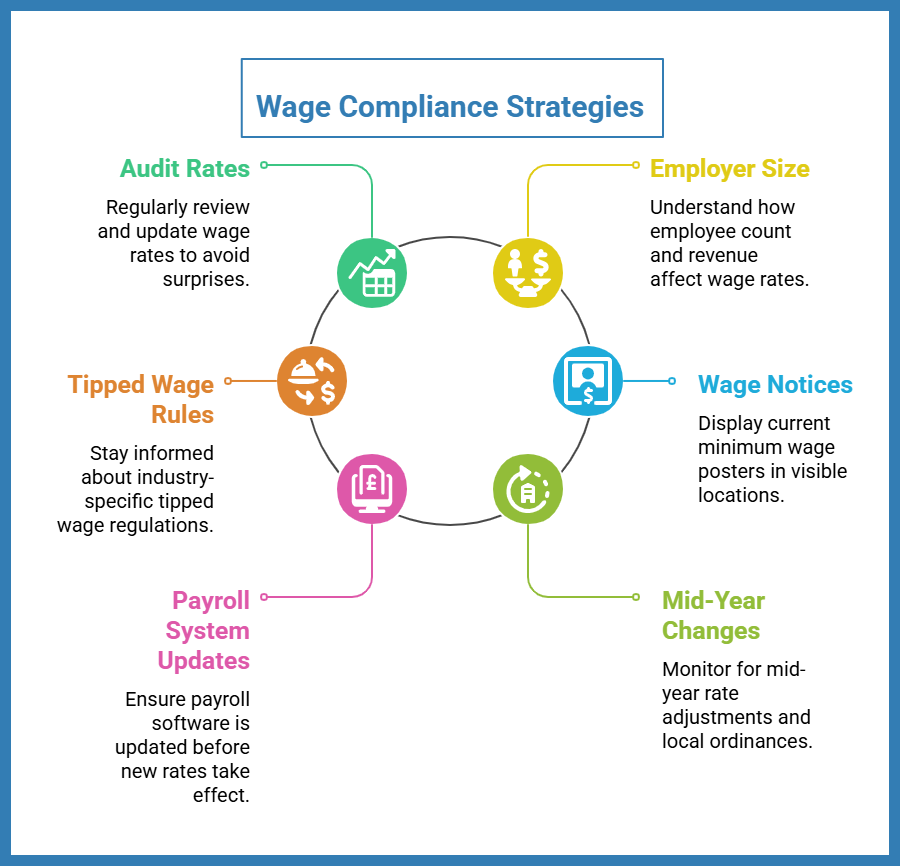
With rates changing frequently and industry-specific thresholds layering complexity into state requirements, minimum wage compliance requires a proactive, year-round approach. Here are the most critical steps every employer should take:
1. Audit Rates at Least Twice a Year
Most states adjust rates on January 1 or July 1, often tied to CPI schedules or pre-set legislative increases. Add these key dates to your compliance calendar so rate changes never catch you off guard. A mid-year review in June/July is especially important for states with July 1 effective dates.
2. Know Your Employer Size and Revenue Thresholds
Several states, including Illinois, New Jersey, Ohio, Montana, Arkansas, and Nebraska, apply different rates based on number of employees or annual gross revenue. Confirm which tier applies to your business every year, as your employee count or revenue may shift you into a different bracket.
3. Understand Tipped Wage Rules for Your Industry
Rules vary widely by state and even by occupation. Restaurant and hospitality employers in particular need to review tipped wage requirements each time rates change. Some states differentiate between food service workers and bartenders. Seven states prohibit tip credits entirely.
4. Post Required Wage Notices
Most states require employers to display the current minimum wage poster in a prominent, visible location. Many also require notices in multiple languages depending on your workforce composition. Check your state labor department's website for the current poster requirements and download updated versions when rates change.
5. Update Your Payroll System Before the Effective Date
When rates change, your payroll software must be updated before the new rate takes effect, not after. Failing to do so creates underpayment liability and may trigger back-pay requirements. Work with your payroll provider to confirm updates are scheduled proactively.
6. Watch for Mid-Year Changes and Local Ordinances
While most rate adjustments happen on January 1, some states and many cities update rates at other points in the year. The rates in this guide reflect March 2026. Always verify current rates if referencing later in the year. Also check for city and county ordinances in every location you operate. Local rates often exceed state minimums.
✅ Lift HCM Tip: Payroll software with automatic compliance updates, like isolved, handles rate changes on your behalf so your team is not manually tracking a spreadsheet of state deadlines. Our team monitors wage changes year-round and updates your payroll configuration before effective dates.
Frequently Asked Questions About Minimum Wage
What happens if a state minimum wage is lower than the federal minimum?
The federal rate applies. No covered employer may legally pay below $7.25/hour, regardless of what the state law says. Georgia and Wyoming have state rates below federal. FLSA-covered employers there must pay $7.25/hour.
Does my city have a higher minimum wage than the state?
Possibly, yes. Many major cities, including Chicago, Los Angeles, Seattle, Denver, and New York City, have local wage ordinances that exceed state rates. Always check local ordinances for every location you employ workers in. This guide covers state rates only.
How do I know which rate applies to my business?
Start with your state's minimum wage, then check whether employer size or revenue thresholds apply. Then look up any local ordinances for your city or county. Finally, confirm tip credit rules if you have tipped employees. When rates differ, you must pay the highest applicable rate.
How often do minimum wage rates change?
Most states update rates annually, either January 1 or July 1. Several states index their rates to the Consumer Price Index (CPI), meaning rates automatically adjust with inflation each year. A few states have multi-year phase-in schedules locked in by legislation.
What are the penalties for paying below minimum wage?
Penalties vary by state but typically include back pay for all affected employees, civil penalties per violation, and potential investigation by the state department of labor. Willful violations may result in additional damages. Some states allow private lawsuits by employees as well.
Are there exemptions to minimum wage requirements?
Yes. Common exemptions include certain salaried executive, administrative, and professional employees (under FLSA's white-collar exemptions), student workers in some circumstances, workers with disabilities under special certificates, and apprentices in some states. Always confirm exemption criteria carefully. Misclassification is a leading source of wage and hour violations.
Turning Minimum Wage Complexity Into Payroll Confidence
Minimum wage will continue to evolve in 2026 and beyond, and so will your responsibilities as an employer. Understanding how federal, state, and local rules interact, keeping an eye on tipped wage requirements, and tracking mid‑year adjustments are no longer “nice to haves”, they are essential to protecting your business and maintaining employee trust.
If you are finding it difficult to manage rate changes manually or to keep up with multi-state rules, you do not have to solve it alone. A reliable payroll and HCM partner can monitor regulatory updates for you, maintain accurate settings in your system, and provide guidance when you encounter gray areas such as exemptions, tip credits, or local ordinances.
By pairing clear internal processes with technology and expert support, you can stay compliant, pay your employees correctly every time, and focus more of your attention on running and growing your organization.

Topics:





.png?width=1536&height=1024&name=Create%20a%20background%20that%20reads%2c%20How%20Long%20to%20Keep%20P%20(1).png)