

Would outsourcing payroll lower your costs, or would it mainly give your team time back? Those are different benefits, and understanding the difference can help you compare your options without overstating the savings.
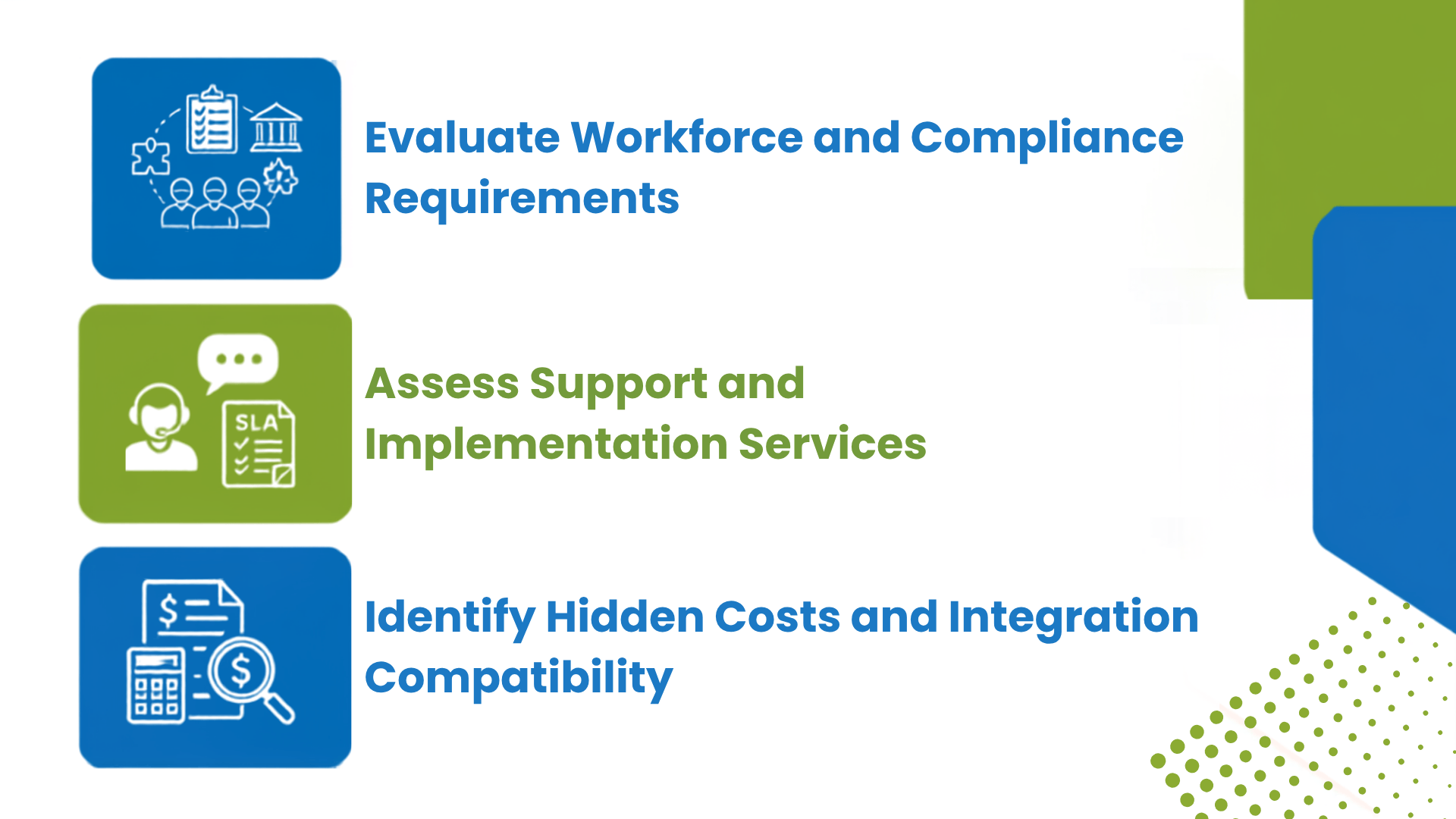
A useful comparison includes more than your current software subscription and a provider’s monthly fee. You also need to account for internal processing time, work that stays with your team, implementation expenses, and services billed separately.
This guide gives you a worksheet for calculating your current costs, a framework for comparing provider quotes, and a hypothetical example. You’ll also learn when outsourcing may improve your workflow without reducing your cash expenses.
Table of Contents
- What Does Your Current Payroll Process Cost?
- How Do You Compare Payroll Provider Quotes Fairly?
- The Tangible Benefits of Outsourcing Payroll: Measurable Returns
- Beyond Numbers: The Intangible Advantages of Payroll Outsourcing
- Addressing Potential Challenges of Outsourcing Payroll
- Calculating Your Business's Specific Cost-Benefit for Payroll Outsourcing
- When Does Outsourcing Payroll Make the Most Sense?
- Maximizing Business Potential Through Strategic Payroll Outsourcing
What Does Your Current Payroll Process Cost?
Start with your own records rather than an industry average. Track a representative month of payroll work, then account for year-end tasks and other activities that do not happen every month.
Separate money your business spends from the value of existing staff time. Both matter, but they should not be treated as the same type of savings.
Use this worksheet to estimate your annual payroll costs. Copy it into a spreadsheet or print it to enter your own figures.
| Cost to Review | How to Calculate It | Your Annual Estimate |
| Payroll software and required modules | Monthly fees × 12, plus annual charges | $________ |
| External payroll or tax support | Total relevant invoices for the year | $________ |
| Supplies and delivery | Checks, printing, postage, and related costs | $________ |
| Payroll processing time | Annual hours × loaded hourly labor cost | $________ |
| Review and approval time | Annual hours × loaded hourly labor cost | $________ |
| Corrections and reconciliation | Annual hours × loaded hourly labor cost, plus separate fees | $________ |
| Training and payroll administration | Annual hours × loaded hourly labor cost, plus course fees | $________ |
Loaded hourly labor cost includes compensation and applicable employer-paid taxes and benefits. Use a consistent method for both options.
Count each expense once. For example, do not include correction time again if it is already part of your processing-hours estimate. Exclude employee wages and payroll taxes owed regardless of how payroll is processed.
Record actual penalties separately. Do not assume outsourcing will eliminate them or count hypothetical avoided penalties as guaranteed savings.
How Do You Compare Payroll Provider Quotes Fairly?
Understanding the cost structure of outsourced payroll services is crucial for an accurate comparison with your current expenses. The cost structure for payroll outsourcing varies depending on the provider, the specific services included, and the complexity of your business needs.
Give each provider the same employee count, pay frequency, work locations, pay types, and required services. Ask for an itemized first-year estimate and an ongoing annual estimate using those assumptions. Providers may charge per employee per month (PEPM), per payroll run, a fixed fee, or a combination. Confirm how each charge is calculated and which services are included.
Common Pricing Models for Payroll Services
Most payroll service providers utilize a per-employee-per-pay-period pricing structure, sometimes with additional base fees. Key models include:
- Per-Payroll Pricing: You’re charged every time payroll is run (e.g., biweekly, monthly).
- Per Employee Per Month (PEPM): You’re billed based on the number of employees paid each month.
- Base processing fees: A flat monthly fee or a fee per pay run, in addition to PEPM charges.
- Volume-based tiered pricing: Often benefiting larger organizations with more employees.
- Service package levels: Basic (e.g., direct deposit, tax filing) to comprehensive (e.g., HRIS integration, benefits administration, dedicated support).
Use the comparison below to organize quotes. Copy it into a spreadsheet or print it to record each provider’s answers.
| What to Compare | Provider A | Provider B |
|---|---|---|
| Base fees, including billing frequency | _____ | _____ |
| Employee and payroll-run charges | _____ | _____ |
| Tax deposits, filings, and year-end forms | _____ | _____ |
| Expected off-cycle runs and corrections | _____ | _____ |
| Tax notices and prior-period amendments | _____ | _____ |
| Required integrations and modules | _____ | _____ |
| Implementation, conversion, and training | _____ | _____ |
| Internal work that remains each month | _____ hours | _____ hours |
| Estimated first-year cash expenses | $_____ | $_____ |
| Estimated ongoing annual cash expenses | $_____ | $_____ |
Mark a service “included” when its cost is already covered elsewhere, so you do not add it twice. Convert monthly and per-run charges into annual amounts before comparing totals. Include one-time charges in the first-year estimate, but not in ongoing annual costs.
Outsourcing does not remove every internal task. Ask who supplies employee changes, approves hours, reviews payroll, maintains registrations, and follows up on discrepancies.
Confirm renewal terms, cancellation charges, and data-export fees separately. For a deeper explanation of potential charges, read our guide to payroll pricing models and hidden fees.
The Tangible Benefits of Outsourcing Payroll: Measurable Returns
Outsourcing payroll delivers concrete, measurable advantages that directly impact your organization's financial health and operational efficiency.
Resource Optimization & Time Savings
Redirecting internal talent from administrative payroll tasks to strategic initiatives creates measurable value. Your HR and finance personnel can focus on employee development, financial analysis, and business growth rather than data entry and tax calculations.
Enhanced Payroll Compliance Assurance
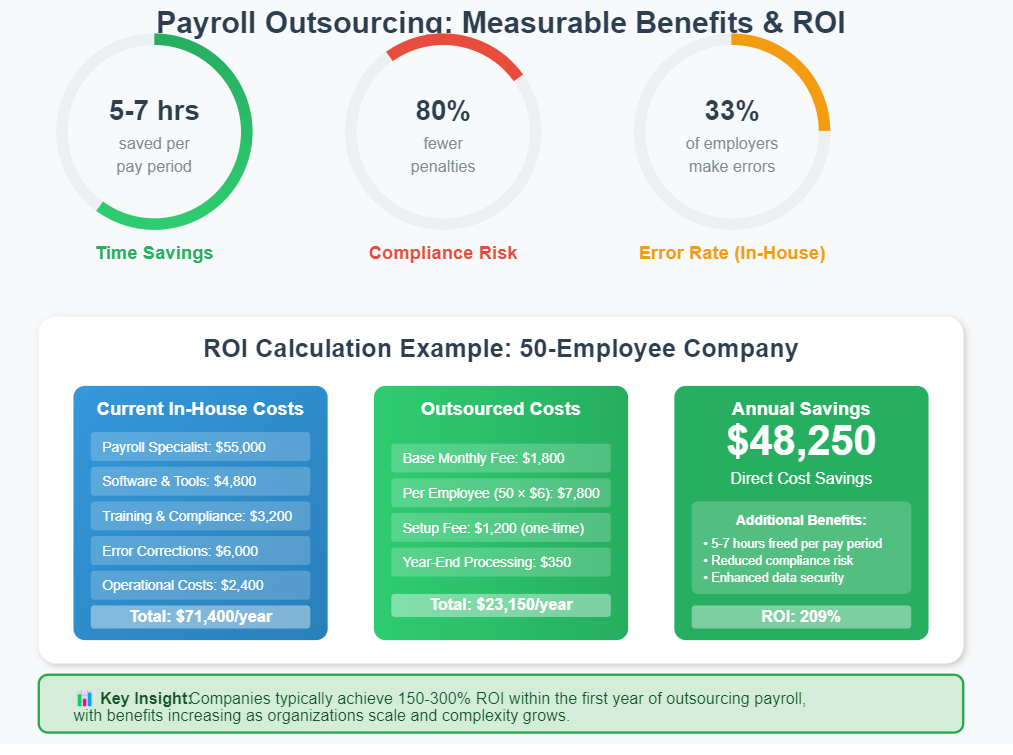
Professional payroll services have compliance teams that monitor regulatory changes, reducing exposure to penalties. Businesses using professional payroll services experience up to 80% fewer compliance-related penalties compared to those managing payroll in-house.
Scalability Without Added Complexity
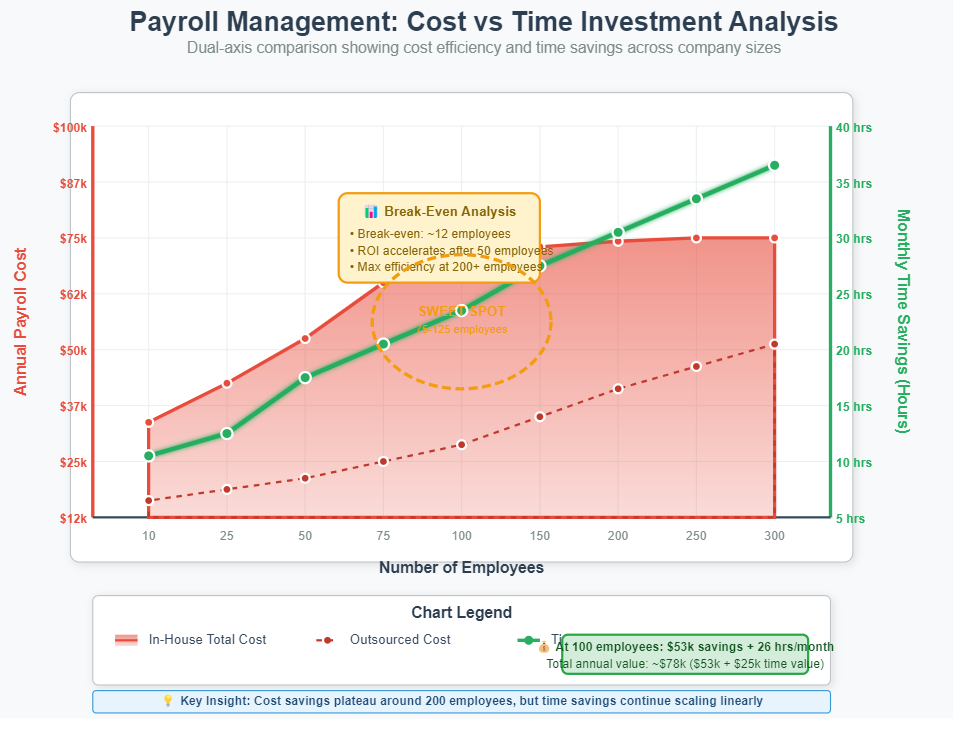
As your business grows, outsourced payroll solutions scale seamlessly without requiring additional internal resources or expertise. This eliminates the need for expensive software upgrades or specialized staff hiring during growth phases.
As your business grows, outsourced payroll solutions scale seamlessly without requiring additional internal resources or expertise. This eliminates the need for expensive software upgrades or hiring specialized staff during growth phases, making it an ideal payroll solution for growing businesses.
Beyond Numbers: The Intangible Advantages of Payroll Outsourcing
While harder to quantify in dollars and cents, these benefits contribute significantly to organizational health, leadership effectiveness, and reduced HR administrative burden.
Leadership Focus: Business leaders report substantial reductions in stress and administrative burden when payroll responsibilities shift to specialized providers. This mental bandwidth becomes available for strategic planning and business development initiatives.
Enhanced Data Security: Reputable payroll providers implement enterprise-grade security protocols that typically exceed what most small and mid-sized businesses can implement independently such as, advanced encryption standards, multi-factor authentication, regular security audits and penetration testing, and secure, redundant data storage.
Access to Specialized Expertise: Professional payroll partners provide on-demand access to specialists who can navigate complex scenarios like multi-state taxation requirements, employee classification challenges, benefit integration complexities, and regulatory compliance across jurisdictions.
Access to Specialized Expertise: Professional payroll partners provide on-demand access to specialists who can navigate complex scenarios like multi-state taxation requirements, employee classification challenges (e.g., contractor vs. employee), benefit integration complexities, and regulatory compliance across diverse jurisdictions.
Addressing Potential Challenges of Outsourcing Payroll
A balanced assessment requires acknowledging potential concerns with outsourcing payroll and understanding how to mitigate them effectively.
Maintaining Visibility and Control
- Challenge: Concern about reduced oversight of critical payroll processes
- Solution: Select providers offering comprehensive reporting dashboards, real-time access to payroll data, and clear communication protocols.
Implementation Transition
- Challenge: Initial setup requirements and potential disruption to existing workflows.
- Solution: Prioritize partners with structured, proven implementation processes, dedicated transition support, and thorough testing protocols before live deployment.
Provider Selection Risks
- Challenge: Potential service quality issues or a mismatch if you choose the wrong partner.
- Solution: Conduct due diligence by reviewing client testimonials, evaluating service agreements, assessing support accessibility, and observing platform demonstrations.
Maintaining Visibility and Control:💡 Pro Tip: Create a weighted evaluation matrix for potential providers that aligns with your specific business priorities and requirements.
.
Calculating Your Business's Specific Cost-Benefit for Payroll Outsourcing
Determining whether outsourcing payroll makes financial sense requires a tailored analysis specific to your organization's circumstances.
- Calculate Current In-House Payroll Expenses: Create a comprehensive inventory of your present payroll-related costs. Include:
- Direct personnel expenses (prorated for time spent on payroll).
- Technology and payroll software investments.
- Physical resources (check stock, printers).
- Time and costs associated with training and staying updated on compliance updates.
- Quantify Potential Savings & Gains from Outsourcing: Evaluate potential efficiency gains and risk reduction:
- Hours redirected from payroll to strategic initiatives (multiplied by appropriate hourly rates).
- Reduced error correction time and potential penalty exposure (remember, 33% of employers make payroll errors annually).
- Eliminated technology maintenance and upgrade requirements.
- Simplified scaling during business growth phases.
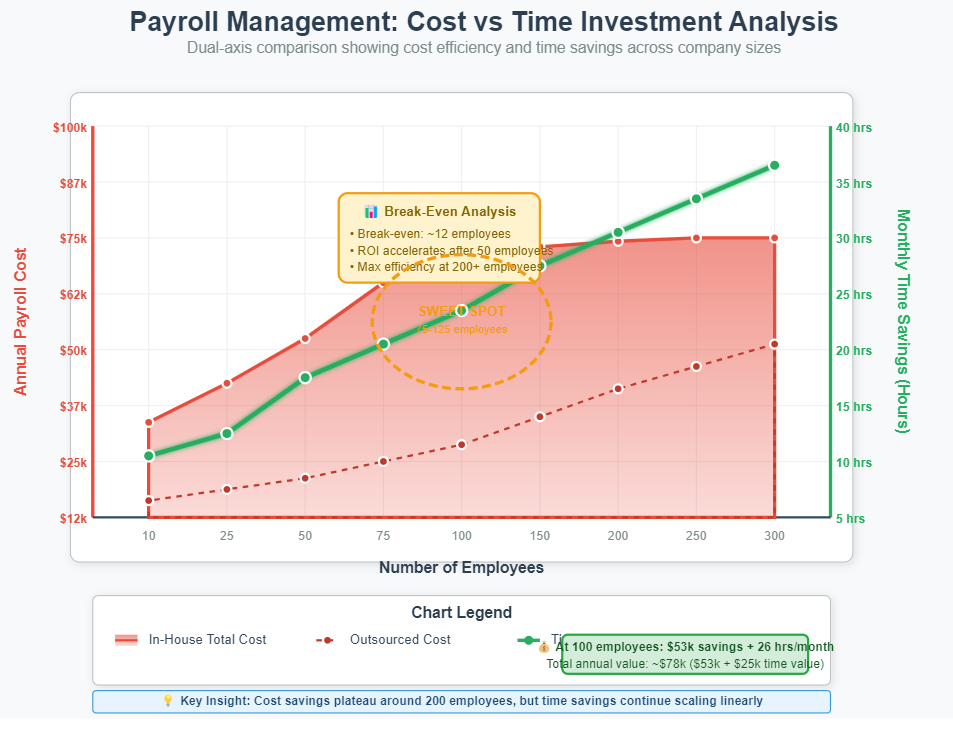
- Decision Framework/Strategic Alignment: Beyond a pure cost comparison, evaluate strategic factors:
- Your company's growth trajectory and scalability needs.
- Availability and limitations of internal expertise.
- The regulatory complexity of your operating environment (e.g., multiple states).
- The strategic importance of redirecting internal resources to core business functions.
When Does Outsourcing Payroll Make the Most Sense?
While each business requires a custom analysis, specific organizational profiles typically realize substantial benefits from payroll outsourcing.
- Small and Medium Businesses (SMBs): Organizations with limited administrative staff often achieve immediate efficiency gains through payroll outsourcing for small businesses. When personnel wear multiple operational hats, removing payroll administration creates substantial capacity for higher-value activities.
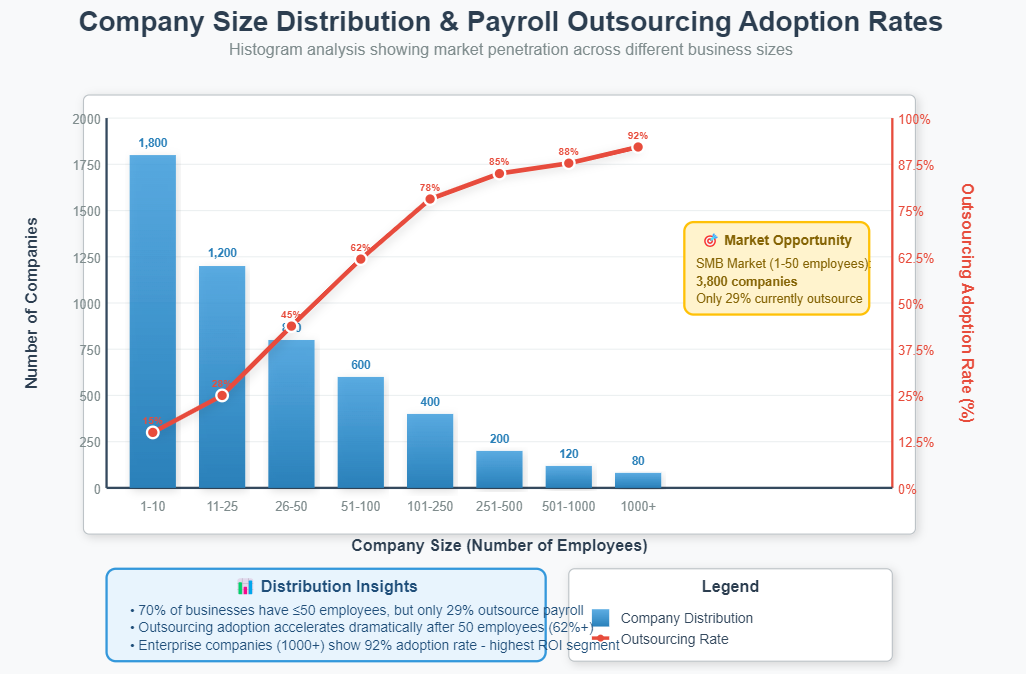
- Growth-Stage Companies: Businesses experiencing rapid headcount increases face escalating payroll complexity. Outsourcing creates a scalable payroll solution that grows seamlessly with your organization without requiring proportional increases in internal resources or expertise.
- Businesses with Multi-Jurisdiction Operations: Companies operating in multiple states face increased compliance challenges. Professional payroll services reduce these risks and burdens, with 72% of such businesses outsourcing payroll to specialized providers.
Maximizing Business Potential Through Strategic Payroll Outsourcing
If you’ve ever felt unsure whether your payroll provider is pulling its weight—or if you’re simply overwhelmed by the number of options out there—you’re not alone. For many businesses, payroll starts as a routine task but quickly becomes a pain point when errors, inefficiencies, or compliance risks appear.
By understanding the true costs behind professional payroll services—and weighing them against time savings, accuracy, compliance, and employee experience—you’ve now got a clearer view of what’s worth investing in.
This isn’t just about saving money. It’s about unlocking more time, reducing stress, and giving your team the tools to thrive. Whether you're a growing startup or an established organization, the right payroll solution should feel like a foundation—not a frustration.
At Lift HCM, we are committed to providing tailored payroll solutions that not only meet but exceed the expectations of businesses across the U.S. With flexible pricing, transparent support, and decades of experience, we’ll help you find a better way to pay people, stay compliant, and support your growth.
Ready to simplify payroll and regain control?
Get a personalized quote from Lift HCM and see the difference true payroll partnership can make.