

Switching payroll providers in the hospitality industry is a different animal than switching in most other industries. You're juggling tipped employees, fluctuating seasonal headcounts, multiple locations with different state tax rules, and shift-based time tracking that has to be right down to the minute. Get one piece wrong during the transition, and your next pay run misfires across every location at once.
Most hospitality operators we talk to say the same thing: they knew they needed to make a change months ago, but the risk of disrupting employee pay kept them stuck. We understand why.
A botched payroll cutover in a 200-seat restaurant group does more than frustrate your staff. It can create wage claims, tax filing gaps, and turnover you cannot afford during peak season.
That is exactly what this guide is built to help you avoid. Below, we walk through 10 hospitality-specific steps for switching payroll providers without putting employee pay at risk. Each step addresses a complexity that generic payroll checklists usually skip.
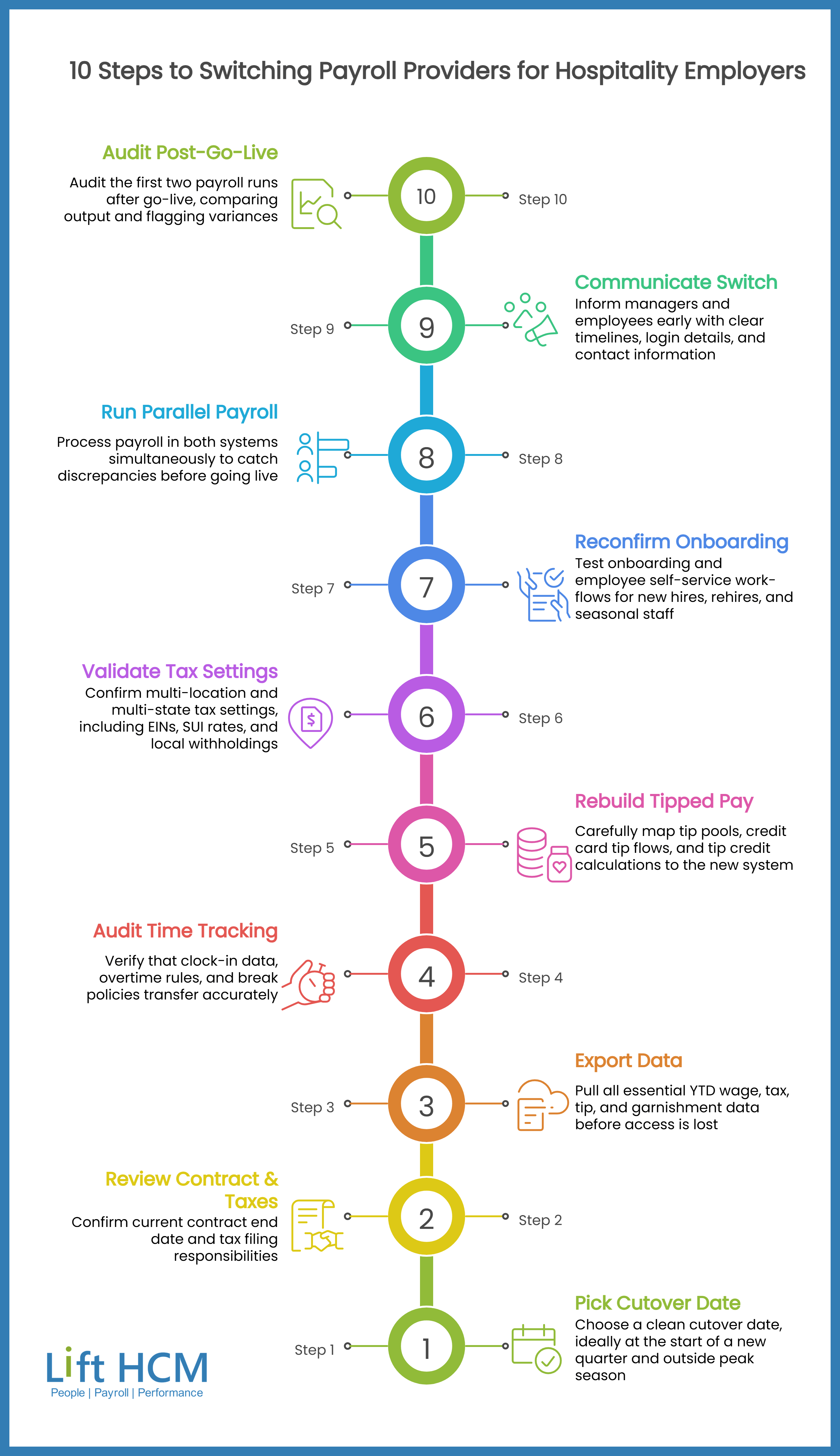
Quick Guide: 10 Steps To Switching Payroll Providers For Hospitality Employers
- Pick a clean cutover date: Align the switch with the start of a new quarter and avoid peak-season transitions
- Review your current contract and tax filing responsibilities: Confirm who files final returns and when your agreement actually ends
- Export the data you cannot afford to lose: Pull YTD wage records, tax filings, tip allocations, and garnishment details before access disappears
- Audit time tracking before payroll moves: Verify that clock-in data, overtime rules, and break policies transfer accurately
- Rebuild tipped pay and service charge rules carefully: Map tip pools, credit card tip flows, and tip credit calculations to the new system
- Validate multi-location and multi-state tax settings: Confirm each location's EIN, SUI rates, and local tax withholdings are correct
- Reconfirm onboarding and employee self-service workflows: Test that new hires, rehires, and returning seasonal staff can enroll without delays
- Run at least one parallel payroll: Process payroll in both systems simultaneously to catch discrepancies before going live
- Communicate the switch to managers and employees early: Give your team clear timelines, new login details, and a point of contact for questions
- Audit the first two payroll runs after go-live: Compare output against the parallel run and flag any variance in net pay, taxes, or tip distributions
|
Step Number & Name |
Focus Area |
Key Action Item / Success Criteria |
|---|---|---|
|
1. Pick a clean cutover date |
Timing |
Align with start of quarter; avoid peak season and year-end. |
|
2. Review contract & tax duties |
Compliance |
Confirm end date, notice periods, and final tax filing owners. |
|
3. Export vital historical data |
Data Integrity |
Export raw YTD wage, tax, tip allocation, and garnishment records. |
|
4. Audit time tracking |
Time & Attendance |
Verify OT, meal break, shift differential, and split-shift rules. |
|
5. Rebuild tipped pay rules |
Tipped Pay |
Map tip pools, credit card flows, service charges, and tip credits. |
|
6. Validate multi-location tax |
Tax Setup |
Confirm EINs, SUI rates, and local withholding for all sites. |
|
7. Reconfirm onboarding rules |
Workforce / HR |
Test mobile self-service, I-9/W-4 completion, and seasonal rehires. |
|
8. Run parallel payroll |
Testing |
Run dual calculations and resolve all variances before go-live. |
|
9. Communicate switch early |
Change Mgmt |
Provide timelines, login info, and support channels to all staff. |
|
10. Audit initial live pay runs |
Validation |
Audit first two pay cycles to ensure steady state without errors. |
Table of Contents
-
How We Chose The Right Switching Steps For Hospitality Employers
-
What Should Hospitality Employers Look For In A New Payroll Partner?
-
How Do You Switch Payroll Providers Without Disrupting Employee Pay?
-
Why Lift HCM Is The Right Payroll Partner For Hospitality Employers
How We Chose The Right Switching Steps For Hospitality Employers
At Lift HCM, we've helped dozens of hospitality businesses navigate payroll transitions. Hotels, restaurant groups, catering companies, seasonal resorts. Each one brought a different combination of tipped pay rules, multi-location tax filings, and workforce volatility that made the standard "export and import" playbook fall short. We've seen behind the curtain on what actually goes wrong when these switches aren't planned around the realities of hospitality.
We built this checklist around the friction points that cause real problems during a hospitality payroll switch. Here's what we evaluated for each step:
- Tipped-pay accuracy: Whether the step addresses tip pools, tip credits, and service charge allocations that are unique to restaurants and hotels
- Multi-location tax complexity: Whether it accounts for employers running payroll across multiple states, counties, or municipalities
- Seasonal workforce impact: Whether it reduces risk during high-turnover periods when onboarding and offboarding happen simultaneously
- Time tracking integrity: Whether it protects the clock-in data and overtime rules that feed directly into your pay calculations
- First-payroll accuracy: Whether the step directly prevents errors on the first live payroll run after cutover
- Compliance continuity: Whether it ensures tax filings, W-2 data, and wage records transfer without gaps that could trigger penalties
The 10 Steps To A Cleaner Payroll Transition
1. Pick A Clean Cutover Date
Timing matters more in hospitality than in almost any other industry. Your workforce fluctuates with the calendar, so choosing a cutover date that falls during your busiest stretch is a recipe for payroll errors at the worst possible moment.
Align your switch with the beginning of a new quarter. This gives you a clean break in quarterly tax filings and reduces the risk of mid-quarter wage reconciliation problems between your old and new providers.
If your business is seasonal (think beach resorts or ski lodges), target the shoulder season when headcount is stable and your team has capacity to manage the transition.
📌 Avoid switching payroll during the last two months of the calendar year. Year-end W-2 processing requires continuity between systems, and splitting that process across providers creates reconciliation headaches that follow you into the next filing season.
2. Review Your Current Contract And Tax Filing Responsibilities
Before you sign with a new provider, pull out your current contract and read the fine print. Many payroll agreements include cancellation notice periods (often 30 to 60 days), and some charge early termination fees that catch employers off guard.
More importantly, clarify who is responsible for final tax filings. Your outgoing provider may file your last quarterly return (Form 941) and state unemployment reports. If you're unfamiliar with the filing landscape, review the full list of payroll tax forms employers are responsible for.
Your outgoing provider may also hand that responsibility back to you the moment the contract ends. If nobody files, you end up with IRS and state notices that are entirely avoidable.
Ask your current provider in writing: Will you file all returns through our final pay date, and will you issue W-2s at year end? Get that answer documented before you start the migration.
3. Export The Data You Cannot Afford To Lose
Once your contract with the old provider ends, your access to historical data may disappear. In hospitality, that data includes more than standard payroll records.
Export everything you'll need for compliance and accuracy:
- Year-to-date earnings and withholdings for every employee (including seasonal staff who may have already departed)
- Tip allocation reports and Form 8027 data if you're required to file
- Garnishment orders and deduction schedules
- Workers' compensation codes and rates by location
- All quarterly and annual tax filing confirmations
💡 Download raw data files (CSV or Excel), not just PDF summaries. Your new provider will need importable data to set up accurate YTD balances, and manually re-entering tip allocations for a 150-person restaurant group is exactly the kind of task that introduces errors.
4. Audit Time Tracking Before Payroll Moves
In hospitality, time tracking isn't just an HR function. It's the foundation of every payroll calculation. If your time data doesn't transfer cleanly, nothing downstream will be accurate.
Before you migrate, audit how your current system handles overtime calculations, break deductions, shift differentials, and split-shift premiums. Confirm that the new provider supports the same rules.
A restaurant in California with split-shift premium requirements needs different configurations than a hotel in Texas. Those differences have to be built into the new system before the first pay run.
If your current time tracking tool integrates with your old payroll provider but not the new one, you'll also need to evaluate whether to switch time tracking systems simultaneously or build a manual bridge. Running payroll from inaccurate time data defeats the purpose of switching providers in the first place.
5. Rebuild Tipped Pay And Service Charge Rules Carefully
This is where hospitality payroll transitions break down most often. Tipped pay involves multiple moving parts that general payroll systems don't handle natively.
Map out your complete tip structure before your new provider begins configuration:
- Which positions participate in tip pools, and what are the distribution formulas?
- How do credit card tips flow from the POS system into payroll?
- Are you taking a tip credit against the minimum wage, and what's the applicable rate by state?
- Do you distribute service charges differently from voluntary tips (they have different tax treatment)?
Test the configuration with real historical data before going live. Run a sample pay calculation for your highest-volume location and compare the output line by line against a recent payroll. Discrepancies in tip credit calculations or pool distributions will show up here, where you can fix them, rather than on an employee's paycheck.
6. Validate Multi-Location And Multi-State Tax Settings
Hospitality businesses often operate across city lines, county lines, and state lines. A hotel group with properties in Illinois and Indiana needs distinct state withholding configurations, different SUI rates, and potentially different local taxes for each location.
For each location, verify:
- Federal EIN assignment (some multi-location operators use a single EIN, others use separate ones per entity)
- State unemployment insurance (SUI) rates and account numbers
- Local and municipal tax withholding requirements
- State-specific wage and hour rules that affect overtime, meal breaks, and tip credits
This is not a step you can shortcut. A single misconfigured state tax setting on day one means every paycheck for employees at that location will be wrong. And correcting multi-state tax filings mid-quarter takes significantly more time than getting it right from the start.
7. Reconfirm Onboarding And Employee Self-Service Workflows
Hospitality employers hire constantly. Restaurants in tourist areas may onboard 20 or more seasonal employees in a single week, and those new hires need to be in the payroll system before their first shift ends.
Test your new provider's onboarding workflow end to end before go-live:
- Can new hires complete I-9s, W-4s, and direct deposit enrollment digitally and on a mobile device?
- How quickly does a completed onboarding record appear in the payroll system?
- Does the self-service portal let employees view pay stubs, update tax withholdings, and access tip reports?
- Can returning seasonal employees be reactivated without re-entering all of their information?
If your previous provider supported on-site kiosk check-in or manager-assisted onboarding, confirm that the new system offers similar functionality. A gap in onboarding speed during peak hiring season will slow down your entire operation.
8. Run At Least One Parallel Payroll
This step is non-negotiable, especially for hospitality employers with complex pay structures. Running parallel payroll means processing the same pay period in both your old and new systems simultaneously, then comparing the results.
In a parallel run, you're looking for variances in:
- Gross-to-net pay for tipped and non-tipped employees
- Federal, state, and local tax withholdings by location
- Tip credit calculations and tip pool distributions
- Overtime pay, especially for employees who work across multiple locations or roles
- Deductions for benefits, garnishments, and uniforms
If the two systems match within acceptable tolerances (a few cents on rounding is normal), you're ready to go live. If they don't, isolate the discrepancies before you cut over.
Paying employees from an untested system in hospitality, where a single location might have 50 tipped employees with different pool arrangements, is a risk that doesn't need to exist.
9. Communicate The Switch To Managers And Employees Early
A payroll transition affects every employee, and in hospitality, your frontline managers are the ones fielding questions when something looks different on a pay stub. Give them the information they need before the switch happens.
At a minimum, communicate:
- The exact date the new system goes live
- How employees will access their new self-service portal (login credentials, mobile app details)
- Whether direct deposit accounts need to be re-verified
- Who to contact with payroll questions during the transition period
- Any changes to pay schedules or pay stub formatting
For multi-location operations, brief each location's general manager individually. They need to know the specific changes relevant to their site (such as a new time clock process or different tip reporting workflow) so they can relay accurate information to their teams.
10. Audit The First Two Payroll Runs After Go-Live
The first live payroll on a new system is not the finish line. It's the beginning of a validation period. Plan to audit the first two complete pay cycles in detail.
Compare each run against your parallel payroll results and flag any discrepancies in:
- Net pay amounts for tipped versus non-tipped employees
- Tax withholdings by state and locality
- Tip pool distributions and tip credit application
- Overtime calculations for employees crossing location or role boundaries
- Deduction accuracy for benefits, garnishments, and meal/uniform deductions
If variances appear, resolve them before the third payroll run. Two clean cycles give you enough data to confirm that your configurations are holding steady across different pay scenarios. After that, you can shift from intensive auditing to standard payroll review.
What Should Hospitality Employers Look For In A New Payroll Partner?
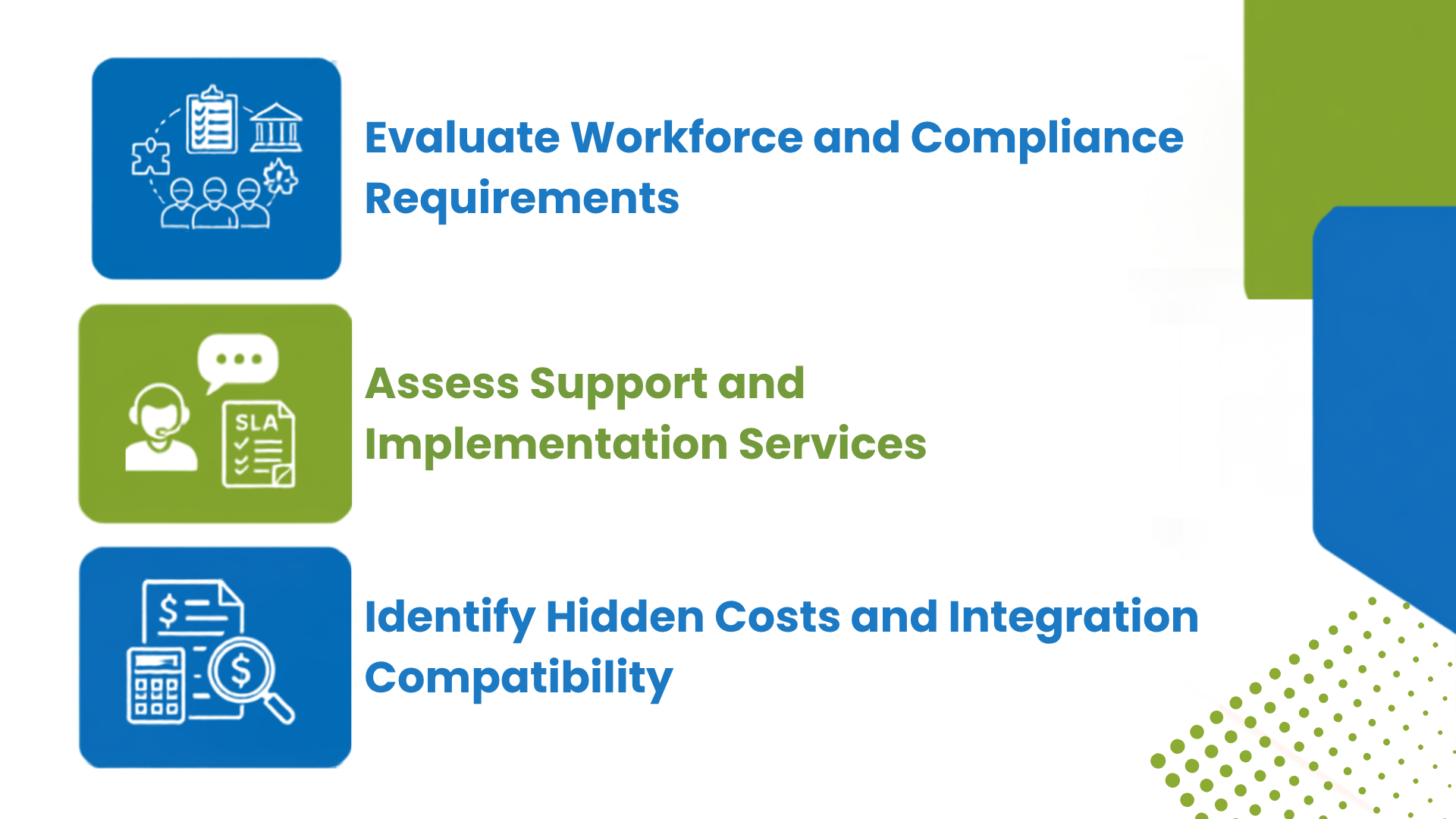
Choosing the right payroll partner for a hospitality business requires looking beyond basic payroll processing. Your partner needs to handle the operational realities that come with tipped employees, volatile schedules, and compliance across multiple jurisdictions.
Prioritize providers that offer integrated time tracking with direct payroll feeds, built-in tip management (including tip credit, tip pooling, and service charge configurations), and multi-state tax support that doesn't require manual setup for each location. If your workforce fluctuates seasonally, the provider should also support rapid onboarding and easy reactivation of returning employees.
Ask prospective partners whether they have existing hospitality clients and how they handle the industry's specific tax and labor challenges. Here's the truth: a partner that hasn't configured tip pools or managed multi-location SUI filings before will learn on your dime. That learning curve shows up as errors on your employees' paychecks.
How Do You Switch Payroll Providers Without Disrupting Employee Pay?
The key to a disruption-free switch is overlap. Running parallel payroll, maintaining access to both systems during the transition, and verifying every configuration before the first live run are the most effective ways to protect employee pay.
Start the transition at least 60 days before your target go-live date. Use the first 30 days for data migration, configuration, and testing. A structured payroll implementation timeline helps keep this phase on track.
Use the second 30 days for parallel runs and employee communication. This timeline gives you enough buffer to catch problems before they affect an actual paycheck.
For hospitality specifically, lock in your tipped pay rules and multi-location tax settings before you attempt the parallel run. Those are the two areas where discrepancies are most likely to appear, and they affect the highest number of employees at once.
FAQs About Switching Payroll Providers
When Is The Best Time For A Restaurant To Switch Payroll Providers?
The safest window is the start of a new quarter during your slowest season. That aligns the switch with quarterly tax filing deadlines and avoids mid-quarter reconciliation between providers. For seasonal operations, target the shoulder months when headcount is stable.
How Long Does It Typically Take To Switch Payroll Providers In Hospitality?
Plan for 60 to 90 days from kickoff to go-live. Hospitality transitions usually take longer than standard switches because of tipped pay configuration, multi-location tax setup, and parallel payroll testing.
Will My Employees Lose Access To Their Old Pay Stubs During The Switch?
That depends on your outgoing provider’s data retention policy. Some providers cut access within 30 days of cancellation. Download all historical pay stubs and tax documents before your contract ends, and confirm that your new provider can import historical records into the new self-service portal.
Do I Need To Re-Enroll Employees In Direct Deposit When Switching Providers?
In most cases, yes. Direct deposit authorizations are tied to the payroll provider, so employees usually need to re-enter their bank account information in the new system.
What Happens To My Year-To-Date Payroll Data During The Transition?
Your new provider should import YTD wage totals, tax withholdings, and tip allocations from your exported records. Accurate YTD data is critical for correct tax calculations on every paycheck after the switch. Verify these balances during the parallel payroll run to catch any discrepancies before they compound.
Can I Switch Payroll Providers Mid-Year Without Affecting W-2s?
Yes, but it requires careful coordination. Either your old provider issues a partial-year W-2 and your new provider issues a second one, or your new provider absorbs the full year’s data and issues a single W-2. The right approach depends on which option creates the cleanest reporting for your employees.
Why Lift HCM Is The Right Payroll Partner For Hospitality Employers
For hospitality employers, payroll and workforce operations need to reflect the realities of the job. Tipped pay, multi-location tax compliance, integrated time tracking, and rapid seasonal onboarding should be built into the system from the start, not added later as workarounds.
That matters because generic payroll processing often falls short in hospitality. The right partner combines technology with support from people who understand how hospitality payroll actually works.
When questions come up about tip pool configuration or multi-state tax filing, you should be able to talk to someone who understands those scenarios and can help you work through them.
A unified system that connects payroll, time and attendance, HR, and benefits also makes day-to-day operations easier. Time tracking flows directly into payroll, new hires can onboard from a mobile device before their first shift, and managers get real-time visibility into labor costs across locations.
If you are planning a payroll provider switch and want a clearer picture of what a clean hospitality cutover should look like, Lift HCM can help you map the process before payroll errors become a problem.

Topics:



.png?width=1536&height=1024&name=Create%20a%20background%20that%20reads%2c%20How%20Long%20to%20Keep%20P%20(1).png)