

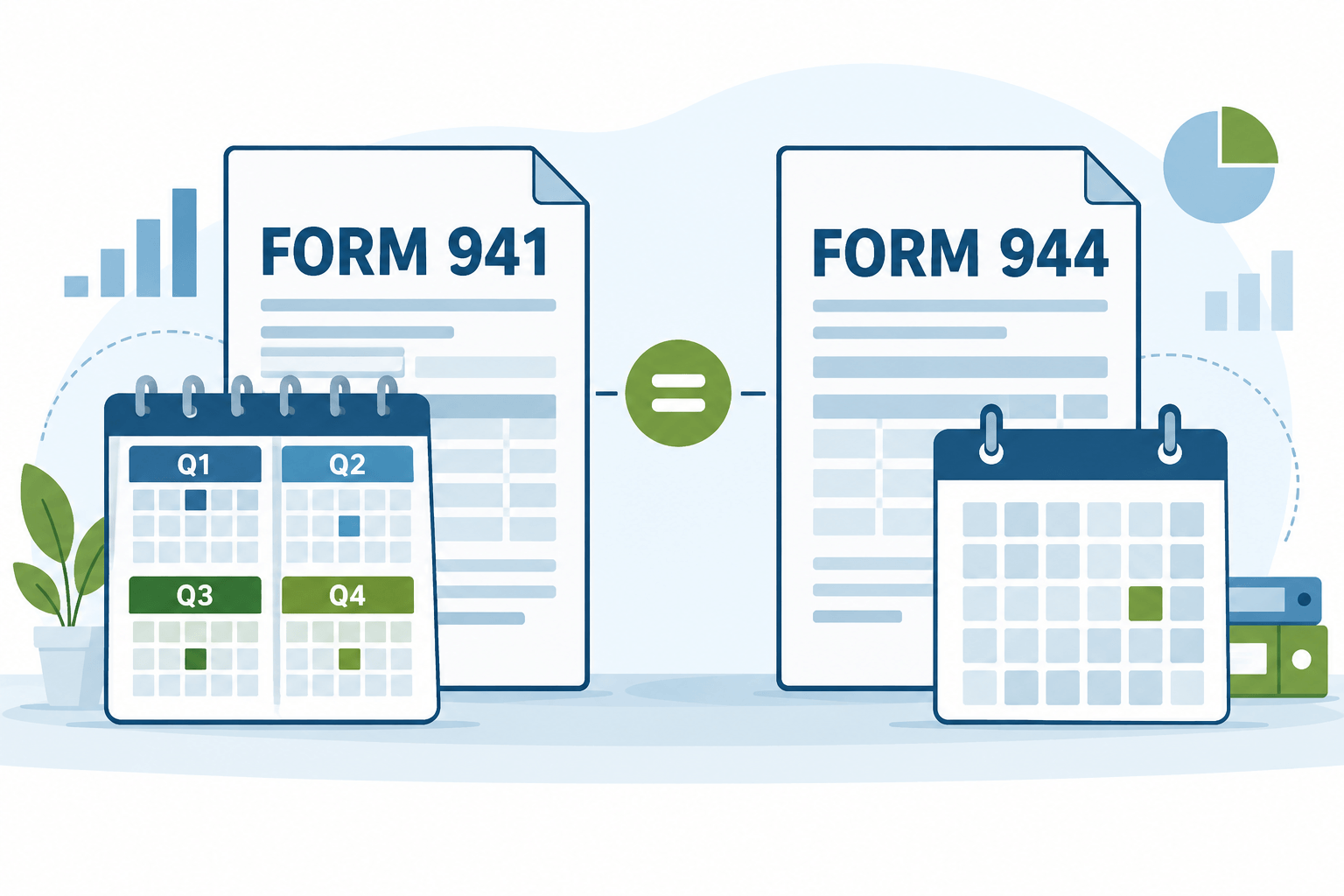
Most employers that pay wages subject to federal income tax withholding or Social Security and Medicare taxes must report those amounts to the IRS. The confusing part is knowing whether the IRS expects a quarterly Form 941 or an annual Form 944.
Choosing the wrong return can create missed-filing notices, correction work, and possible penalties. It is also easy to confuse the filing schedule with the separate schedule for depositing the taxes owed.
At Lift HCM, we work with employers that need clearer payroll tax processes and more visibility into deadlines. This guide explains the difference between Form 941 and Form 944, who files each return, the adjusted 2026 deadlines, how tax deposits work, and what to do if your filing requirement needs to change. If you want a broader view of how these returns fit into the full federal payroll filing picture, our guide 11 Payroll Tax Forms Every Employer Needs to Know is a useful companion.
Key Takeaways
- Most employers report federal income tax withholding and Social Security and Medicare taxes on Form 941 every quarter.
- Form 944 is an annual return for certain very small employers, generally those expected to owe $1,000 or less in annual employment taxes.
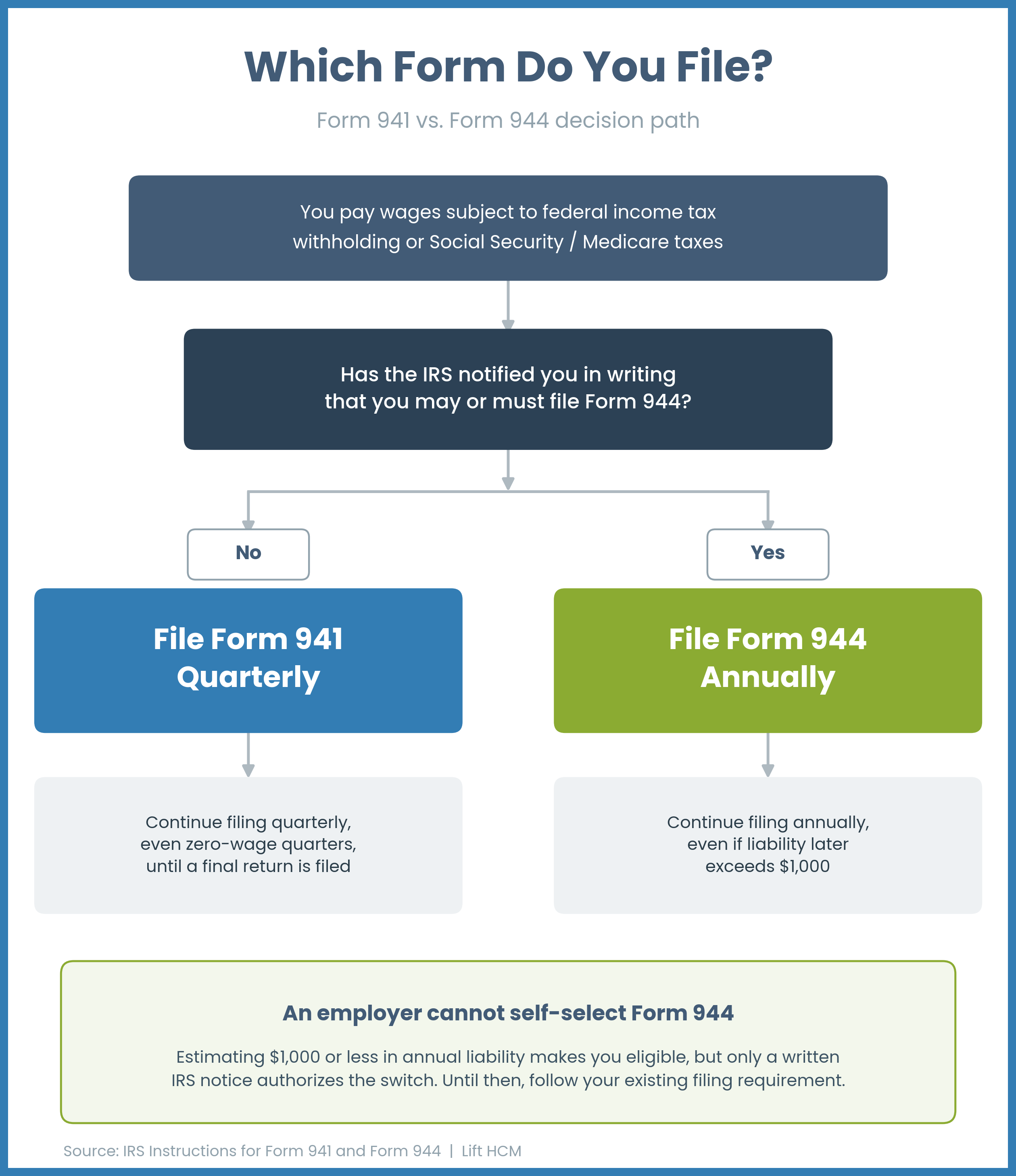
- You cannot choose Form 944 solely because your liability is below the threshold. The IRS must notify you in writing that you may or must file it.
- Filing a return and depositing payroll taxes are separate obligations with different rules and deadlines.
- The adjusted Q3 2026 Form 941 deadline is November 2, 2026. The adjusted Q4 deadline is February 1, 2027.
Table of Contents
What Do Forms 941 and 944 Report?
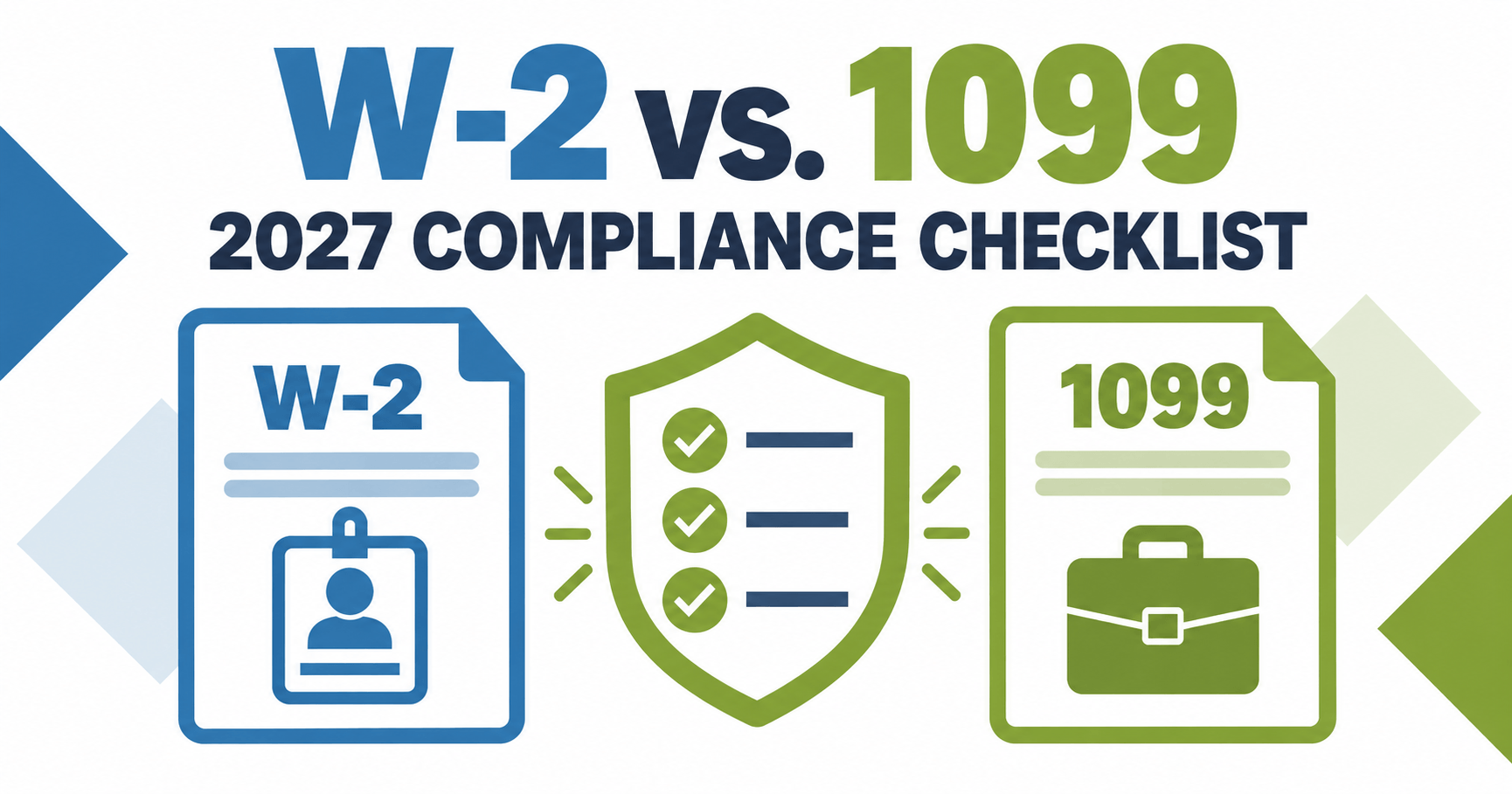
Forms 941 and 944 generally report the same federal employment tax information. The main differences are who is authorized to file each return and how often the return is filed.
Both forms generally report:
- Wages and tips paid
- Federal income tax withheld from employees
- Employee and employer shares of Social Security tax
- Employee and employer shares of Medicare tax
- Additional Medicare Tax withheld from employees when required
- Certain current-period adjustments, including adjustments involving fractions of cents, sick pay, tips, and group-term life insurance
- The qualified small business payroll tax credit for increasing research activities, when applicable
For 2026, the Social Security tax rate is 6.2% for the employee and 6.2% for the employer, up to the $184,500 Social Security wage base. The regular Medicare tax rate is 1.45% for each side and has no wage limit. Employers must also withhold the 0.9% Additional Medicare Tax after paying an employee more than $200,000 in Medicare wages during the calendar year. Employers do not match the Additional Medicare Tax. These rates and the 2026 wage base are confirmed in the IRS Instructions for Form 941.
Forms 941 and 944 do not report FUTA tax. Employers generally report federal unemployment tax separately on Form 940. Household and agricultural employers may be subject to different filing rules and forms.
Form 941 vs. Form 944: What Is the Difference?
|
Question |
Form 941 |
Form 944 |
|
Official name |
Employer's Quarterly Federal Tax Return |
Employer's Annual Federal Tax Return |
|
Typical filer |
Most employers |
Certain very small employers notified by the IRS |
|
Filing frequency |
Quarterly |
Annually |
|
General liability guideline |
Usually more than $1,000 for the year |
Generally $1,000 or less for the year |
|
Can an employer self-select it? |
No. Follow the IRS-assigned filing requirement. |
No. The IRS must notify the employer in writing. |
|
Does filing frequency determine deposit frequency? |
No |
No |
|
Can the filing requirement change? |
Yes, after an IRS-approved request |
Yes, after an IRS-approved request |
The $1,000 amount is an eligibility guideline for Form 944, not a simple switch that an employer can make independently. The IRS filing notice controls which return the employer must file.
Who Must File Form 941?
Form 941 is the quarterly federal employment tax return used by most employers. If no exception applies and the IRS has not notified you to file Form 944, you generally file Form 941 for the quarter in which you first pay wages subject to federal income tax withholding or Social Security and Medicare taxes.
After the first filing, employers generally continue filing each quarter, including quarters with no taxes to report, until they file a final return. Seasonal employers may skip quarters in which they paid no wages if they properly indicate their seasonal status on Form 941.
Some employers follow different rules:
- Employers notified by the IRS to file Form 944 file annually instead of filing quarterly Forms 941.
- Employers of household employees generally report those taxes on Schedule H rather than Form 941.
- Employers of agricultural employees generally use Form 943 for agricultural wages.
The IRS explains these exceptions in its current Form 941 instructions.
What Are the 2026 Form 941 Deadlines?
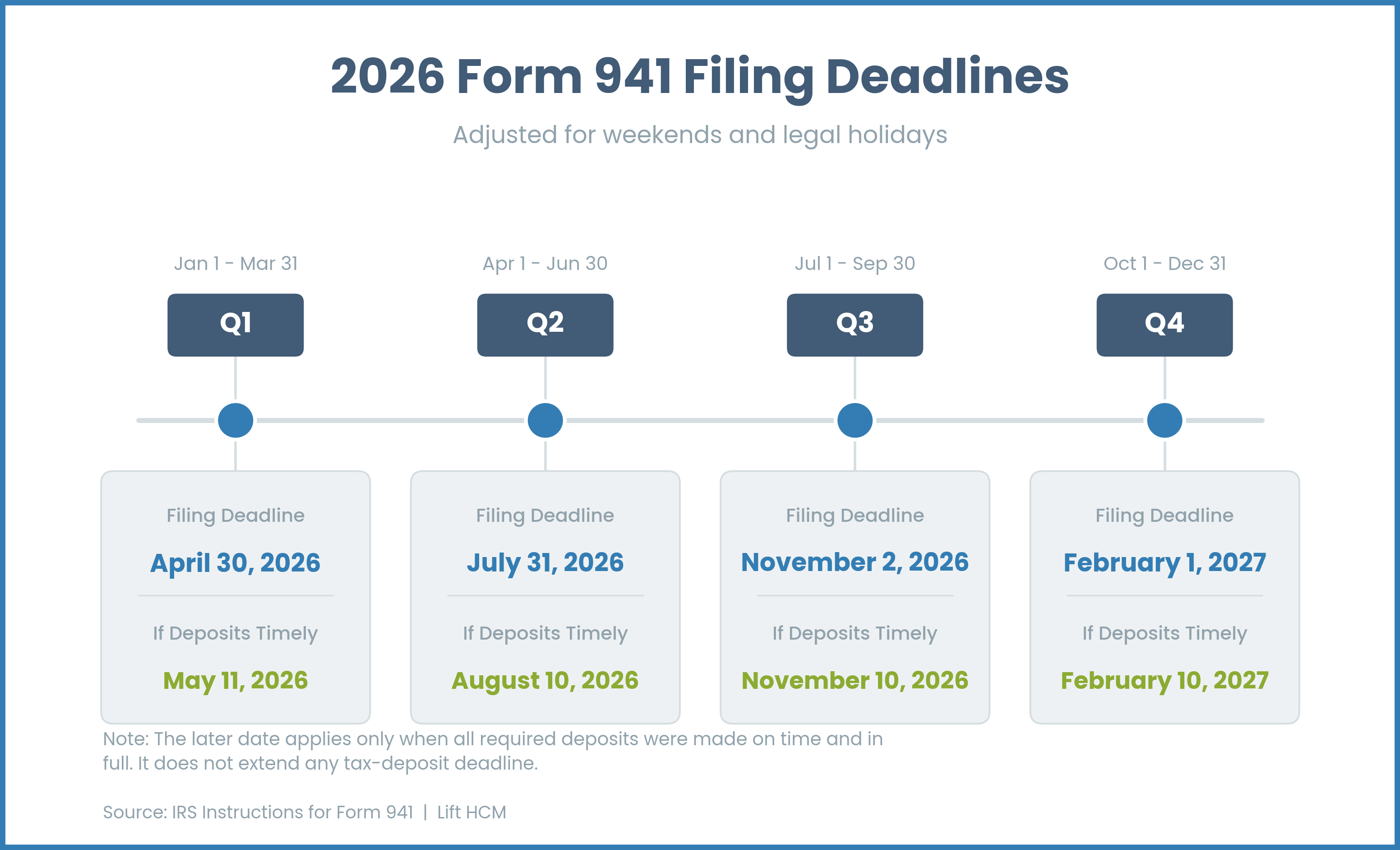
Form 941 is normally due by the last day of the month after a quarter ends. When that date falls on a Saturday, Sunday, or legal holiday, the deadline moves to the next business day.
|
2026 Quarter |
Period Covered |
Adjusted Filing Deadline |
Deadline If All Deposits Were Timely and Paid in Full |
|
Q1 |
January 1 to March 31 |
April 30, 2026 |
May 11, 2026 |
|
Q2 |
April 1 to June 30 |
July 31, 2026 |
August 10, 2026 |
|
Q3 |
July 1 to September 30 |
November 2, 2026 |
November 10, 2026 |
|
Q4 |
October 1 to December 31 |
February 1, 2027 |
February 10, 2027 |
Q3 moves from October 31 to November 2 because October 31, 2026, is a Saturday. Q4 moves from January 31 to February 1 because January 31, 2027, is a Sunday. The Q1 extended date moves from May 10 to May 11 because May 10, 2026, is a Sunday.
The later filing dates apply only when the employer made all required deposits on time and in full. They do not extend the underlying tax-deposit deadlines.
Who Qualifies to File Form 944?
Form 944 is designed for the smallest employers, generally those whose annual liability for federal income tax withholding plus the employee and employer shares of Social Security and Medicare taxes is expected to be $1,000 or less. Based on current tax rates, the IRS says employers paying $5,000 or less in wages subject to these taxes are generally likely to remain within the $1,000 liability threshold.
The wage estimate is only a general guide. Actual liability can vary based on federal income tax withholding and the type of wages paid.
Most importantly, an employer must receive written IRS notice before filing Form 944. A business that calculates an annual liability below $1,000 but has not received that authorization should not simply replace its Forms 941 with Form 944.
The reverse is also true. If the IRS notified an employer to file Form 944, the employer generally continues to file Form 944 for that year even if its liability rises above $1,000, unless the IRS approves a change to Form 941. The IRS Form 944 instructions explain both the eligibility guideline and the written-notice requirement.
When Is the 2026 Form 944 Due?
Form 944 is normally due January 31 after the calendar year ends. Because January 31, 2027, is a Sunday, the normal weekend rule would move the filing date for the 2026 return to Monday, February 1, 2027. Employers that made all required deposits on time and in full would generally have until February 10, 2027.
As of September 2026, the IRS website still lists the 2025 Form 944 instructions as the current final annual instructions. Employers should confirm the 2026 deadline in the final 2026 instructions when the IRS publishes them on its Form 944 page.
Are Filing Deadlines and Tax-Deposit Deadlines the Same?
No. Filing Form 941 quarterly or Form 944 annually does not automatically tell you when to deposit payroll taxes. The deposit schedule is a separate obligation based on tax liability and, when applicable, the IRS lookback period.
For Form 941 filers, the general deposit framework is:
- If the applicable total tax is below $2,500 for the current quarter or was below $2,500 for the prior quarter, the employer may qualify to pay with a timely filed return, provided the $100,000 next-day deposit rule did not apply.
- Monthly schedule depositors generally deposit accumulated taxes by the 15th day of the following month.
- Semiweekly schedule depositors generally deposit by Wednesday for wages paid Wednesday through Friday and by Friday for wages paid Saturday through Tuesday.
- Any employer that accumulates $100,000 or more in employment tax liability on one day generally must deposit it by the next business day.
For 2026, a Form 941 filer is generally a monthly schedule depositor if it reported $50,000 or less during the lookback period from July 1, 2024, through June 30, 2025. A liability above $50,000 generally creates a semiweekly schedule. New employers generally begin as monthly schedule depositors because their lookback-period liability is treated as zero, but the $100,000 next-day rule can still apply.
Form 944 filers also need to watch deposit rules. Based on the current final Form 944 instructions:
|
Form 944 Tax Liability |
General Deposit Rule |
|
Less than $2,500 for the year |
No deposit is generally required. The employer may pay with a timely filed return. |
|
$2,500 or more for the year, but less than $2,500 for a quarter |
The employer may generally deposit by the last day of the month after the quarter ends. |
|
$2,500 or more for a quarter |
Monthly or semiweekly deposit rules generally apply. The $100,000 next-day rule can also apply. |
This creates an important distinction. An employer may still be assigned to file Form 944 even if growth during the year causes its liability to exceed the original $1,000 eligibility estimate. That employer may need to make deposits during the year while still filing the annual return required by the IRS.
How Do You Switch Between Forms 941 and 944?
An employer must request the change and receive written confirmation from the IRS. The process applies in both directions.
For the 2026 calendar year, the IRS required employers to:
- Call 800-829-4933 between January 1 and April 1, 2026, or
- Send a written request postmarked between January 1 and March 16, 2026
Those 2026 request windows had already closed as of this article's September 14, 2026, review date. Employers seeking a change for 2027 should check the next set of IRS instructions for the applicable dates rather than assume the 2026 dates will remain unchanged.
After requesting a change, continue following the existing filing requirement until the IRS sends written confirmation. If the IRS previously told you to file Form 944 and does not approve a change, file Form 944. If you have been filing Forms 941 and do not receive authorization for Form 944, continue filing Forms 941.
What Should You Do If You Filed the Wrong Form?
Contact the IRS or a qualified tax professional promptly to confirm the filing requirement and the correct next step. The right response depends on the notice the IRS issued, which return was filed, which periods are missing, whether the taxes were reported correctly, and whether deposits were made on time.
Do not assume Form 941-X or Form 944-X alone will fix a wrong-form filing. Those adjusted returns are designed to correct tax amounts or other errors on a previously filed Form 941 or Form 944. They do not independently change the IRS-assigned filing requirement.
Possible consequences can include late-return penalties, late-payment penalties, failure-to-deposit penalties, and interest. The commonly cited failure-to-file penalty is generally 5% of unpaid tax for each month or part of a month the return is late, up to 25%. The failure-to-pay penalty is generally 0.5% per month, also up to 25%. When both apply in the same month, the combined monthly amount is generally 5%, not 5.5%. Penalty calculations depend on the facts, taxes remaining unpaid, and any available relief. The IRS provides current details on its failure-to-file penalty page.
If you receive an IRS notice, use the contact information on that notice. Keep copies of the filing notice, returns, deposit confirmations, payroll registers, and correspondence. Employers may be able to request penalty relief when they meet the IRS requirements, but relief is not automatic. If you are fixing a reporting error from an earlier period, our article How to Correct a Payroll Mistake in a Prior Quarter can help you think through the documentation and review steps before you act.
Strong records matter here. If you want to tighten your payroll documentation before the next filing cycle or an audit, 9 Audit-Ready Payroll & Tax Reports Every Business Needs outlines the reports employers should be able to pull quickly.
How Can Payroll Technology and Service Support Help?
Payroll software can reduce manual work, but employers should confirm which tax-filing services are actually included. A full-service payroll arrangement may support:
- Payroll tax calculations each pay period
- Electronic deposits based on the employer's applicable schedule
- Preparation and electronic filing of Forms 941 or 944
- Year-end reconciliation among payroll records, Forms W-2, Form W-3, and employment tax returns
- Deadline tracking and access to filing records
- Support with notices related to returns processed by the provider
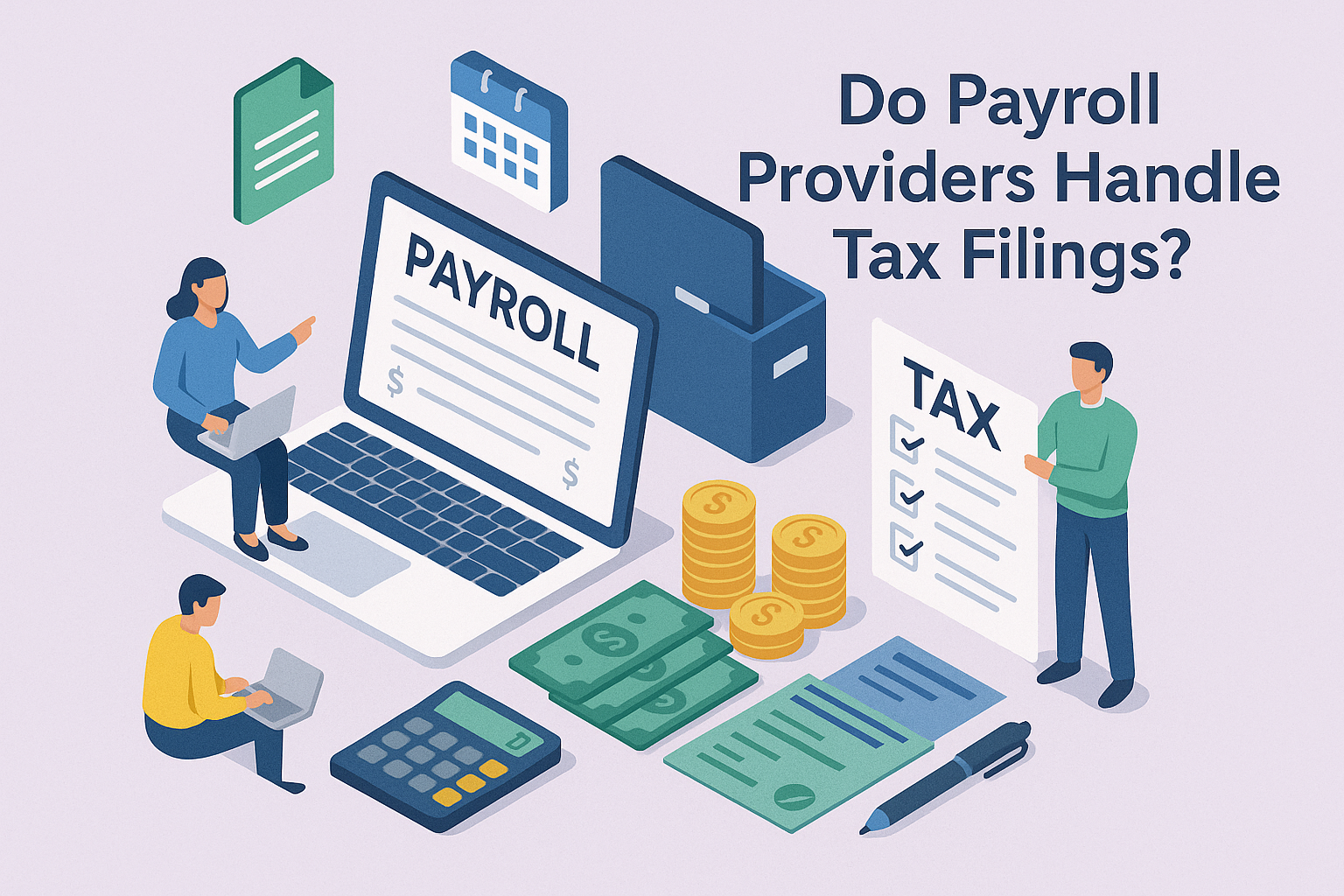
The scope varies by provider, jurisdiction, and service agreement. Ask whether the provider only calculates taxes or also deposits funds and files returns. Employers should also know who handles prior-period corrections, tax notices, local payroll taxes, and filings for new jurisdictions. That is exactly where many employers get tripped up, which is why Do Payroll Providers Handle Tax Filings from Start to Finish? is a useful resource if you are comparing support models or pressure-testing what your current provider actually owns.
Using a payroll provider does not eliminate the employer's responsibility for federal employment taxes. The IRS recommends that employers enroll in EFTPS and periodically verify payments even when a third party makes deposits or files returns on their behalf. See the IRS guidance on outsourcing payroll duties.
Lift HCM pairs payroll technology powered by isolved with payroll tax filing support and a dedicated service contact. Employers evaluating any provider can use our guide to full-service payroll tax filing to compare what is included and what may require separate support.
Frequently Asked Questions About Form 941 vs. Form 944
Can I File Form 944 If I Owe Less Than $1,000?
Only if the IRS has notified you in writing that you may or must file Form 944. Owing $1,000 or less may make you eligible, but it does not authorize the change by itself.
What If My Form 944 Liability Exceeds $1,000 During the Year?
Continue following the filing requirement in your IRS notice unless the IRS approves a change. You may need to make tax deposits during the year even though you will still file one annual Form 944.
Does Filing Form 944 Mean I Pay Payroll Taxes Only Once a Year?
Not always. Employers with less than $2,500 in total annual Form 944 tax may generally pay with the timely filed return. Higher liabilities can trigger quarterly, monthly, semiweekly, or next-day deposit requirements even though the return itself is annual.
Can a New Employer Choose Form 944 on Form SS-4?
A new employer may indicate on Form SS-4 that it expects to have $1,000 or less in annual employment tax liability and would like to file Form 944. The employer should follow the filing requirement shown in the IRS notice it receives.
Do Forms 941 and 944 Include Federal Unemployment Tax?
No. FUTA tax is generally reported on Form 940. Form 940 filing and deposit rules are separate from Forms 941 and 944.
Does an Extension to File Also Extend the Deposit Deadline?
No. The later filing date for employers that deposited all taxes on time and in full does not extend any deposit deadline.
The Bottom Line: Master Your Payroll Tax Compliance
For most employers, Form 941 is the quarterly return used to report federal income tax withholding and Social Security and Medicare taxes. Form 944 is an annual alternative for certain very small employers, but only when the IRS authorizes or requires it in writing.
The safest approach is to follow the filing requirement shown in your IRS notice, keep filing and deposit schedules separate, and ask for help quickly if your records do not match the return the IRS expects.
At Lift HCM, we help employers manage payroll calculations, tax deposits, filings, and related records through a connected payroll process backed by dedicated support. If you want another set of eyes on your current setup, contact Lift HCM to discuss your payroll tax filing process.
Topics:








.jpg?width=4000&height=3723&name=stack-papers-tax-concept-illustration(1).jpg)




.jpeg?width=1344&height=768&name=two%20binders%20stacked%20on%20top%20of%20eachother%20on%20top%20of%20paperwork%20and%20a%20calculator(1).jpeg)


.jpeg?width=1792&height=1024&name=glass%20jar%20on%20a%20restaurant%20table%20top%20bar%20with%20someone%20putting%20cash%20tips%20in%20it(1).jpeg)
