
.jpg?width=5000&height=3851&name=account-assets-audit-bank-bookkeeping-finance-concept(1).jpg)
Life is unpredictable. One day, your finances are perfectly in order, and the next, an emergency expense throws everything off balance. If you’re a federal employee, you may have a steady paycheck, but that doesn’t mean surprise costs (like medical bills, home repairs, or sudden travel) won’t disrupt your budget.
Traditional loans can be stressful, with high interest rates and manual payments that add to your financial worries. That’s where federal employee payroll deduction loans come in: a structured, predictable way to borrow money without the hassle of manual repayments. Just keep in mind that “structured” doesn’t always mean “cheap,” and the right option depends on the lender and your job situation.
At Lift HCM, we understand the financial challenges you face. In this article, we’ll walk you through how payroll deduction loans work (including payroll allotments and Thrift Savings Plan loans), their benefits, potential downsides, lower-cost alternatives to compare, and how to apply. By the end, you’ll clearly understand whether this type of loan is right for you.
Table of Contents
- What is a Federal Employee Payroll Deduction Loan?
- Why Federal Employees Use These Loans
- How Federal Employee Payroll Deduction Loans Work
- TSP Loans: The Other Federal Payroll Deduction Loan
- Lower-Cost Alternatives to Compare First
- Key Benefits of Payroll Deduction Loans
- Potential Drawbacks to Consider
- Who Qualifies? Key Eligibility Requirements
- Is a Payroll Deduction Loan Right for You?
- Frequently Asked Questions
- Take Control of Your Financial Future
What is a Federal Employee Payroll Deduction Loan?
A federal employee payroll deduction loan, often called an allotment loan, is a personal loan tailored for federal government employees. Repayment is made through automatic deductions from the borrower’s paycheck, set up as a payroll allotment through the employee’s agency payroll system. Credit unions, banks, and specialized lenders typically offer these loans to serving government employees.
The other common federal payroll deduction loan is a Thrift Savings Plan (TSP) loan, where you borrow from your own retirement account and repay yourself through payroll deductions. Both are covered below.
For federal employees, a payroll deduction loan offers a structured way to borrow money with predictable repayment. Because automatic payroll deductions can lower a lender’s risk, some lenders (credit unions in particular) may offer competitive rates. That isn’t guaranteed: some lenders that market to federal workers charge very high APRs, so always compare the annual percentage rate (APR) and the total repayment cost.
How This Loan Stands Out
- Fewer missed payments: Payments are deducted automatically, so you don’t have to remember due dates.
- Potentially lower rates: Some lenders offer better rates because of the lower risk of non-payment, but rates vary widely, so compare APRs.
- Predictable payments: Knowing exactly how much is deducted each paycheck makes budgeting easier.
Why Federal Employees Use These Loans
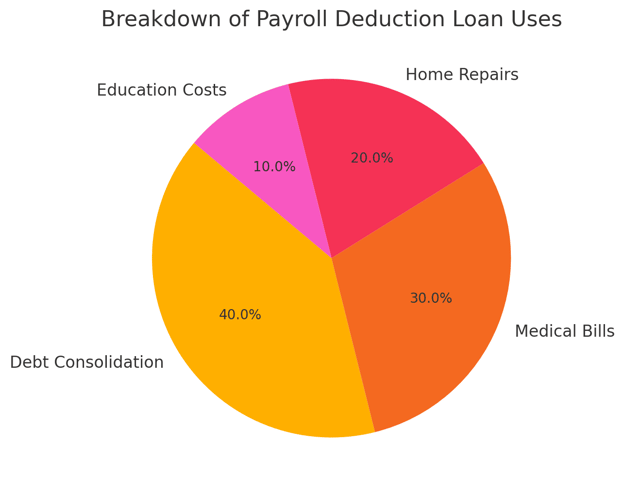
Even with a steady government salary, unexpected expenses can catch anyone off guard. Here are a few common scenarios where federal employees rely on payroll deduction loans:
1. Emergency Medical Bills
Even with insurance, copays, deductibles, or uncovered treatments can add up quickly. A payroll deduction loan can provide quick access to funds without using high-interest credit cards.
2. Urgent Home Repairs
When the HVAC system breaks down in the middle of winter or a plumbing issue floods your home, waiting isn’t an option. These loans can help cover unexpected repairs without draining your savings.
3. Debt Consolidation
If you’re juggling multiple debts—such as credit cards with high interest rates—consolidating them into one lower-interest loan with fixed payments can be a game-changer for your financial health.
4. Education Costs
Whether it’s covering tuition, books, or professional certifications, these loans offer a structured way to invest in your future without the burden of irregular payments.
How Federal Employee Payroll Deduction Loans Work
Here’s a step-by-step look at how these loans function:
Eligibility
- Typically available to federal civilian employees and, at some lenders, postal, military, or state and municipal workers. Eligibility depends on the lender and on whether your payroll provider supports the deduction.
- The borrower must have a stable employment record and meet the minimum income and credit requirements the lender sets.
- Active-duty servicemembers are covered by the Military Lending Act, which caps the Military APR at 36% on most consumer loans and prohibits lenders from requiring a military allotment as a condition of the loan.
Application Process
- The borrower applies for the loan through a participating lender.
- The lender verifies employment, salary, and repayment capability.
- Loan terms (interest rate, repayment schedule) are determined based on creditworthiness and employment status.
Payroll Deduction Setup
- Once approved, the loan repayment is set up as an automatic deduction from the borrower’s paycheck.
- The agency’s payroll provider processes the allotment and sends payments to the lender, reducing the risk of missed payments. The deduction will also show up on your pay stub.
- If you leave federal service or change agencies, the allotment typically ends, but you still owe the loan balance. Contact your lender right away to arrange repayment.
Loan Terms
- Loan amounts vary based on the borrower’s income and lender policies.
- Interest rates vary widely by lender. Some credit unions offer low rates, while some high-cost lenders charge APRs far above 36%, so compare the APR, fees, and total repayment amount, not just the monthly payment.
- Repayment terms range from a few months to several years, depending on the loan amount and agreement.
-1.png?width=2610&height=1589&name=_-%20visual%20selection%20(3)-1.png)
TSP Loans: The Other Federal Payroll Deduction Loan
Federal employees who contribute to the Thrift Savings Plan (TSP) can also borrow from their own account and repay the loan through payroll deductions. Here are the key points:
- Two loan types: A general purpose loan can be used for any reason and is repaid over 1 to 5 years. A residential loan is for buying or building a primary residence, requires documentation, and can be repaid over up to 15 years.
- Cost: There is no credit check. The interest rate matches the G Fund rate and stays fixed for the life of the loan, and the interest you pay goes back into your own TSP account. A one-time fee of $50 (general purpose) or $100 (residential) applies. The rate changes monthly, so check tsp.gov for the current loan rate.
- Limits: The minimum loan is $1,000. The maximum is $50,000, reduced by any outstanding loan balances and limited by your own contributions and earnings.
- Trade-offs: Money you borrow is out of the market while you repay it, so you can miss investment growth. If you separate from federal service with an unpaid balance and don’t repay it, the TSP may treat the outstanding amount as a taxable distribution, which could also carry an early withdrawal penalty. Confirm the details on the TSP loans page before borrowing.
Lower-Cost Alternatives to Compare First
- FEEA emergency loans: The Federal Employee Education and Assistance Fund (FEEA) offers no-interest emergency hardship loans of up to $2,000 to eligible federal civilian and postal employees. A qualifying hardship and at least one year of service are required, so check the FEEA site for current eligibility.
- Credit union loans: Many federal employees can join a credit union that offers small personal loans at lower, capped rates. Federal credit unions’ Payday Alternative Loans, for example, are capped at 28% APR and are for small amounts (up to $2,000 for PAL II), though not every credit union offers them. Ask the credit union about current terms.
Key Benefits of Payroll Deduction Loans
For federal employees, the advantages of these loans include:
- Convenience: No need to remember payment deadlines, since everything is automated.
- Potentially lower rates: Some lenders, especially credit unions, and the TSP loan program offer better rates than credit cards or unsecured personal loans. Compare APRs, because not every allotment lender does.
- Budget-friendly: Fixed repayment amounts make it easier to manage monthly expenses.
- Fewer late payments: Since payments are automatic, you’re less likely to miss a due date, as long as the deduction continues.
Potential Drawbacks to Consider
While these loans offer great benefits, they also come with some downsides:
- Limited flexibility: Since deductions are automatic, you have less control over your paycheck.
- Payroll involvement: Your agency’s payroll office processes the deduction, which could raise privacy concerns for some borrowers.
- Job change risk: The deduction usually stops if you leave federal service or change agencies, but the loan doesn’t go away. You’ll need to repay the balance another way.
- Potentially high costs: Some lenders that market to federal employees charge APRs far above 36%, and a low monthly payment can hide a high total cost.
- Eligibility requirements: Not all employees qualify, especially those with irregular income or existing high debt loads.

Who Qualifies? Key Eligibility Requirements
Lenders typically consider several criteria when evaluating federal employee payroll deduction loan applicants. Requirements are set by each lender, so treat the items below as general examples, not fixed rules.
1. Employment Requirements
- Must be an active federal employee.
- Minimum length of employment: set by the lender.
- Employment verification is required via a recent pay stub or employment letter.
2. Income Stability
- Consistent income: a minimum monthly income set by the lender.
- Proof of income: recent pay stubs or direct deposit statements.
- Ability to meet loan payment requirements without exceeding the lender’s debt-to-income (DTI) limit.
3. Creditworthiness
- Minimum credit score: set by the lender. Some lenders don’t check credit at all, which often means higher rates and fees.
- Soft or hard credit pull to assess borrowing history.
- No recent bankruptcies or significant delinquencies.
4. Debt-to-Income (DTI) Ratio
- DTI is often capped at a lender-set level to ensure the borrower can afford the loan repayments alongside existing debts.
5. Loan Amount and Terms
- Loan limits: set by the lender based on income and credit profile (TSP loans have their own limits, described above).
- Fixed repayment terms: vary by lender and loan type.
- Interest rate: varies widely by lender and credit profile, from relatively low rates at some credit unions and on TSP loans to well above 36% APR at some high-cost lenders. Always compare the APR.
6. Payroll Participation
- Your agency’s payroll provider must be able to process the allotment. Federal employees typically authorize it through their agency payroll or HR system.
- Some lenders require agency authorization forms or specific arrangements with federal payroll systems.
7. Other Documentation
- Valid government-issued photo ID (e.g., passport, driver’s license).
- Proof of residency (e.g., utility bill or lease agreement).
- Bank account details for disbursal of loan funds.
8. Additional Factors
- Some lenders may offer flexibility for borrowers with lower credit scores if other factors, such as job stability, are substantial.
Is a Payroll Deduction Loan Right for You?
Consider this loan if you:
- Need a structured repayment plan with automatic deductions
- Want to avoid high-interest debt like credit cards
- Have predictable income and can afford the deductions
- Have compared the APR against a TSP loan, FEEA loan, or credit union loan
It might not be the best choice if you:
- Prefer flexibility in how you make payments
- Have a budget that fluctuates, where automatic deductions might create financial strain
- Are concerned about privacy with payroll involvement
- Are concerned about job security, since the deduction stops if you leave federal service but the balance remains
Frequently Asked Questions
What is a federal employee payroll deduction loan?
It is a loan repaid through automatic payroll deductions. Most are set up as a payroll allotment through your agency, while a TSP loan is repaid to your own retirement account through payroll deductions.
Are allotment loans cheaper than other personal loans?
Not necessarily. Rates vary widely by lender, and some lenders that market to federal employees charge very high APRs. Compare the APR and total repayment cost, and consider a TSP loan, FEEA loan, or credit union loan first.
What happens to my loan if I leave federal service?
The payroll deduction typically stops, but you still owe the balance, so contact your lender right away. For a TSP loan, an unpaid balance may be treated as a taxable distribution.
Do military servicemembers get extra protections?
Yes. The Military Lending Act caps the Military APR at 36% on most consumer loans for active-duty servicemembers and covered dependents, and lenders cannot require a military allotment to get the loan.
This information is for educational purposes only and is not intended to replace legal counsel. Confirm current rules and terms with your agency payroll office, your lender, the TSP (tsp.gov), or a qualified financial or legal professional before borrowing.
Take Control of Your Financial Future
Navigating the financial uncertainties of life can be daunting, especially when unexpected expenses arise. For federal employees, payroll deduction loans can offer a structured, predictable way to borrow, but they are not automatically cheap or risk-free. Compare the APR, weigh lower-cost options like TSP and FEEA loans, and think through what happens if your pay stops.
By understanding the workings, benefits, and potential drawbacks of these loans, you can make an informed decision that aligns with your financial goals. At Lift HCM, we are committed to helping you take control of your financial future with confidence and ease.
Business owners and HR leaders: Any deduction from an employee’s pay has to be processed accurately and on time. Lift HCM’s payroll and tax management solutions help employers run payroll with built-in compliance controls, including garnishment and agency payment administration, and our benefits administration tools keep benefit elections in sync with payroll deductions, so deductions are handled correctly.

Topics:




.png?width=1536&height=1024&name=Create%20a%20background%20that%20reads%2c%20How%20Long%20to%20Keep%20P%20(1).png)