

Hiring decisions become harder to explain when every manager follows a different process. One interviewer asks detailed behavioral questions. Another has a casual conversation and decides whether the candidate feels right. Feedback arrives late, expectations shift, and the team struggles to explain why one person advanced while another did not.
That does not mean your managers are careless. It usually means they are making important hiring decisions without shared criteria, clear ownership, or consistent tools.
Lift HCM helps growing companies connect recruiting, hiring, onboarding, and payroll more effectively. We often see that hiring problems do not begin with a lack of effort. They begin when the process depends too heavily on individual habits. This article explains how to build a structured hiring process that your team can repeat, measure, and improve without creating a cold or unnecessarily long candidate experience.
Quick Answer: What Is a Structured Hiring Process?
A structured hiring process is a repeatable method for evaluating candidates using consistent, job-related criteria. It defines what success looks like before recruiting begins and typically includes a role scorecard, standardized screening stages, structured interviews, independent feedback, documented decision rules, and a clear transition into onboarding.
Key Takeaways
- Define the role and its measurable outcomes before posting the position.
- Evaluate candidates against a shared scorecard instead of personal chemistry.
- Ask the same core, job-related questions and use consistent scoring standards.
- Give candidates a clear way to request reasonable accommodations.
- Require interviewers to submit evidence-based feedback before the group debrief.
- Use technology to support the process, but do not expect software to fix unclear criteria.
- Review hiring outcomes so the process improves over time.
Table of Contents
What Is a Structured Hiring Process?
A structured hiring process is a repeatable method for defining a role, attracting candidates, evaluating their qualifications, making a selection, and moving the chosen candidate into onboarding. Each stage has a clear purpose, an owner, and criteria for deciding who moves forward.
The goal is not to remove human judgment. Hiring will always require judgment. The goal is to make that judgment more consistent and job-related by giving managers shared information, questions, and scoring standards.
Structure should not make interviews cold or robotic. Interviewers can still build rapport, answer questions, and respond naturally to candidates. What stays consistent is the core information being evaluated and the standard used to evaluate it.
This is especially important for growing businesses. When several managers hire independently, small differences in their methods can quickly turn into inconsistent candidate experiences, delayed decisions, duplicated work, and uneven hiring quality.
Structured hiring is one part of the broader HR infrastructure growing companies need. This guide focuses specifically on the decisions, tools, and handoffs involved in filling an open position.
Why Does a Structured Hiring Process Matter?
A structured hiring process helps a company make more consistent decisions while using managers’ time more effectively. It also creates clearer records of the job-related reasons candidates advanced or were declined.
The U.S. Office of Personnel Management reports that interviews with higher degrees of structure generally show stronger validity, rater reliability, rater agreement, and consistency. Questions tied to competencies identified through job analysis also tend to produce stronger assessments than loosely connected conversational questions.
Structure can also reduce unnecessary delays. According to SHRM’s 2026 recruiting benchmark, the median time-to-fill for nonexecutive roles was 39 calendar days. That is a benchmark, not a required target for every organization. The appropriate timeline depends on the role, labor market, screening requirements, and number of decision-makers. Still, when managers know what they are evaluating and when feedback is due, avoidable internal delays become easier to identify.
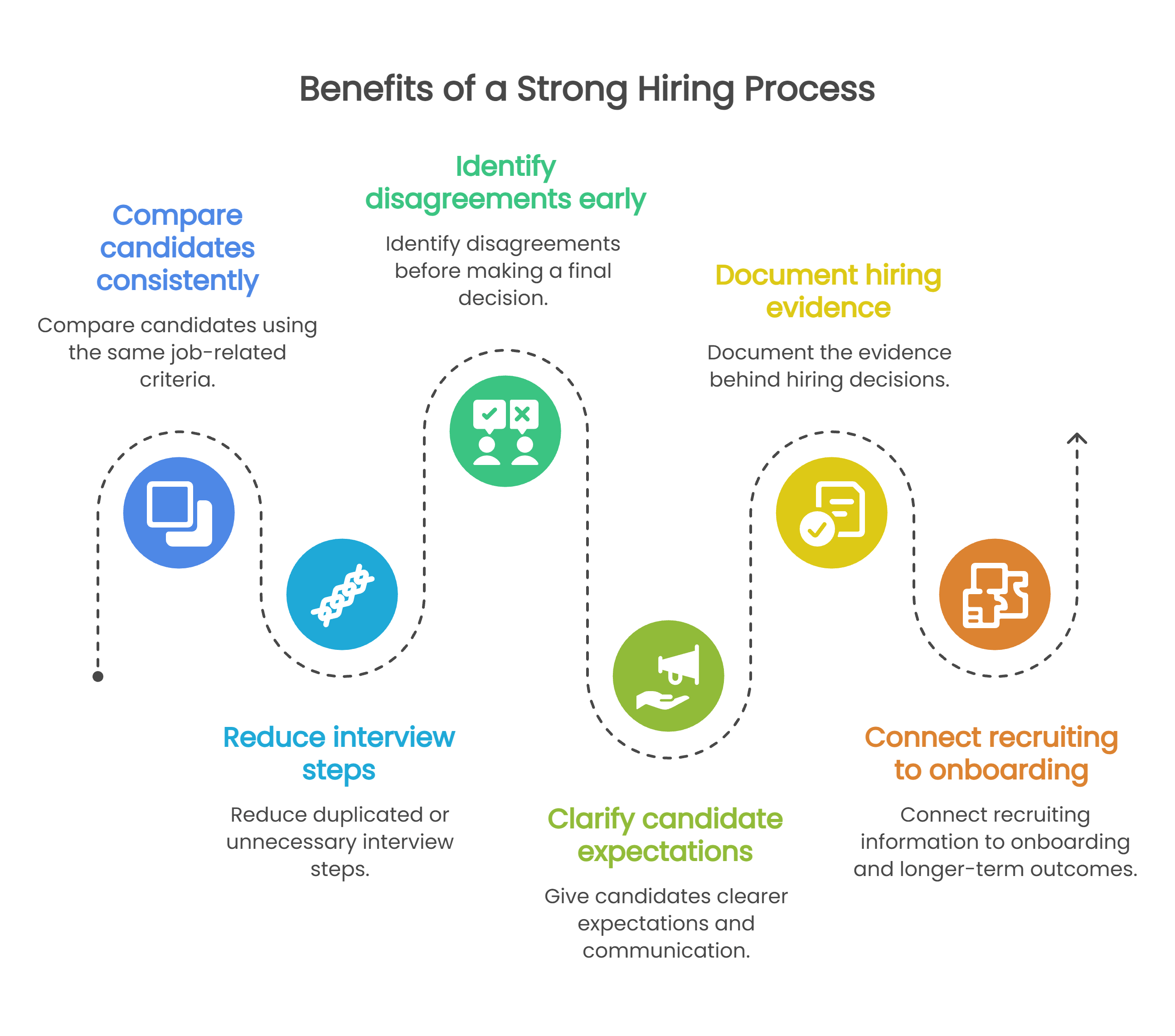
A strong process can help you:
- Compare candidates using the same job-related criteria
- Reduce duplicated or unnecessary interview steps
- Identify disagreements before the final decision
- Give candidates clearer communication and expectations
- Document why candidates advanced or were declined
- Connect recruiting data to onboarding and longer-term performance
What Are the Most Common Hiring Process Mistakes?
The most common hiring mistakes occur when recruiting starts before the team agrees on the role, evaluation criteria, or decision process. That leaves each interviewer to create a personal definition of a strong candidate.
|
Hiring Mistake |
Why It Creates a Problem |
|
Posting before defining success |
Interviewers evaluate candidates against different assumptions about the role. |
|
Treating interviews as casual conversations |
Candidates are asked different questions, making fair comparison difficult. |
|
Using vague scorecards |
Labels such as "good communicator" or "culture fit" do not define observable evidence. |
|
Discussing candidates before scoring |
The first or most senior speaker can influence other interviewers' opinions. |
|
Adding interviews without a purpose |
Repeated stages consume time without producing new evidence. |
|
Ignoring candidate experience |
Delays, repeated questions, and inaccessible systems can cause candidates to leave. |
Each stage should answer a defined question and produce information the team does not already have. Structure should make hiring clearer for both the employer and the candidate, not create unnecessary bureaucracy.
How Do You Build a Structured Hiring Process?
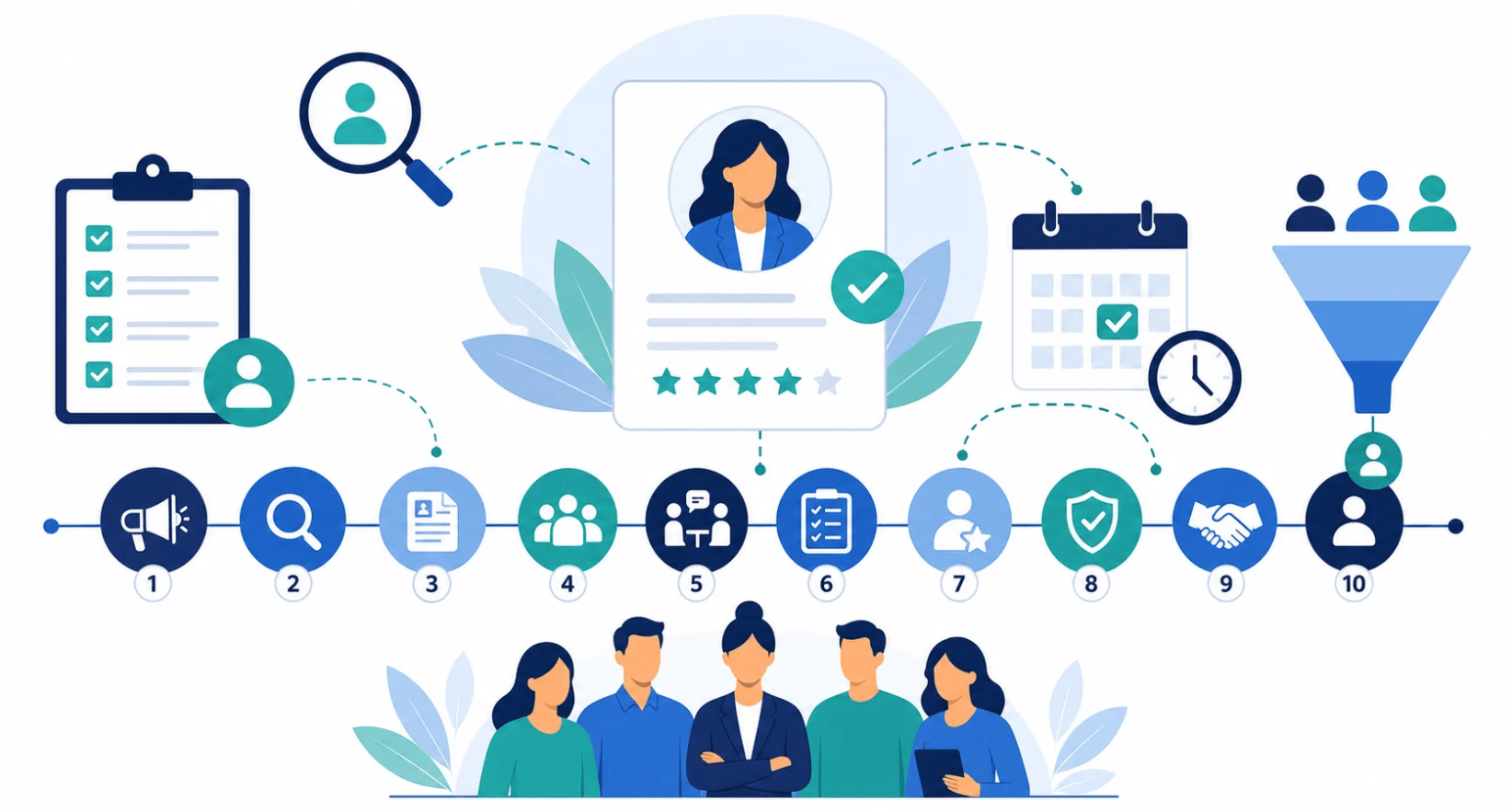
You build a structured hiring process by defining the business need, deciding what success looks like, assigning ownership, and creating consistent evaluation rules before recruiting begins. The following ten steps create an end-to-end framework that can be adapted to different roles.
1. Confirm the Business Need and Approval
Start by documenting why the role is needed. Is it a replacement, new headcount, a seasonal requirement, or a response to increased demand? Confirm the budget, employment status, reporting relationship, location, target start date, and person authorized to approve the hire.
This prevents a team from sourcing candidates for a role that is still changing or has not received final approval.
2. Define the Role and Measurable Outcomes
Translate the job description into outcomes. Instead of listing only activities, define what the employee should accomplish in the first 30, 60, or 90 days and what success should look like after the first year.
For example, “manage customer escalations” describes an activity. “Resolve escalated customer issues within the company’s service standard and reduce repeat complaints” describes an outcome that can be evaluated.
3. Create a Candidate Scorecard
List the technical competencies, behavioral competencies, and required qualifications for the role. Define what weak, acceptable, and strong evidence looks like for each category.
Separate true requirements from preferences. If every preference becomes a requirement, qualified candidates may be screened out before a manager reviews their experience.
4. Establish the Recruiting and Screening Plan
Decide where the role will be promoted, who reviews applications, which screening criteria are used, and how quickly candidates should receive a response. Determine whether employee referrals, job boards, direct sourcing, or external recruiting support are appropriate.
Use the same job-related screening criteria for every applicant. Avoid changing requirements midway through the search unless the hiring team formally recalibrates the role.
5. Design the Interview Process
Assign each interview stage a clear objective. An initial screen may confirm basic requirements and candidate interest. A hiring manager interview may assess role-specific experience. A panel or work sample may evaluate the candidate’s approach to realistic job situations.
Ask each candidate the same core questions for the role and score answers against the same standards. Interviewers can ask predefined follow-up questions when clarification is needed, but the evaluation criteria should remain consistent.
6. Make the Process Accessible
Give applicants a clear way to request reasonable accommodations. Accessibility may affect applications, assessments, scheduling, interview locations, communication formats, and technology.
Recruiters and managers should know where to direct accommodation requests. According to the U.S. Equal Employment Opportunity Commission, employers generally may not ask disability-related questions or require medical examinations before making a conditional offer, although they may ask whether an applicant can perform specific job functions.
Consistency does not require an identical format in every circumstance. An accommodation may change how a candidate participates while the essential competencies and decision standards remain the same.
7. Collect Independent, Evidence-Based Feedback
Require interviewers to submit feedback before seeing other reviewers' scores. Notes should reference something the candidate said, demonstrated, or completed rather than a broad impression.
"Strong communicator" is an impression. "Explained a complex customer issue in clear steps and confirmed the listener's understanding" is observable evidence.
Set a reasonable feedback deadline. Prompt feedback preserves details and helps prevent candidates from stalling while the team waits for notes.
8. Complete Appropriate References and Screening
Determine which reference checks, background checks, license verifications, or assessments are appropriate and lawful. Apply them consistently and follow applicable federal, state, and local requirements.
When technology or artificial intelligence affects who advances, understand what information the tool uses, how its output influences a decision, and whether a person can review or override the result. The EEOC and U.S. Department of Justice have warned that automated hiring tools can create disability-discrimination risk. A vendor's involvement does not remove the employer's responsibility for how the tool is used.
For additional guidance, review Lift HCM's 2026 employer background check compliance playbook. If this resource is helpful, check out Background Check Laws by State (2026): What Employers Can and Can't Ask.
9. Make and Document the Selection Decision
After independent feedback is submitted, review the scorecard, discuss conflicting evidence, and identify whether any required competency remains unverified.
The highest numerical score should not automatically determine the hire. Scores organize the evidence, but the decision should also account for required qualifications, reference or screening results, and decision rules established before interviews began.
Document the job-related reasons for the decision. Avoid vague notes such as "not a fit" or comments about appearance, personality, family status, age, health, or other information unrelated to the position.
Define who approves compensation, prepares the offer, communicates with finalists, and begins onboarding. Lift HCM's guide to digital onboarding and the new-hire experience explains what should happen after an offer is accepted.
10. Review Results and Improve the Process
Compare the original scorecard with early performance and retention results. Look for patterns across several hires rather than judging the process based on one employee.
Useful measures include:
- Time-to-fill: Days from opening the requisition to accepting an offer
- Time-to-hire: Days from a candidate entering the process to accepting an offer
- Stage conversion rate: Percentage of candidates who move from one stage to the next
- Candidate withdrawal rate: Percentage of candidates who leave the process voluntarily
- Offer-acceptance rate: Percentage of formal offers that are accepted
- First-year retention: Percentage of new hires who remain employed after one year
- Quality of hire: A defined combination of early performance, retention, manager feedback, and role-specific results
Establish each definition before reporting it. If managers start the time-to-fill clock at different points, their results will not be comparable.
What Does a Strong Hiring Scorecard Look Like?
A strong hiring scorecard defines what the company is evaluating, how important each competency is, what evidence interviewers should collect, and how scores are assigned. It should be specific enough that two trained interviewers can review the same answer and understand why it received a particular rating.
Below is a simplified example for a customer service team lead.
|
Competency |
Weight |
What Strong Looks Like |
Sample Interview Question |
Evidence to Record |
Score |
|
Conflict Resolution |
30% |
Resolves escalated issues using a repeatable process and identifies the cause of repeat problems. |
Tell me about a time you de-escalated an angry customer. What did you do, and what was the outcome? |
Actions taken, reasoning, result, and follow-up. |
1–5 |
|
Team Coaching |
30% |
Uses specific feedback and follow-up to improve another employee’s performance. |
Describe a time you helped a struggling employee improve. What specifically changed? |
Coaching method, expectations, and measurable change. |
1–5 |
|
Process Improvement |
25% |
Identifies a workflow problem, implements a practical change, and measures the result. |
Walk me through a process you improved in a previous role. |
Problem, proposed change, implementation, and result. |
1–5 |
|
Communication |
15% |
Explains complex information clearly and adjusts the message for the audience. |
Tell me about a time you had to explain an unpopular decision. |
Audience, message, response, and outcome. |
1–5 |
A basic scoring scale might look like this:
- 1: No relevant example or evidence
- 2: Limited evidence that does not meet the role’s needs
- 3: Adequate evidence that meets the expected standard
- 4: Strong evidence with a clear, relevant result
- 5: Exceptional evidence with repeatable results or broader impact
Do not let the total score hide a missing requirement. If conflict resolution is essential for the role, a high overall score should not compensate for a lack of evidence in that competency.
Structured vs. Unstructured Interviews: What Is the Difference?
Structured interviews use consistent, job-related questions and scoring standards. Unstructured interviews allow the questions and evaluation method to change with each candidate or interviewer.
|
Factor |
Unstructured Interview |
Structured Interview |
|
Questions |
Change with the interviewer or conversation |
Same core questions for candidates applying to the same role |
|
Evaluation |
General impression or informal notes |
Predefined, job-related scoring criteria |
|
Candidate Comparison |
Candidates may be evaluated using different information |
Candidates are compared against the same competencies |
|
Feedback |
Often discussed before individual scores are recorded |
Submitted independently before the debrief |
|
Documentation |
Limited explanation for the decision |
Clearer record of the job-related evidence considered |
|
Interviewer Training |
May depend on personal experience |
Includes guidance on questions, scoring, and prohibited topics |
Structured interviews do not eliminate bias or guarantee a successful hire. They reduce opportunities for irrelevant preferences and inconsistent criteria to influence the decision. They work best when questions come from a careful analysis of the role and interviewers are trained to apply the scoring rubric consistently.
What Compliance Guardrails Should Be Part of the Process?
Compliance should be built into the hiring workflow instead of added at the end. Federal, state, and local requirements can affect job advertisements, interview questions, assessments, background checks, accommodations, recordkeeping, and offer procedures.
The EEOC recommends analyzing the duties and competencies relevant to a job, creating objective qualification standards, and applying those standards consistently. The EEOC also advises employers to avoid interview questions about protected personal characteristics, including race, religion, pregnancy, national origin, and age except where a lawful age requirement applies.
Your process should include the following guardrails:
- Use criteria that are related to the duties and requirements of the position.
- Apply the same core evaluation standards to candidates for the same role.
- Train interviewers on questions they should not ask.
- Provide reasonable accommodations during the application and interview process when required.
- Review tests and assessments for job relevance and potential adverse effects.
- Follow applicable background-check and pre-adverse-action procedures.
- Document who can access candidate information and how long records are retained.
- Check state and local requirements, including pay-transparency and fair-chance hiring laws where applicable.
Covered private employers generally must retain many applications and hiring records for one year from the date the record was created or the personnel action occurred, whichever is later. Different periods apply to certain employers and circumstances, and records related to a discrimination charge must be kept until final disposition. The EEOC recordkeeping summary is a useful federal starting point, but employers should confirm their complete schedule with qualified counsel.
Illinois Note: AI Used in Hiring
Illinois employers should conduct an additional review when artificial intelligence is used in recruitment or hiring. Effective January 1, 2026, Public Act 103-0804 amended the Illinois Human Rights Act to address the use of AI in employment decisions. Among other provisions, the law prohibits covered uses that result in discrimination based on protected classes, prohibits using ZIP codes as a proxy for protected classes, and includes notice requirements.
The requirements can depend on the tool, use case, implementing rules, and people affected. Illinois employers should confirm their notice, documentation, accommodation, and review procedures with qualified counsel.
This article provides general educational information and is not legal advice.
How Can an ATS Support a Structured Hiring Process?
An applicant tracking system can centralize job approvals, applications, candidate communication, interview schedules, scorecards, feedback, and reporting. This makes it easier for hiring teams to follow the same workflow and see where candidates are in the process.
Technology is most helpful after the company has defined its process. An ATS cannot decide what success looks like for a role or determine which competencies matter most. Automating an unclear process can simply make inconsistent decisions happen faster.
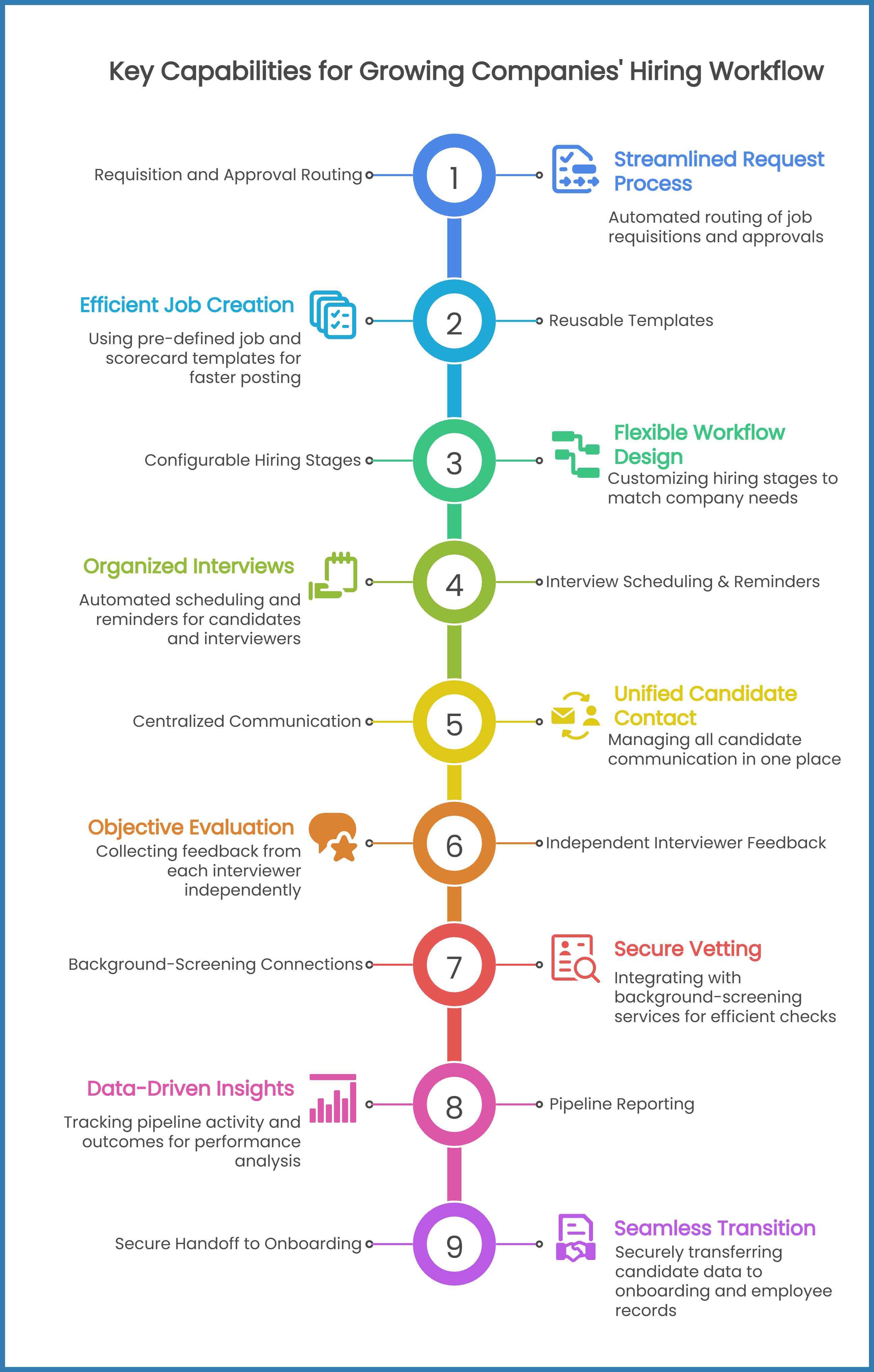
Growing companies should look for capabilities that support their established workflow, such as:
- Requisition and approval routing
- Reusable job and scorecard templates
- Configurable hiring stages
- Interview scheduling and reminders
- Centralized candidate communication
- Independent interviewer feedback
- Background-screening connections where available
- Reporting on pipeline activity and outcomes
- A secure handoff into onboarding and employee records
If you are still determining what type of platform you need, start with our explanation of how applicant tracking systems work. When you are ready to compare options, review the best applicant tracking systems for growing businesses.
How Should You Measure Hiring Process Results?
Measure whether the process is timely, consistent, and producing employees who succeed in the role. No single metric tells the entire story, so combine process measures with longer-term outcomes.
Useful measures include:
- Time-to-fill: Days from opening the requisition to accepting an offer
- Time-to-hire: Days from a candidate entering the process to accepting an offer
- Stage conversion rate: Percentage of candidates who move from one stage to the next
- Candidate withdrawal rate: Percentage of candidates who leave the process voluntarily
- Offer-acceptance rate: Percentage of formal offers that are accepted
- First-year retention: Percentage of new hires who remain employed after one year
- Quality of hire: A defined combination of early performance, retention, manager feedback, and role-specific outcomes
Establish definitions before reporting the numbers. For example, if different managers start the time-to-fill clock at different points, the comparison will not be reliable.
Frequently Asked Questions
What Is the Difference Between Recruiting and Hiring?
Recruiting focuses on attracting and engaging potential candidates. Hiring is the broader process that includes defining the role, recruiting, screening, interviewing, selecting, offering the job, and preparing the new employee for onboarding.
How Many Interview Steps Should a Hiring Process Include?
Use the fewest interview stages needed to evaluate the role’s essential competencies. Many positions may require an initial screen and one or two focused interviews. Specialized, leadership, or safety-sensitive roles may require additional assessments or approvals. Every stage should have a purpose that is not already covered elsewhere.
How Can a Company Reduce Bias in Hiring?
A company can reduce subjectivity by using job-related criteria, consistent core questions, behaviorally anchored scorecards, trained interviewers, and independent feedback. These practices do not eliminate bias, but they make irrelevant preferences easier to identify and challenge.
What Does It Cost to Build a Structured Hiring Process?
The largest initial cost is usually staff time. Managers and HR need time to define the role, create scorecards, design questions, train interviewers, and configure the workflow. Software may add licensing or implementation costs, but a small company can begin with documented templates and shared evaluation rules before purchasing a dedicated ATS.
Does a Small Business Need an Applicant Tracking System?
Not every small business needs an ATS. A company that hires only occasionally may be able to manage a consistent process with secure templates and clearly assigned responsibilities. An ATS becomes more valuable when hiring volume increases, several managers participate, candidate communication becomes difficult to track, or information is spread across inboxes and spreadsheets.
How Long Should the Hiring Process Take?
There is no universal ideal timeline. The role, labor market, screening requirements, and number of decision-makers all affect the process. Set realistic response deadlines for each stage, communicate the timeline to candidates, and monitor where internal delays occur instead of relying on one benchmark for every role.
Build a Hiring Process Your Team Can Repeat
A structured hiring process does not require a large recruiting department. It requires agreement about what the role needs, how candidates will be evaluated, who owns each step, and how the final decision will be documented.
Start with one upcoming opening. Define the outcomes expected from the role, build a one-page scorecard, assign each interview stage a clear purpose, and require independent feedback before the debrief. Once the team has used the process, review what worked and improve it before the next search.
At Lift HCM, we help growing businesses connect recruiting and applicant tracking with onboarding, payroll, and the rest of the employee lifecycle. If disconnected systems or inconsistent workflows are making hiring harder to manage, explore Lift HCM’s recruiting and applicant tracking solution or contact our team to discuss what a more connected process could look like for your organization.

Topics:






.jpg?width=3000&height=2000&name=digital%20onboarding%20image%20(1).jpg)



.jpeg?width=1024&height=1024&name=happy%20employees%20working%20together%20outside%20in%20the%20fall%20time(1).jpeg)



-1.jpg?width=1000&height=550&name=Businessman%20hand%20typing%20with%20cloud%20technology%20system%20and%20office%20symbol%20concept%20(1)-1.jpg)
