

Is your hiring process a never-ending cycle of missed deadlines, hundreds of resumes, and not enough qualified candidates? You’re not alone. Many HR professionals today find themselves buried under endless applications, struggling to keep up in a fast-moving market where top talent is snatched up almost instantly. And without the right system in place, it’s easy to feel like you're always playing catch-up, stuck in a process that’s chaotic, time-consuming, and inefficient.
At Lift HCM, we get it. We’ve worked with countless organizations that were drowning in recruitment chaos until they found the right tools to streamline the process. With our extensive experience in the human capital management and payroll industry, we’ve seen firsthand how an efficient Applicant Tracking System (ATS) can transform the way businesses hire. The right ATS isn’t just a software—it’s the key to managing your recruitment pipeline with ease, speed, and precision.
This guide breaks down the best ATS platforms for growing businesses, with an honest look at what each one does well, where each falls short, and which workflow features matter most when your hiring volume increases.
Table of Contents
- Workday Recruiting
- Greenhouse
- BambooHR
- JazzHR
- Lever
- iCIMS Talent Cloud
- Jobvite
- SmartRecruiters
- Bullhorn
- What Approval Routing Features Should Your ATS Include?
- How Do Requisition Templates Save Time When Hiring Volume Increases?
- Frequently Asked Questions About Applicant Tracking Systems
- Choosing an ATS That Grows With Your Business
We have already explained what an applicant tracking system is, the benefits of an applicant tracking system, and the challenges of hiring without an applicant tracking system. Now, let's explore the best applicant tracking systems for growing businesses.
How Did We Evaluate These ATS Platforms?
When hiring volume increases, you need more than a place to store resumes. We evaluated each platform on the workflows that slow growing businesses down most.
- Approval routing: Can hiring managers approve requisitions without email chains?
- Requisition templates: Does the system let you standardize job setups so you are not starting from scratch every time?
- Pipeline visibility: Can you see where candidates stand across all roles in real time?
- Payroll and HR integration: Does candidate data flow into onboarding and payroll automatically when someone is hired?
- Hiring manager collaboration: Can managers review candidates and leave feedback without back-and-forth emails?
- Compliance checkpoints: Does the ATS help you document EEO, OFCCP, and other requirements?
- Candidate communication: Can you reach candidates via text and email from one place?
At Lift HCM, we offer isolved's ATS, Attract & Hire, to streamline hiring with automation, collaboration, and reporting. It integrates with over 5,000 job boards, offers branded career sites, mobile applications, and AI tools for recruitment efficiency. Explore our free resources for more information!
Workday Recruiting: Best for Large Enterprises with Advanced Integration Needs
 Workday Recruiting is part of the broader Workday HCM suite, integrating natively with payroll, benefits administration, and performance management for organizations already invested in the Workday ecosystem. It offers advanced candidate search, automated interview scheduling, and comprehensive reporting tools designed for complex, high-volume enterprise hiring.
Key Features:
- Full Workday HCM integration: Connects recruiting directly to payroll, benefits, and performance management
- Advanced candidate search: Sophisticated filtering and matching for high-volume hiring
- Customizable workflows: Adaptable hiring processes for large, complex organizations
| Pros | Cons |
|---|---|
|
|
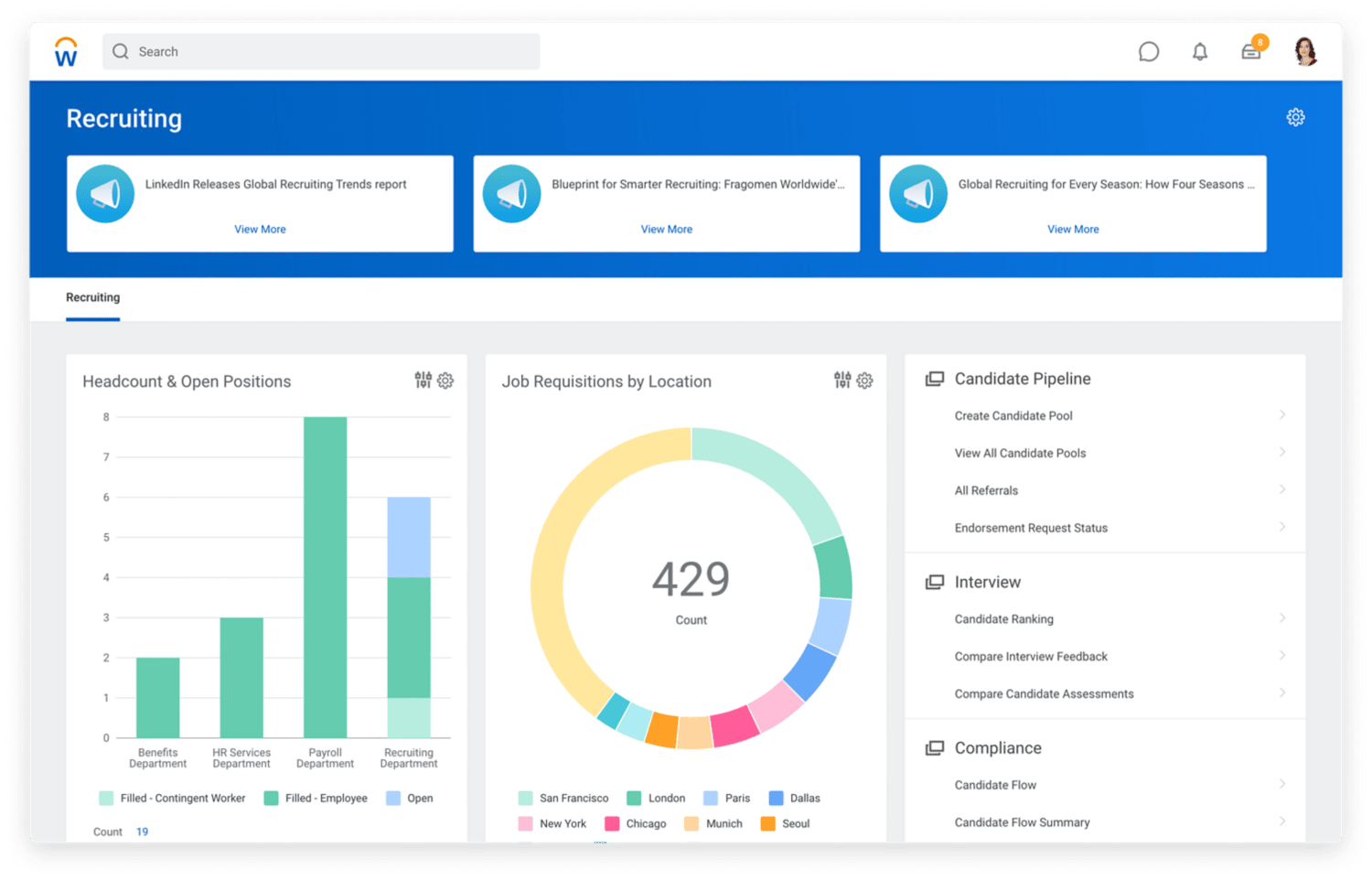
Greenhouse: Ideal for Growing Tech Companies and Structured Hiring

Greenhouse is popular among tech companies and startups because of its emphasis on structured hiring processes designed to reduce bias and improve hire quality. The platform offers customizable interview kits, scorecards, and task management tools, and integrates with a wide range of HR tools and job boards.
Key Features:
- Structured hiring tools: Customizable interview kits and scorecards reduce bias and improve consistency
- Collaborative review: Hiring team members share feedback and scores in one place
- Integration marketplace: Connects to a wide range of HR and productivity tools
| Pros | Cons |
|---|---|
|
|
Greenhouse is popular among tech companies and startups because of its user-friendly interface and strong emphasis on creating a structured hiring process.
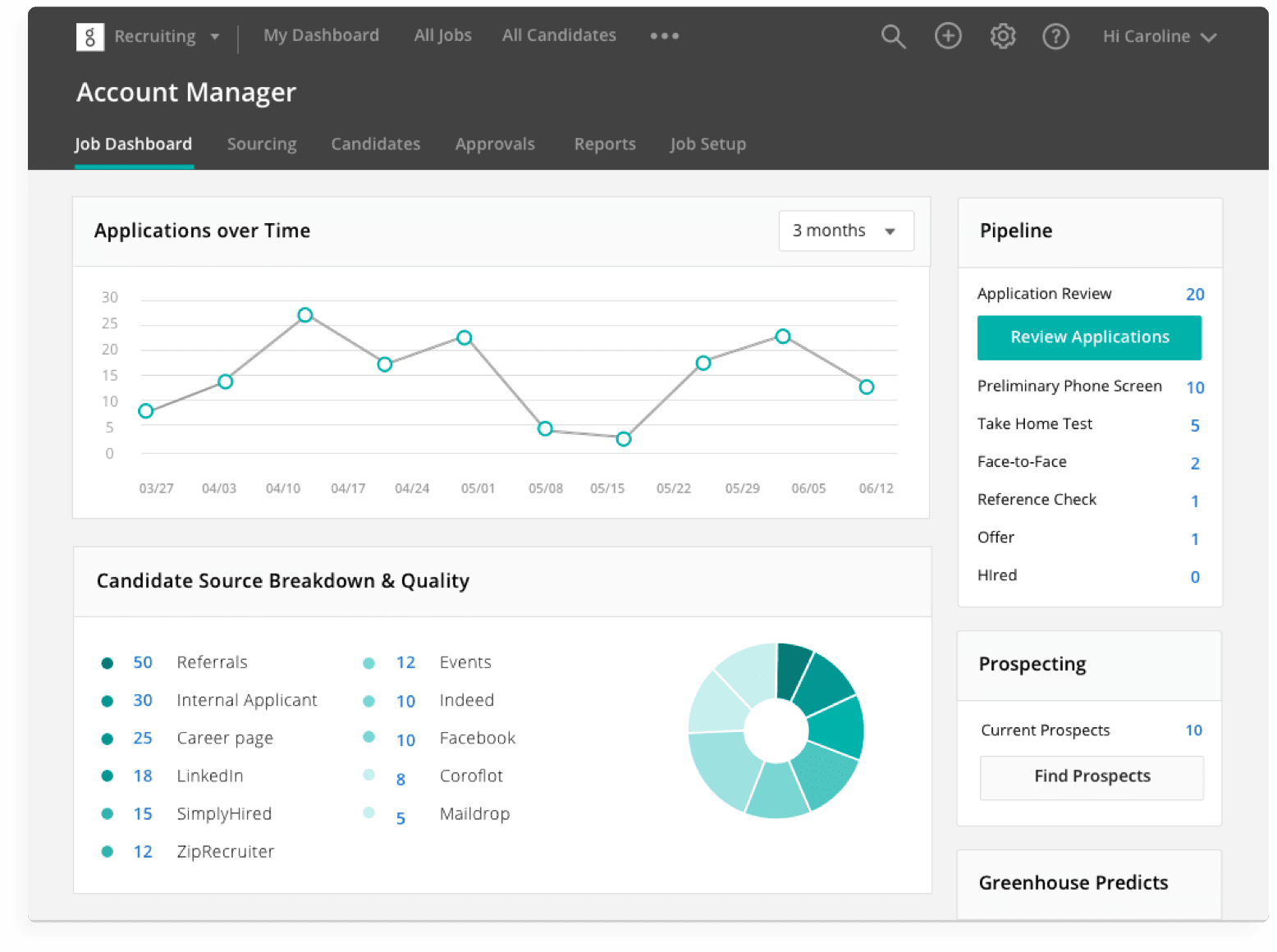
BambooHR: A Simple Option for Small HR Teams
 BambooHR centralizes employee data and streamlines HR workflows with applicant tracking built into its core HR features. It is a straightforward option for smaller organizations that want recruiting and employee records in one place without a complex configuration process. The interface tends to be intuitive for HR generalists who are not full-time recruiters, and onboarding features include e-signatures and task management for new hire setup.
Key Features:
- Integrated ATS: Recruiting connects directly to employee records and onboarding tasks
- Onboarding workflows: Digital forms, e-signatures, and automated task assignments for new hires
- Reporting tools: Track time-to-hire, source effectiveness, and other recruiting metrics
| Pros | Cons |
|---|---|
|
|
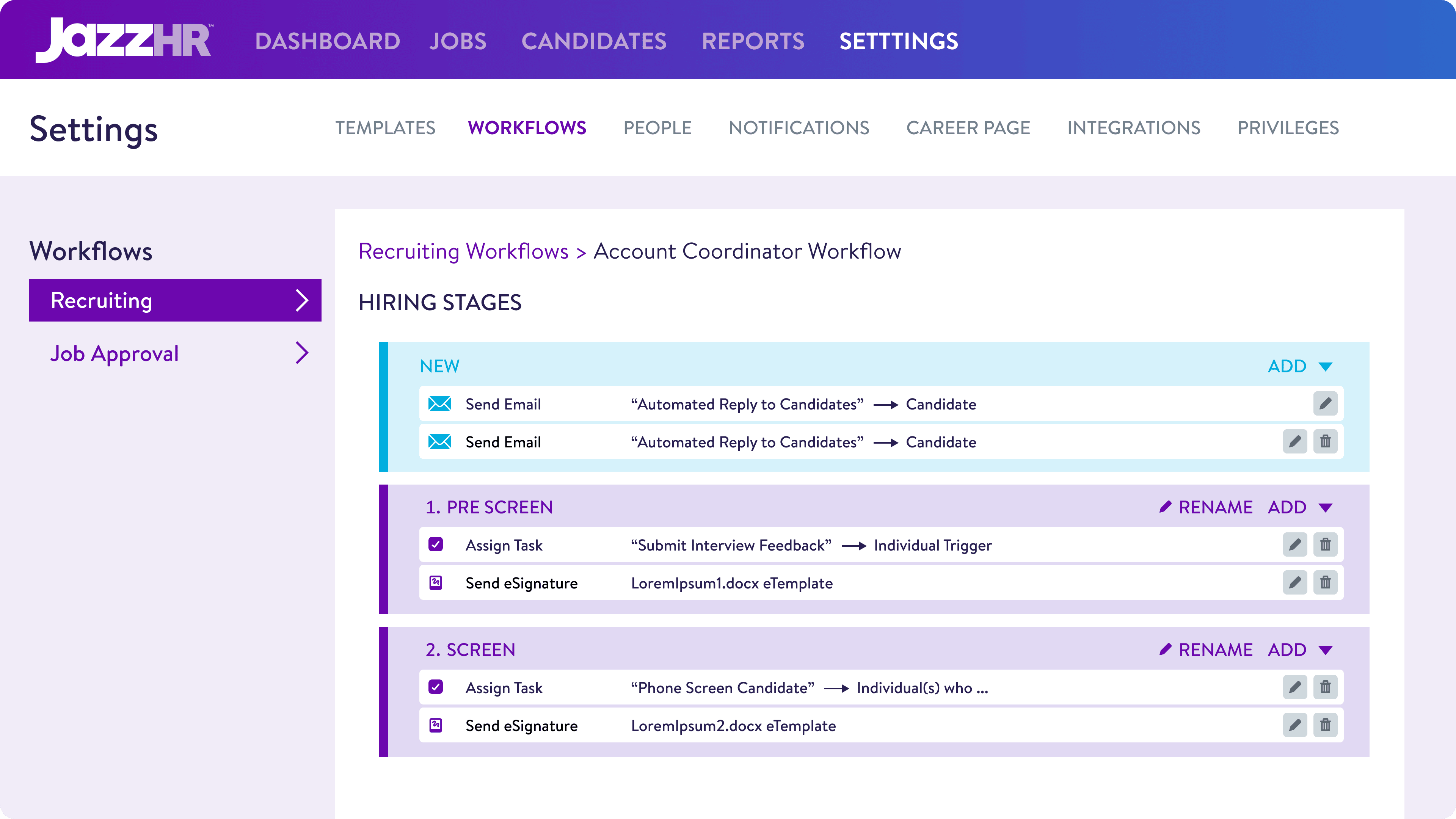
JazzHR: Affordable ATS for Startups and Early-Stage Businesses
 JazzHR is designed for startups and small companies, offering customizable job postings, automated resume screening, and interview scheduling at a price point that works for early-stage budgets. It focuses on connecting recruiting activities to overall business performance through analytics and reporting.
Key Features:
- Customizable job postings: Branded career pages and postings tailored to your company
- Automated resume screening: Filter candidates with knockout questions and scoring
- Recruiting analytics: Track time-to-hire, candidate quality, and source effectiveness
| Pros | Cons |
|---|---|
|
|
Lever: Collaborative ATS for Relationship-Building and Candidate Engagement

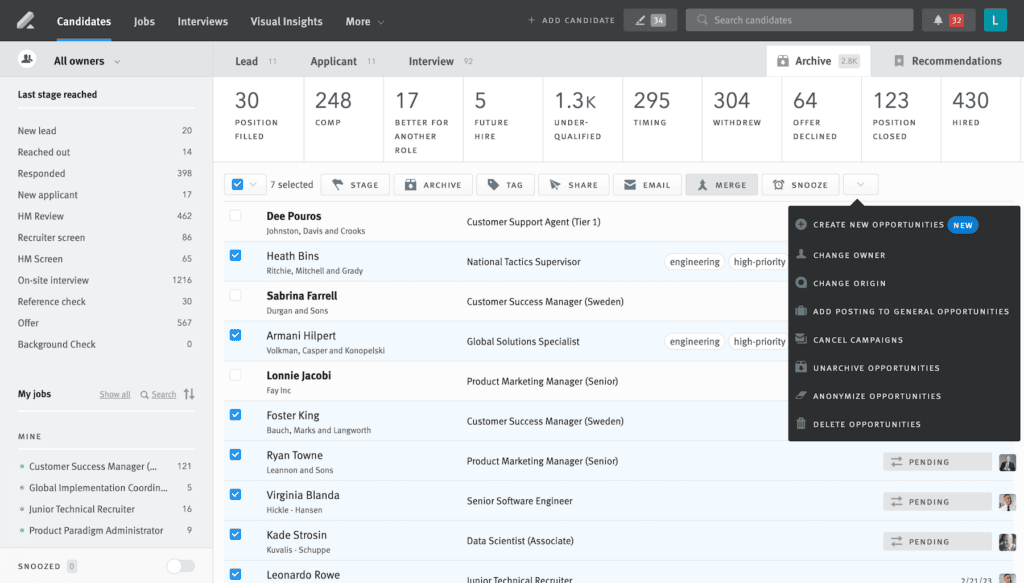
Lever emphasizes collaboration and candidate relationship-building throughout the hiring process. It features personalized communication templates, automated follow-up reminders, and a centralized database for tracking all candidate interactions. Collaborative tools allow hiring teams to share notes and feedback, helping make more informed decisions.
Key Features:
- Candidate relationship tools: Personalized communication templates and automated follow-up reminders
- Collaborative review: Centralized notes and feedback sharing among hiring team members
- Pipeline tracking: Centralized database for all candidate interactions and status
| Pros | Cons |
|---|---|
|
|
Lever emphasizes collaboration and relationship-building throughout the hiring process. It features personalized communication templates, automated follow-up reminders, and a centralized database to track candidate interactions. By nurturing ongoing engagement with candidates, Lever helps recruiters keep top talent interested throughout the recruitment journey. Additionally, Lever’s collaborative tools enable seamless sharing of notes and feedback among hiring teams, fostering informed decision-making.
iCIMS Talent Cloud: Comprehensive ATS and Talent Management Platform
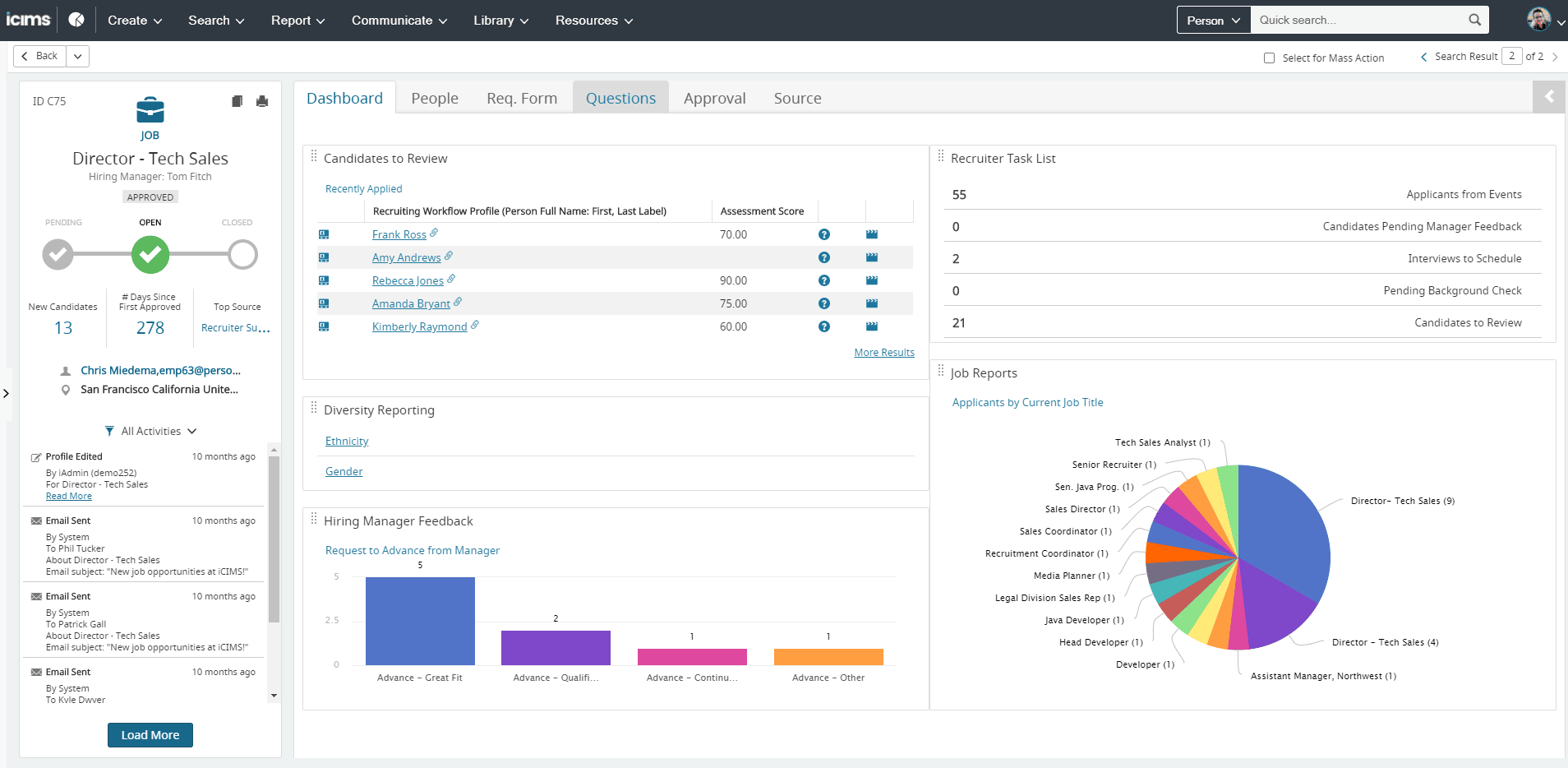
 iCIMS is a full talent acquisition platform that includes ATS functionality alongside CRM tools, onboarding solutions, and advanced analytics. It is designed for organizations that want to manage the full recruiting lifecycle from sourcing through onboarding in one place, with strong integration capabilities for mid-to-large enterprises.
Key Features:
- Full talent acquisition suite: ATS, CRM, onboarding, and advanced analytics in one platform
- Integration capabilities: Strong connections to HRIS, payroll, and third-party tools
- Candidate experience tools: Branded career sites and communication tools across the hiring journey
| Pros | Cons |
|---|---|
|
|
A comprehensive talent acquisition platform that includes ATS functionality along with other recruitment tools.
Jobvite: Best ATS for Social Recruiting and Mobile-Friendly Hiring
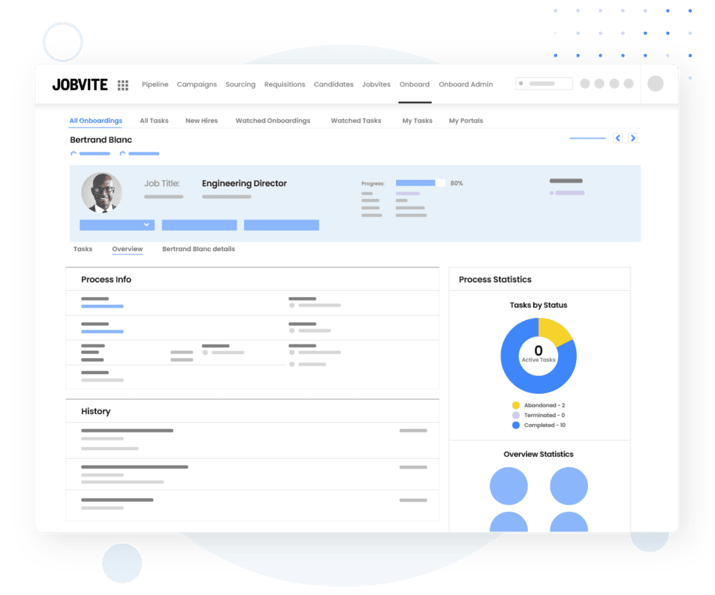
.png?width=259&height=35&name=jobvite-employ-logo(2).png) Jobvite offers a complete talent acquisition suite with a strong emphasis on social recruiting capabilities and a mobile-friendly design that supports both recruiters and candidates on the go. Advanced analytics and reporting tools help track the effectiveness of recruiting strategies across channels.
Jobvite offers a complete talent acquisition suite with a strong emphasis on social recruiting capabilities and a mobile-friendly design that supports both recruiters and candidates on the go. Advanced analytics and reporting tools help track the effectiveness of recruiting strategies across channels.
Key Features:
- Social recruiting tools: Engage and attract candidates across social media networks
- Mobile-friendly design: Supports recruiters and candidates across devices
- Analytics and reporting: Track source effectiveness, time-to-hire, and pipeline metrics
| Pros | Cons |
|---|---|
|
|
Offering a complete talent acquisition suite, Jobvite is known for its social recruiting capabilities and mobile-friendly features.
SmartRecruiters: Flexible ATS with Extensive Integration Options
.png?width=191&height=78&name=SmartRecruiters-logo1(1).png) SmartRecruiters is a user-friendly, cloud-based ATS with an extensive marketplace of third-party integrations covering background checks, onboarding, and other HR functions. The intuitive interface is designed to be accessible even for users with minimal technical expertise, making it a flexible option for organizations that need to connect recruiting to an existing tech stack.
SmartRecruiters is a user-friendly, cloud-based ATS with an extensive marketplace of third-party integrations covering background checks, onboarding, and other HR functions. The intuitive interface is designed to be accessible even for users with minimal technical expertise, making it a flexible option for organizations that need to connect recruiting to an existing tech stack.
Key Features:
- Integration marketplace: Extensive third-party connections including background checks and onboarding tools
- Intuitive interface: Accessible for users without deep technical expertise
- Collaborative hiring: Tools for hiring teams to review, score, and discuss candidates
| Pros | Cons |
|---|---|
|
|
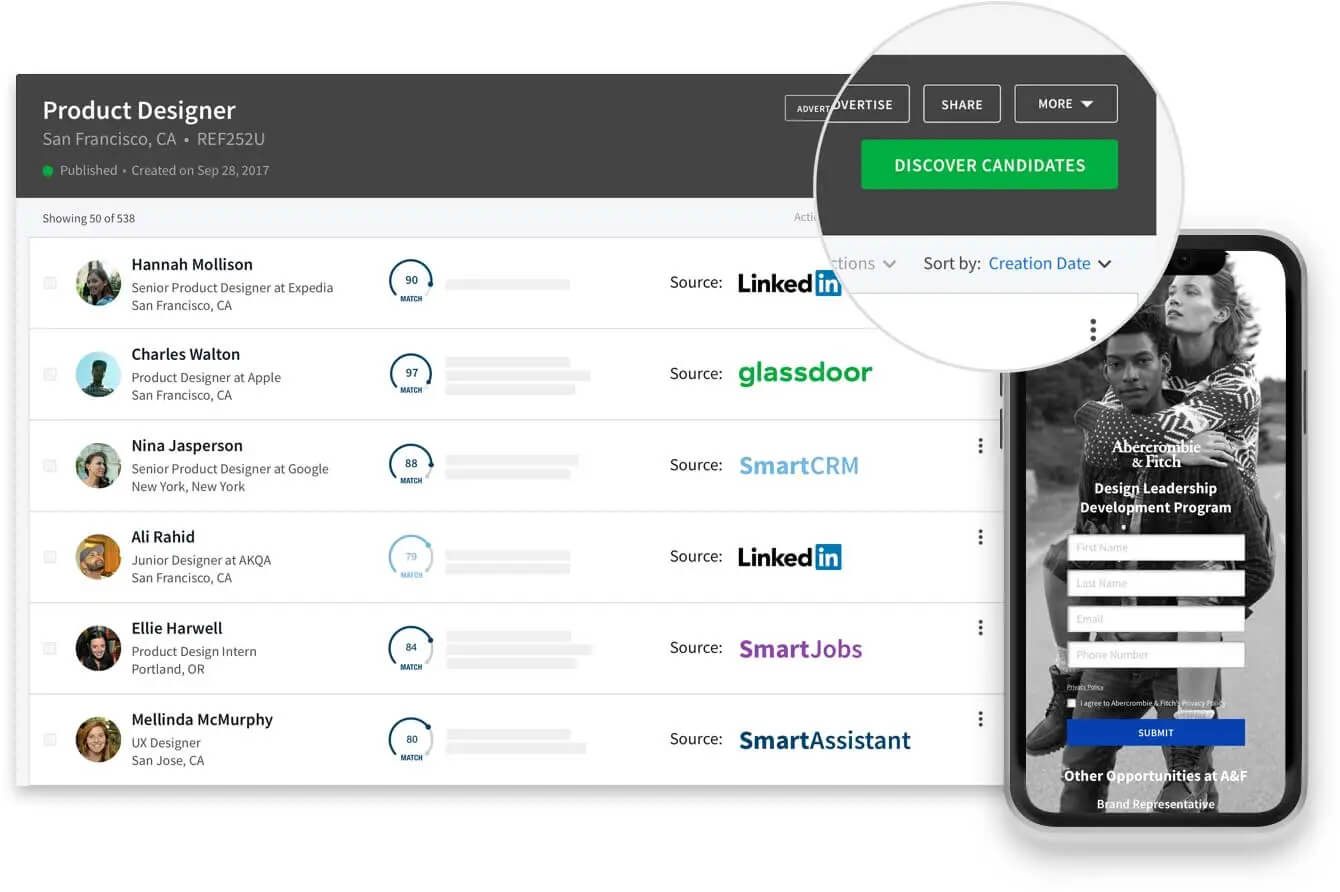
Bullhorn: Top ATS for Staffing Agencies and Recruiting Firms
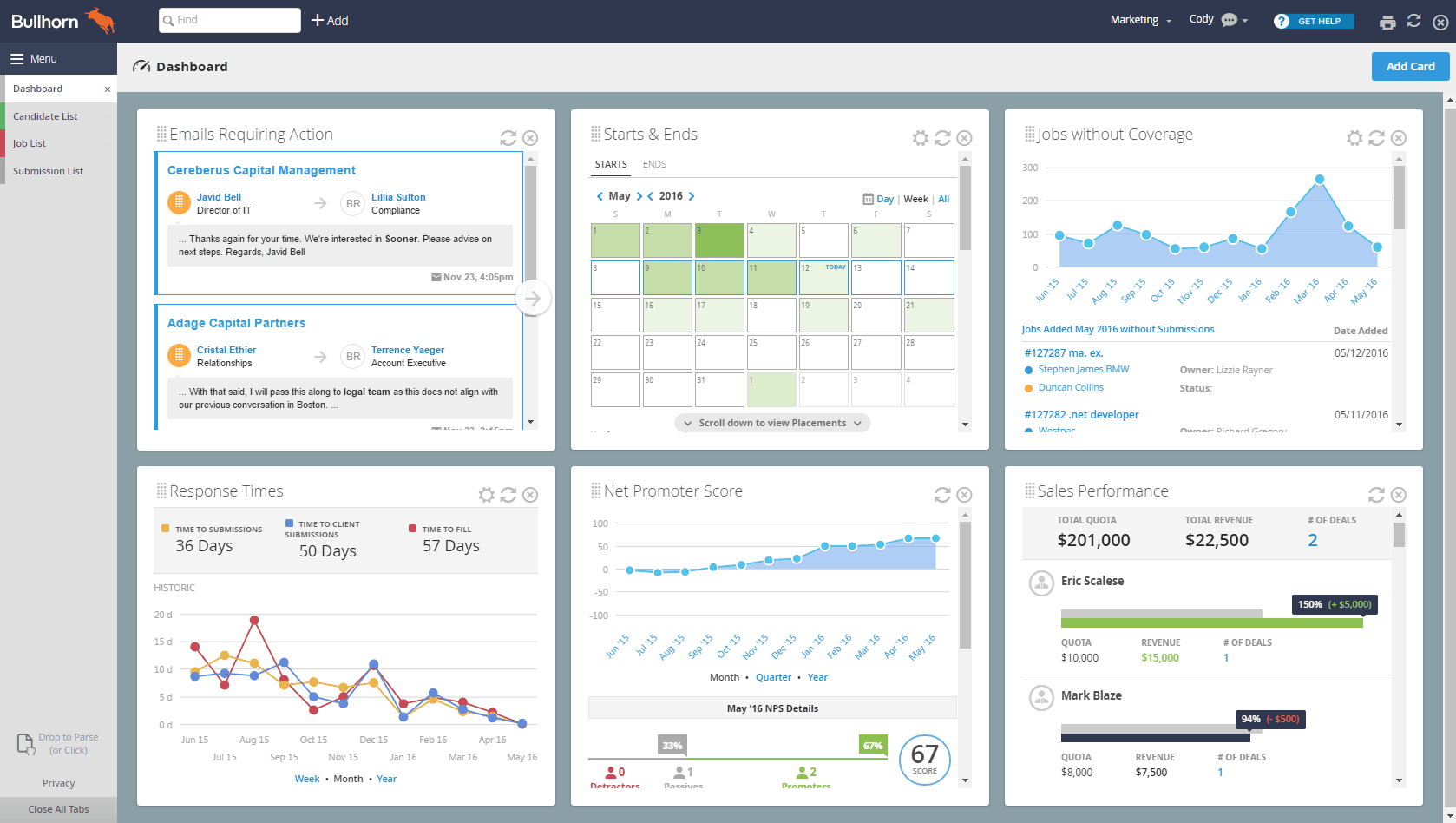
 Bullhorn is built primarily for staffing and recruiting agencies, though it also offers ATS solutions for corporate HR teams. The platform features automated resume parsing, candidate tracking, and interview scheduling, with strong CRM integration for managing ongoing candidate and client relationships over time.
Key Features:
- Resume parsing: Automated extraction and storage of candidate information from resumes
- CRM integration: Tracks candidate and client relationships across the full recruiting lifecycle
- Reporting and analytics: Data-driven insights for staffing agency performance and placement tracking
| Pros | Cons |
|---|---|
|
|
Applicant Tracking System (ATS) Comparison Chart
| ATS Platform | Pricing Model | Best For | Key Features |
| Workday Recruiting | Custom Pricing | Large enterprises | Advanced integration with HR functions |
| Greenhouse | Starts at $6,000/year | Tech startups | Customizable interview kits, structured hiring |
| BambooHR | Custom Pricing | SMBs | Employee data tracking, communication tools |
| JazzHR | Starts at $39/month | Startups | Automated resume screening, customizable job postings |
| Lever | Starting at $120/user/month | Growing businesses | Collaboration tools, candidate engagement |
| iCIMS Talent Cloud | Custom Pricing | Mid-large enterprises | CRM, advanced analytics |
| Jobvite | Starts at $500/month | SMBs | Social recruiting, mobile-friendly |
| SmartRecruiters | Custom Pricing | Various sizes | Marketplace of integrations, user-friendly |
| Bullhorn | Custom Pricing | Staffing agencies | Resume parsing, CRM integration |
What Approval Routing Features Should Your ATS Include?
The right approval routing features let you open new positions and move candidates forward without routing everything through email chains that stall out in someone's inbox.
Look for systems that allow conditional routing based on job type, department, or salary level. Some roles might require VP approval while others only need a hiring manager sign-off. Your ATS should handle both configurations without requiring IT involvement every time you need to adjust the workflow.
Audit trails matter too. When hiring volume grows, you need documentation showing who approved what and when. This becomes especially important during compliance audits or when leadership asks about hiring decisions from six months ago.
How Do Requisition Templates Save Time When Hiring Volume Increases?
Requisition templates save time by letting you standardize the setup process for common roles so you are not rebuilding every job posting from scratch each time you open a new position.
When you create a template, you pre-fill the interview stages, screening questions, and approval chain for that role type. The next time you need to hire another Customer Service Representative or Sales Development Rep, you select the template and adjust only what is different for this specific opening.
Templates also enforce your compliance requirements automatically. If every role needs certain EEO questions or requires specific approval steps, the template ensures nothing gets skipped, even when hiring moves fast and your team is stretched thin.
Frequently Asked Questions About Applicant Tracking Systems
What is an ATS workflow?
An ATS workflow is the sequence of steps a candidate moves through during your hiring process, from application submission through screening, interviews, approvals, and offers. Lift HCM lets you customize these workflows by job type so each role follows the right process automatically.
How do ATS features help small businesses scale hiring?
ATS features like automated screening, multi-board posting, and configurable approvals reduce the time your team spends on repetitive tasks. Lift HCM automates candidate communication, routes approvals to the right people, and keeps your pipeline data clean so you can fill more roles without adding more recruiters.
What is the difference between an ATS and an HCM platform?
An ATS focuses specifically on recruiting and candidate tracking. An HCM platform like Lift HCM includes recruiting plus payroll, onboarding, time tracking, benefits, and HR, all connected in one system. This means candidate data flows into the employee record automatically when someone is hired, with no duplicate entry required.
How long does it take to implement an ATS?
Implementation timelines vary based on your requirements and the platform you choose. Lift HCM walks you through configuration with dedicated support, typically getting customers live faster than enterprise-focused systems that require extensive IT involvement.
Can an ATS help with compliance tracking?
Yes. Modern ATS platforms include features for EEO data collection, OFCCP reporting, and I-9 documentation. Lift HCM builds compliance checkpoints into your hiring workflows so you capture required information at each stage without manual tracking.
Choosing an ATS That Grows With Your Business
Growing businesses cannot afford the gaps that come from disconnected hiring systems. When candidate data has to be re-entered into onboarding, or approvals stall because there is no routing workflow, every open role costs more time and money than it should.
The right ATS closes those gaps. For most small and mid-market businesses, that means a platform that connects recruiting to the rest of your HR operations, not just a place to store resumes until someone gets around to reviewing them.
Lift HCM has been helping businesses build scalable HR workflows since 2005. Whether you are opening your first five management roles or scaling up to handle seasonal hiring surges, the combination of the isolved platform and Lift HCM's dedicated service model gives you the tools and support to grow without outgrowing your HR infrastructure.

Candidates may load their resumes with job-related keywords, knowing that the ATS is scanning for these terms. While this might boost their ranking, it doesn't necessarily mean they're the best fit for the job.
Keyword stuffing: Candidates may load their resumes with job-related keywords, knowing that the ATS is scanning for these terms. While this might boost their ranking, it doesn't necessarily mean they're the best fit for the job.
Some applicants use white font to include extra keywords that aren't visible to the naked eye but are picked up by the ATS. This tactic can result in unqualified candidates appearing more qualified than they are.
Certain resume formats can confuse an ATS, causing it to misread or overlook critical information. Candidates might exploit this by using complex formats that make their resume stand out in ways that don't reflect their actual qualifications.







.jpg?width=3000&height=2000&name=image%20of%20people%20pushing%20clock(1).jpg)


.jpg?width=1344&height=768&name=a%20software%20interface%20showcasing%20payroll%20management%20tools(1).jpg)
.jpeg?width=1024&height=1024&name=An%20image%20of%20a%20cloudbased%20payroll%20system%20with%20realtime%20accessibility%2c%20enhanced%20security%2c%20seamless%20integrations%2c%20scalability%2c%20and%20costeffectiveness%20bene-2(1).jpeg)

.jpeg?width=1344&height=768&name=icons%20of%20benefits%20administration%20software%20for%202025(1).jpeg)
.png?width=2000&height=1376&name=payroll%20software%20image(1).png)




-1.jpg?width=1000&height=550&name=Businessman%20hand%20typing%20with%20cloud%20technology%20system%20and%20office%20symbol%20concept%20(1)-1.jpg)