

As 2027 approaches, employers are balancing new technology, changing workforce expectations, and ongoing compliance responsibilities. For busy HR teams and business owners, the challenge is knowing which changes deserve attention and where to start.
At Lift HCM, we help employers connect HR, payroll, and workforce processes while giving their teams access to knowledgeable support. That experience has shown us that preparing for change starts with understanding how it affects your people and day-to-day operations.
What HR trends should employers prepare for in 2027? Seven priorities to consider are flexible work, responsible AI use, employee experience and well-being, manager effectiveness, skills development, people analytics, and HR compliance.
Below, we explore what each priority means and share practical steps to help you plan for the year ahead.
Table of Contents
- Trend 1: Hybrid and Flexible Work Becomes an Operating Model
- Trend 2: AI Moves From Experimentation to Governance
- Trend 3: Employee Experience, Well-Being and Engagement Stay Connected
- Trend 4: Manager Effectiveness Becomes a Workforce Priority
- Trend 5: Skills-Based Workforce Planning and Continuous Learning Grow
- Trend 6: People Analytics Gets More Powerful and More Accountable
- Trend 7: HR Compliance Gets More Complex
- 2027 Employer Preparation Checklist
- Frequently Asked Questions About HR Trends in 2027
- Is Your Business Ready for Workforce HR in 2027?
Trend 1: Hybrid and Flexible Work Becomes an Operating Model
For HR, the question is no longer just whether employees can work remotely. It’s how to create clear, workable arrangements for different roles while supporting employees and business needs.
Gallup’s hybrid-work data reports reports that, in August 2026, 54% of U.S. employees with remote-capable jobs worked hybrid, 25% worked exclusively remotely, and 21% worked on-site. In a separate November 2025 measurement, 61% of U.S. employees with remote-capable jobs preferred hybrid work.
Flexibility for On-Site and Hourly Teams: Not every role can be remote. Employers in hospitality, healthcare, manufacturing, and other on-site settings can consider predictable schedules, approved shift swaps, advance notice of schedule changes, and easier time-off requests. Match options to staffing, service, safety, and applicable requirements rather than promising identical arrangements for every role.
The challenge for HR is therefore shifting away from simply deciding whether employees can work remotely.
The more useful questions are:
- Which roles can be performed effectively away from the office?
- What should employees be expected to accomplish regardless of location?
- How will managers communicate and provide feedback?
- How will distributed employees receive consistent access to information and opportunities?
- Are payroll, timekeeping and employment requirements being handled correctly when employees work in different jurisdictions?
Best Practices for Hybrid and Flexible Work
Set Clear Expectations: Develop clear guidelines around schedules, availability, communication, collaboration, performance and workplace attendance.
Invest in the Right Technology: Employees should be able to access the information and systems they need without relying on paper documents or disconnected processes.
Manage Outcomes, Not Presence: Establish clear expectations and measurable goals instead of treating time in the office as a substitute for performance.
Create Consistency: Remote, hybrid and on-site employees should have clear processes for accessing HR information, requesting time off, completing onboarding tasks and communicating with managers.
Review Compliance: Employing people across multiple jurisdictions can create payroll, tax and employment-law considerations. Employers should understand where employees perform their work and review applicable requirements.
For a deeper look at this issue, see our Return-to-Office Mandates: Why They Fail & What HR Leaders Should Do.
Trend 2: AI Moves From Experimentation to Governance
Artificial intelligence is already influencing recruiting, employee support, workforce analytics and administrative HR work. As employers plan for 2027, the conversation should move beyond simply asking whether HR should use AI.
The bigger question is how employers can use it responsibly.
IBM identifies agentic AI as an emerging HCM capability while also pointing to new data, security and governance challenges associated with AI adoption. That makes good AI governance increasingly important.
The U.S. Equal Employment Opportunity Commission (EEOC) explains that federal employment-discrimination laws apply to AI-assisted employment decisions. Governance should therefore include fair review of recommendations, not just efficiency checks.
Best Practices for Using AI in HR
Augment, Don't Automatically Replace Human Judgment: AI can help HR teams organize information, identify patterns and reduce repetitive work, but consequential employment decisions need appropriate human oversight.
Establish Governance: Define which AI tools employees may use, which types of information can be entered into them, who owns AI-related decisions, and which uses require additional review.
Evaluate Vendors: Ask how the tool generates recommendations, which employee or applicant data it uses, how data is retained, and what testing and review information the vendor can provide.
Protect Employee Data: HR professionals frequently handle payroll, compensation, benefits, performance and other sensitive workforce information. AI use should follow appropriate privacy and security practices.
Build in Fair Review and Access: Use job-related criteria, review recommendations for potential bias and errors, document human decisions, and provide an accessible way for applicants and employees to raise concerns or request assistance.
AI can make HR more efficient, but efficiency should not come at the expense of fairness, privacy, accuracy or accountability.
Trend 3: Employee Experience, Well-Being and Engagement Stay Connected
Employee well-being should remain a priority in 2027 planning, but employers should think beyond standalone wellness programs. Workload, management, flexibility, communication, technology and everyday employee experience all influence how people experience work.
Gallup’s 2026 State of the Global Workplace report found that 20% of employees globally were engaged at work in 2025, while 34% were classified as thriving. Thriving is Gallup’s measure of life evaluation, not a direct measure of workplace engagement. For HR leaders, that reinforces an important distinction: offering benefits or wellness resources isn't the same thing as creating an engaging employee experience.
Strategies for Supporting Employees
Mental Health Resources: When appropriate for your workforce and benefits strategy, provide employees with access to resources such as employee assistance programs and other available support.
Flexible Work Practices: Where job responsibilities allow, consider schedules and workplace policies that help employees manage professional and personal responsibilities.
Sustainable Workloads: Pay attention to staffing levels, overtime, competing priorities and workload patterns that can contribute to burnout.
Recognition and Feedback: Employees should know what is expected of them and receive meaningful feedback about their work.
Reduce Administrative Friction: Make pay information, time-off requests, policies, and support easy to access for employees across roles and shifts. Offer assistance or accessible alternatives when a digital process creates a barrier.
Digital processes are part of the employee experience, too. Learn more in one of our previous articles: Digital Employee Experience (DEX) in HCM: The Essential 2026 Guide.
Trend 4: Manager Effectiveness Becomes a Workforce Priority
Technology may be transforming HR, but managers remain one of the most important links between an organization's strategy and an employee's everyday experience.
Employers Can Strengthen Managers By:
- defining clear responsibilities and decision-making authority
- providing tools for coaching and feedback
- training managers on HR policies and escalation procedures
- creating consistent performance-management practices
- helping managers recognize workload and staffing problems
- giving managers access to reliable workforce information
Keep Access to Opportunity Consistent: Use clear, job-related criteria for development and advancement, communicate opportunities across shifts and locations, and document review decisions so access does not depend on proximity to a manager.
The goal isn't to turn every supervisor into an HR expert. It's to give managers enough structure, information and support to lead consistently.
Trend 5: Skills-Based Workforce Planning and Continuous Learning Grow
The pace of technological change means employers need to think about skills differently. Instead of focusing exclusively on job titles and traditional credentials, organizations are increasingly considering the capabilities required to perform the work today and what will be needed next.
In the World Economic Forum’s Future of Jobs Report 2025, surveyed employers expected 39% of workers’ core skills to change by 2030. This is an expectation about changing skills, not the percentage of employees who must reskill. AI and big data, networks and cybersecurity, and technological literacy are among the fastest-growing skills identified by surveyed employers.
How Employers Can Prepare
Inventory Existing Skills: Understand the capabilities your workforce already has before automatically hiring externally.
Identify Critical Gaps: Determine which skills the organization needs to develop based on anticipated business requirements.
Create Practical, Accessible Learning Paths: Tie training to actual roles and business needs. Communicate eligibility consistently and offer formats and scheduling that give on-site, hourly, and remote employees a fair opportunity to participate.
Encourage Mentoring and Coaching: Experienced employees can help transfer institutional knowledge as roles and technologies change.
Review Skills Regularly: Workforce planning shouldn't be a once-a-year exercise. Roles and priorities can change faster than job descriptions.
The goal is not to predict every future job. It is to build an organization capable of adapting when required skills change.
Trend 6: People Analytics Gets More Powerful and More Accountable
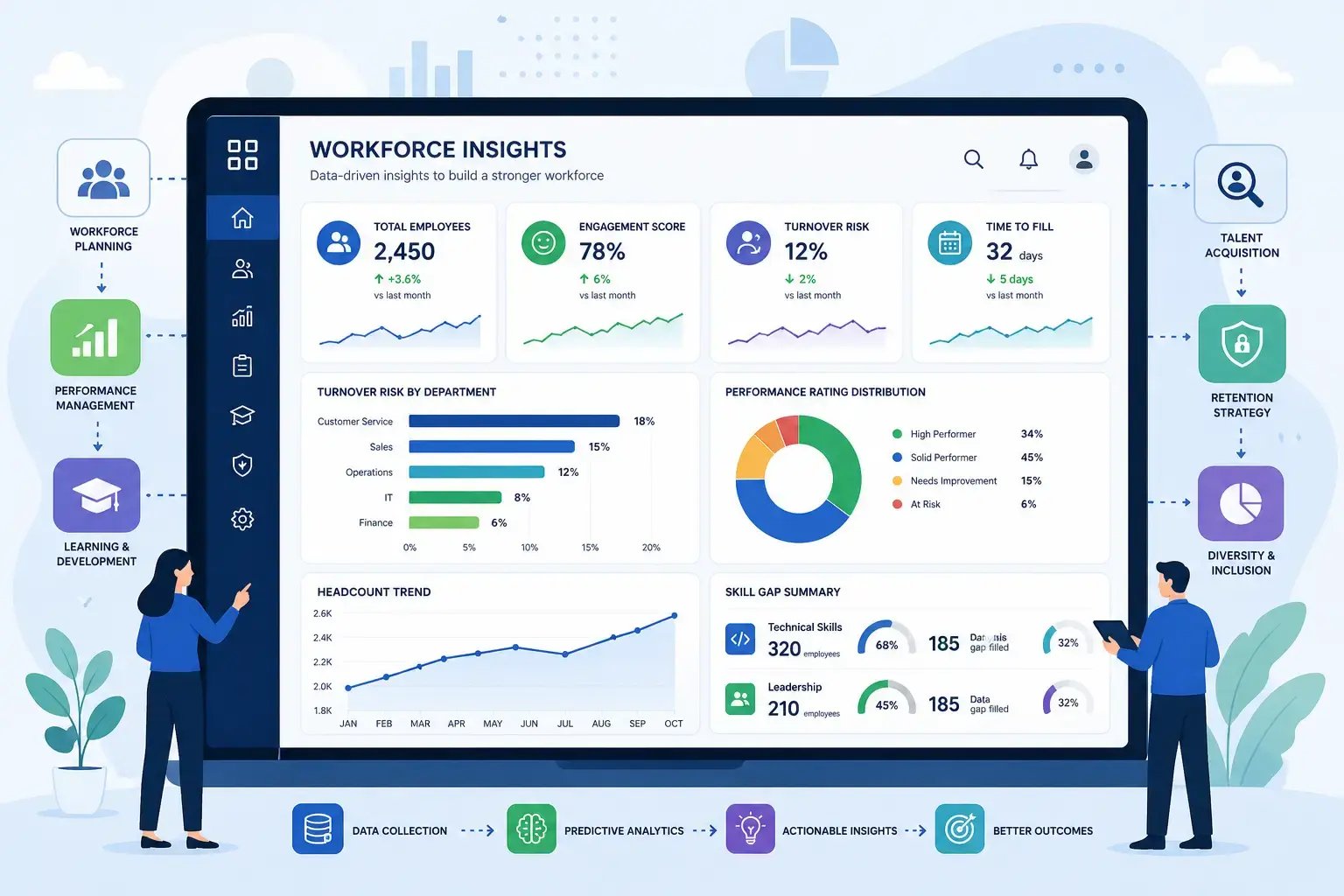
People analytics allows employers to use workforce data to better understand hiring, turnover, overtime, staffing, engagement and other aspects of the employee lifecycle. The opportunity is expanding as HR systems become more connected and analytical tools become more sophisticated.
Useful workforce metrics may include:
Recruiting: Time-to-fill, sources of hire and recruiting-process outcomes.
Retention: Turnover patterns and reasons employees leave.
Time and Attendance: Overtime, absenteeism and scheduling patterns.
Employee Development: Training participation and skill development.
Workforce Planning: Headcount, available capabilities and projected staffing requirements.
Yet more data does not automatically produce better decisions.
Employers also need to consider data quality, privacy, permissions, security, methodology and whether humans understand the limitations of whatever analysis is being used. That becomes especially important when analytics are combined with AI or predictive models.
For a deeper look at this topic, see Predictive HR Analytics: Shaping Workforce Strategy in 2026.
Trend 7: HR Compliance Gets More Complex
One of the biggest HR trends isn't really a trend at all: employers continue to face changing requirements across federal, state and local jurisdictions.
AI-assisted decisions remain subject to existing employment-discrimination laws. The broader operational challenge is applying obligations consistently across policies, systems, and managers.
For growing and multi-state employers, HR operations may also intersect with wage and hour requirements, payroll taxes, leave requirements, accommodations, recordkeeping and other obligations. That creates a practical challenge. A policy may look fine on paper but still fail if payroll, timekeeping, HR and managers apply it differently.
What Employers Can Do:
- regularly review workplace policies
- keep employee records centralized and organized
- document processes and approval responsibilities
- review automated employment tools before relying on their outputs
- coordinate HR, payroll, finance and operational teams
- monitor federal, state and local changes applicable to the workforce
- seek qualified legal guidance when requirements are unclear
2027 Employer Preparation Checklist
Use this table during year-end planning. For each action, assign an owner, set a target date, and update the status as work progresses. Document what completion looks like and prioritize gaps that create the greatest operational or compliance risk.
|
Action |
Owner |
Target Date |
Status |
|
Review flexible-work policies: Confirm role eligibility, schedules, availability and manager expectations. Verify where employees work and flag payroll, tax or employment requirements for qualified review. |
|
|
|
|
Inventory AI tools and set guardrails: List the tools used in HR and recruiting, identify the data they access, designate an approval owner, and define which uses require human or legal review. |
|
|
|
|
Identify employee-experience friction: Gather employee input on workload and routine HR tasks. Choose a practical improvement, such as easier access to pay information, time-off requests or company policies. |
|
|
|
|
Equip managers for consistent support: Establish a regular coaching and feedback cadence, clarify escalation procedures, and schedule training on policies and workload management. |
|
|
|
|
Map critical skills gaps: Compare existing capabilities with 2027 business needs. Select priority learning paths, mentoring opportunities or hiring needs, and define how progress will be assessed. |
|
|
|
|
Strengthen workforce data: Choose metrics tied to specific business questions, confirm definitions and data quality, review access permissions, and establish a reporting cadence. Document limitations before using predictive analysis. |
|
|
|
|
Coordinate compliance and connected processes: Review applicable policy changes with qualified advisers, assign monitoring responsibilities, and check that HR, payroll and timekeeping apply policies consistently. Document approvals and recordkeeping procedures. |
|
|
|
Bring the owners together to review priorities, dependencies and resource needs before finalizing the 2027 plan. Schedule follow-up reviews so the checklist becomes an ongoing process rather than a one-time exercise.
Frequently Asked Questions About HR Trends in 2027
What HR Trends Should Employers Prepare For in 2027?
Employers should consider seven priorities: flexible work, responsible AI use, employee experience and well-being, manager effectiveness, skills development, people analytics, and HR compliance. The right priorities will depend on your workforce and business needs.
How Is AI Changing HR?
AI can help HR teams with recruiting, employee support, reporting, and administrative tasks. Employers should also review how tools use sensitive data, check outputs for errors or potential bias, and maintain appropriate human oversight of employment decisions.
What Does Workplace Flexibility Look Like for On-Site Employees?
Flexibility can include predictable schedules, approved shift swaps, advance notice of schedule changes, and easier time-off requests. The options available will depend on the role, staffing needs, safety, and applicable requirements.
Why Should Employers Focus on Manager Effectiveness?
Managers help employees understand expectations, receive feedback, and find support. Clear responsibilities, regular coaching, and guidance on when to involve HR can help managers lead more consistently.
What Should Employers Measure With People Analytics?
Start with a business question, then choose a relevant measure. For example, an employer concerned about staffing costs might review overtime by department. Other useful measures include turnover, hiring outcomes, absences, and training participation.
How Can Small and Midsize Employers Prepare for These Trends?
Start with one or two areas that matter most to your business. Review your HR processes, ask employees and managers where they encounter problems, assign an owner to each improvement, and set a date to check progress.
Is Your Business Ready for Workforce HR in 2027?
Preparing for HR in 2027 isn’t about chasing every new workplace trend. It’s about using the months ahead to strengthen the processes and infrastructure that let your organization adapt.
That means giving employees and managers clear processes, maintaining accurate workforce information, connecting HR and payroll systems, developing the skills your organization will need, using AI and analytics responsibly, and staying alert to changing compliance requirements.
If your HR processes haven't kept pace with the way your workforce operates, Lift HCM can help you identify where the gaps are. From payroll and timekeeping to HR administration, workforce management, benefits and reporting, we help employers build connected processes that are easier to manage as their organizations evolve.

Please note that this article does not cover all possible scenarios, and any discussions or viewpoints should not be considered as legal advice. For specific legal guidance, readers are advised to consult with legal professionals.
Topics: