
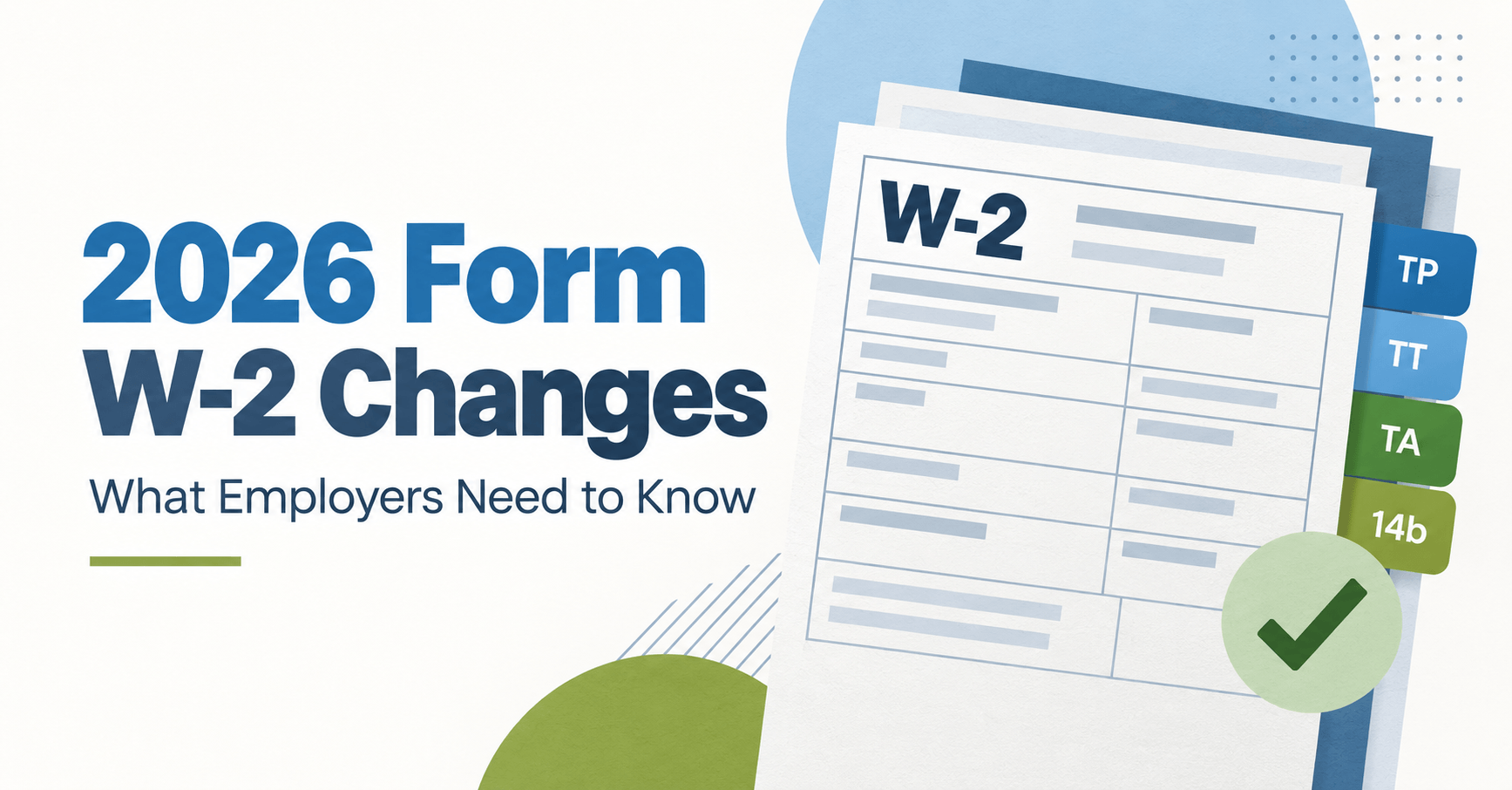
The 2026 Form W-2 introduces three Box 12 codes and a new Box 14b field for reporting cash tips, qualified overtime compensation, and certain employer contributions to Trump Accounts. These fields apply to wages and contributions for the 2026 tax year, with Forms W-2 due to the Social Security Administration and employees by February 1, 2027.
For employers, this is more than a year-end form update. Accurate reporting depends on how payroll systems have tracked tips, overtime premiums, job classifications, and eligible contributions throughout 2026. Payroll teams should reconcile those records now, confirm that earning codes map correctly, and test W-2 output before year-end.
At Lift HCM, we help growing businesses turn complex payroll changes into manageable processes. This guide explains what Codes TP, TT, and TA mean, who must use them, and what employers should do before the 2026 filing deadline.
Quick Answer: What Changed on the 2026 Form W-2?
The IRS added Code TP for total cash tips reported to the employer, Code TT for qualified overtime compensation, and Code TA for qualifying employer contributions under a Section 128 Trump Account contribution program. The IRS also divided Box 14 into Box 14a for other information and Box 14b for Treasury Tipped Occupation Codes.
These changes first apply to 2026 Forms W-2. Employers must file those forms with the SSA and furnish them to employees by February 1, 2027.
| New Field | What It Reports | Who May Need It |
|---|---|---|
| Box 12, Code TP | Total cash tips reported to the employer | Employers with employees who report cash tips |
| Box 12, Code TT | Qualified overtime compensation, generally the FLSA overtime premium above the regular rate | Employers paying FLSA-required overtime |
| Box 12, Code TA | Qualifying employer contributions under a Section 128 Trump Account contribution program | Employers that choose to establish a compliant contribution program |
| Box 14b | Treasury Tipped Occupation Code or codes | Employers reporting an amount under Code TP |
Key Takeaways
- The new fields apply to tax year 2026, not tax year 2025.
- Code TP reports total cash tips an employee reported to the employer. It does not determine the employee's final tax deduction.
- Employers that report Code TP must also report the applicable Treasury Tipped Occupation Code or codes in Box 14b.
- Code TT does not report all overtime wages. It generally reports only the premium portion required by the Fair Labor Standards Act.
- Code TA applies only to qualifying employer Trump Account contributions made through a compliant written program.
- Employers must report the required amounts even when an employee may not be able to deduct the full amount.
- An incorrect Code TT amount may require Form W-2c, and reporting errors can affect an employee's ability to claim a deduction.
- The 2026 Form W-2 filing and furnishing deadline is February 1, 2027.
Table of Contents
Why Did the IRS Change the 2026 Form W-2?
The One Big Beautiful Bill Act, signed into law on July 4, 2025, created federal income tax provisions involving qualified tips, qualified overtime compensation, and Trump Accounts. The new W-2 fields give employees, tax preparers, and the IRS information needed to apply those provisions.
Codes TP and TT are primarily information-reporting fields. They identify amounts an employee may use when calculating a deduction on an individual federal income tax return. They do not automatically make tips or overtime tax-free, and they do not tell the employer to stop normal withholding.
Code TA serves a different purpose. It identifies certain employer contributions made under a qualifying Trump Account contribution program. Whether a contribution is excluded from an employee's gross income depends on compliance with the applicable law and program requirements.
Employers should review the IRS 2026 General Instructions for Forms W-2 and W-3 alongside their payroll provider's year-end guidance. Businesses may also want to review Lift HCM's overview of how the One Big Beautiful Bill Act affects employers.
What Is Code TP for Cash Tips?
Code TP reports the total cash tips an employee reported to the employer during the year. The amount supports the employee's calculation of the federal deduction for qualified tips.
For this purpose, cash tips can include tips paid in cash, by check, or through credit and debit card charges that are distributed to the employee. The reporting rules are different from simply labeling every customer-paid amount as a tip. Mandatory service charges, negotiated payments, and other nonvoluntary charges generally are not treated the same way as voluntary tips.
The employee's occupation also matters. The qualified tips deduction is limited to occupations that customarily and regularly received tips on or before December 31, 2024. The IRS maintains an official list of occupations that customarily and regularly received tips.
Is Code TP the Same as Box 7?
Not necessarily. Box 7 reports Social Security tips, while Code TP reports total cash tips reported to the employer for the new information-reporting requirement. Employers should not assume the two fields will always match without reviewing the applicable definitions and their payroll configuration.
What Should Employers Review for Code TP?
Employers with tipped workers should confirm that they can:
- Capture employee-reported cash tips consistently
- Separate voluntary tips from mandatory service charges when required
- Map tipped job titles to the correct Treasury occupation codes
- Reconcile year-to-date tip records against payroll and point-of-sale data
- Populate both Code TP and Box 14b correctly on a test W-2
What Is Box 14b for Tipped Occupation Codes?
Box 14 is now divided into two fields. Box 14a remains available for other information, while Box 14b reports Treasury Tipped Occupation Codes connected to Code TP.
An employer reporting an amount under Code TP must also report the employee's applicable occupation code in Box 14b. The 2026 Form W-2 instructions allow up to two occupation codes. If the reported tips include tips from an occupation that does not qualify, code 000 must be included as one of those codes.
This makes job-data quality part of year-end payroll accuracy. A generic title such as “associate” may not be enough to identify the right occupation. Employers should compare job duties and payroll records with the Treasury list instead of guessing from the title alone.
A Practical Box 14b Review
Before Forms W-2 are generated, payroll and HR teams should review:
- Employees who changed roles during 2026
- Employees who worked in more than one tipped occupation
- Employees who received tips in both qualifying and nonqualifying roles
- Job titles that do not clearly describe the employee's actual duties
- Payroll records missing a job or occupation mapping
What Is Code TT for Qualified Overtime Compensation?
Code TT reports qualified overtime compensation. It does not report every dollar earned during overtime hours.
Qualified overtime compensation generally means the premium above the employee's regular rate that is required by Section 7 of the FLSA. For traditional time-and-a-half overtime, that is generally the extra one-half portion, not the employee's full overtime rate.
Code TT Calculation Example
Assume a nonexempt employee has a regular rate of $20 per hour and works 10 hours of FLSA-required overtime.
The employee receives $30 per overtime hour, for total overtime-hour pay of $300. That amount consists of:
- $200 for 10 hours at the employee's $20 regular rate
- $100 for the additional $10 per hour FLSA overtime premium
In this example, the $100 premium is generally the qualified overtime compensation relevant to Code TT. The full $300 is not reported as Code TT merely because it was paid for overtime hours.
| Calculation | Amount |
| Regular rate | $20 per hour |
| Overtime rate | $30 per hour |
| Total pay for 10 overtime hours | $300 |
| Regular-rate portion | $200 |
| Qualified overtime premium for Code TT | $100 |
Which Overtime Payments Qualify for Code TT?
The source of the overtime obligation matters. According to the IRS's August 6, 2026 qualified overtime guidance, the qualifying amount generally must be the premium required by the FLSA.
That means:
- State-law overtime does not automatically qualify if it exceeds or differs from the FLSA requirement.
- Overtime paid only because of a collective bargaining agreement or company policy does not automatically qualify.
- Extra pay to an exempt employee does not become qualified overtime merely because payroll labels it overtime.
- Nondiscretionary bonuses, shift differentials, and other includable compensation may affect the regular rate and the premium calculation.
- The calculation may need to be performed by workweek, based on the employee's actual regular rate for that period.
Employers operating in states with daily overtime rules or other requirements should be especially careful. A payroll earning code labeled “OT” may combine FLSA-qualified premiums with amounts that do not qualify for Code TT.
Does the Code TT Amount Equal the Employee's Deduction?
Not necessarily. The employer reports the total qualified overtime compensation required by the W-2 instructions, even if that amount exceeds what the employee can deduct.
For 2026, the federal deduction is generally capped at $12,500 for an individual filer and $25,000 for a married couple filing jointly. It begins to phase out when modified adjusted gross income exceeds $150,000 for an individual filer or $300,000 for joint filers. The employee's filing status, income, and other tax circumstances determine the final deduction.
This is why employers should avoid phrases such as “tax-free overtime.” Code TT identifies an amount that may support a federal income tax deduction. It does not remove that compensation from payroll tax withholding during the year.
What If an Employer Reports Code TT Incorrectly?
An incorrect amount may require the employer to file Form W-2c with the SSA and furnish the correction to the employee as soon as possible. The IRS has also warned that penalties may apply to reporting failures.
The consequence is not limited to employer paperwork. Under the August 2026 IRS guidance, an employee generally cannot claim an omitted amount as qualified overtime compensation unless it is properly reported, including through a corrected statement when needed.
Employers should therefore reconcile Code TT before generating final W-2s. Reconstructing an entire year's regular-rate calculations after a discrepancy appears can be slow and risky.
What Is Code TA for Trump Account Contributions?
Before an employer contribution can be deposited, the child’s Trump Account must be claimed by a parent or guardian. Automatic enrollment alone does not make the account ready to receive employer contributions.
Code TA reports qualifying employer contributions made under a Section 128 Trump Account contribution program. Employers are not required to offer these contributions. Code TA applies only when an employer chooses to establish and fund a compliant program.
Employer contributions cannot begin before July 4, 2026. The annual employer contribution limit is generally $2,500 per employee in the aggregate, not $2,500 for each eligible child. Contributions also count toward the account's broader annual contribution limit.
The program must be maintained under a separate written plan and satisfy applicable requirements. If those conditions are met, employer contributions may be excluded from the employee's gross income and reported using Code TA.
What Did the August 2026 Proposed Regulations Add?
On August 11, 2026, the U.S. Department of the Treasury and IRS issued proposed regulations for employer contributions to Trump Accounts. The proposal covers written plan requirements, employee and dependent eligibility, contribution administration, and nondiscrimination rules.
The public comment period closed September 25, 2026, and the public hearing was scheduled for October 15, 2026. Employers should distinguish these proposed requirements from final regulations and review subsequent IRS guidance before establishing or administering a contribution program. A qualifying program must satisfy applicable statutory requirements, and employers should work with qualified tax and benefits advisers before implementing contributions.
What Should an Employer Decide Before Using Code TA?
Before offering contributions, an employer should determine:
- Whether the organization intends to offer this optional benefit
- Which employees may participate under the written program
- How eligibility and contribution amounts will satisfy nondiscrimination rules
- Which account trustee or custodian will receive contributions
- How payroll will track the annual employee-level limit
- How eligible contributions will map to Code TA
- What employee notices and program documentation will be required
Employers should not create an earning code and begin funding contributions before the written program and administrative process are ready.
Do Codes TP, TT, and TA Change Payroll Taxes?
Codes TP and TT generally do not change the payroll tax treatment of the underlying compensation. Tips and overtime wages generally remain subject to applicable federal income tax withholding and Social Security and Medicare taxes.
Employees claim any available qualified tips or qualified overtime deduction on their individual federal income tax returns. If an employee wants to adjust federal income tax withholding in anticipation of a deduction, the employer should act only on a valid Form W-4 and continue following IRS withholding procedures. Employers should not reduce withholding merely because a Code TP or TT amount appears in payroll records.
Code TA is different because it reports an employer contribution rather than cash compensation paid to the employee. A qualifying contribution may be excluded from gross income if the employer's program and contribution comply with Section 128 and the applicable guidance.
State tax treatment may differ from federal treatment. Employers should not promise employees that a federal deduction will produce the same result on a state return.
What Should Employers Do Now?
With the final quarter of 2026 underway, employers should review year-to-date payroll records before preparing Forms W-2. The new reporting fields depend on information collected throughout the year, including employee-reported tips, FLSA-qualified overtime premiums, tipped occupation classifications, and any qualifying employer Trump Account contributions.
The goal is to identify missing information, incorrect payroll mappings, and reconciliation differences before final W-2 processing begins in January 2027.
What Should Employers Reconcile Before Preparing 2026 Forms W-2?
| Payroll Record | What to Review | Why It Matters |
|---|---|---|
| Employee information | Names, Social Security numbers, addresses, and employment changes | Helps prevent incorrect employee statements |
| Cash tips | Employee-reported tips, payroll totals, and point-of-sale records | Supports accurate Code TP reporting |
| Tipped occupations | Job duties, role changes, and occupation codes | Supports Box 14b reporting |
| Overtime earnings | FLSA-required premiums, regular-rate calculations, and earning codes | Helps prevent incorrect Code TT amounts |
| Employer contributions | Qualifying Trump Account contributions and plan documentation | Supports applicable Code TA reporting |
| Payroll tax records | Quarterly Forms 941, payroll registers, and annual wage totals | Helps identify differences before W-2 and W-3 filing |
Employers should investigate discrepancies before generating final Forms W-2. Payroll records, quarterly employment tax returns, and annual wage statements should be reconciled using the applicable IRS instructions. Differences are not necessarily errors, but they should be understood and documented.
The IRS specifically instructs employers to reconcile Forms W-2 and W-3 with applicable employment tax returns and retain reconciliation information.
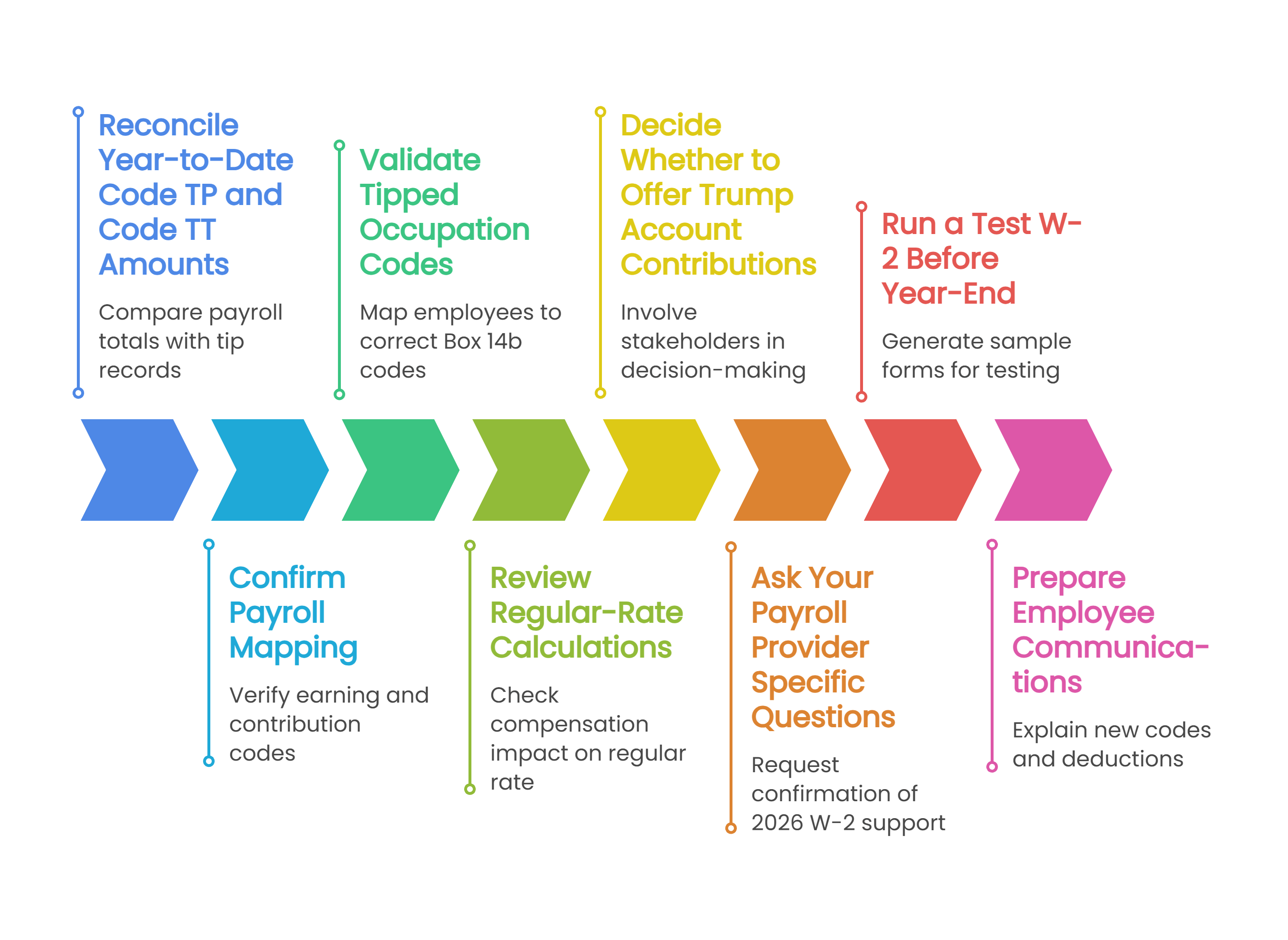
1. Reconcile Year-to-Date Code TP and Code TT Amounts
Compare payroll totals with tip records, timekeeping data, earning codes, and regular-rate calculations. Investigate missing values and unusual variances while supporting records are still accessible.
2. Confirm Payroll Mapping
Verify which earning and contribution codes feed Codes TP, TT, and TA. Confirm that Code TT isolates the qualifying FLSA premium instead of pulling all overtime earnings.
3. Validate Tipped Occupation Codes
Map each affected employee to the correct Box 14b code. Review transfers, multiple roles, and records that may require code 000.
4. Review Regular-Rate Calculations
Check how bonuses, shift differentials, multiple rates, and other compensation affect the regular rate. Confirm that state-only or policy-based premiums are not automatically included in Code TT.
5. Decide Whether to Offer Trump Account Contributions
If leadership is considering this optional benefit, involve payroll, benefits counsel, tax advisers, and the account provider early. Do not treat the program as a routine post-tax deduction.
6. Ask Your Payroll Provider Specific Questions
Request confirmation that your configuration supports the 2026 W-2 fields, occupation codes, corrections, and reconciliation reports. Lift HCM clients can contact their dedicated CXR to review their setup.
7. Run a Test W-2 Before Year-End
Generate sample forms for employees with tips, overtime, multiple roles, and any qualifying Trump Account contribution. Confirm the values and field placement before final processing.
8. Prepare Employee Communications
Explain what each new code means without giving personal tax advice. Make clear that Code TT is not all overtime pay and that the reported amount is not automatically the employee's final deduction.
Employers should also review the IRS W-2 electronic filing threshold and the potential cost of payroll tax filing and payment errors as part of year-end planning.
Frequently Asked Questions About the 2026 Form W-2
When Are 2026 Forms W-2 Due?
Employers must file 2026 Forms W-2 with the Social Security Administration and furnish them to employees by February 1, 2027. January 31 falls on a Sunday in 2027, so the deadline moves to the next business day.
Should Form W-2 Totals Match Form 941?
Employers should reconcile annual Forms W-2 and W-3 with their quarterly Forms 941. However, certain amounts may differ because the forms report different types of wages, compensation, and adjustments. Employers should review applicable IRS reconciliation guidance, investigate unexplained differences, and retain supporting documentation before filing year-end returns.
What Is Code TP on Form W-2?
Code TP reports total cash tips an employee reported to the employer during the year. The employee may use that information when calculating the federal deduction for qualified tips.
What Is Code TT on Form W-2?
Code TT reports qualified overtime compensation. For traditional FLSA time-and-a-half overtime, it generally reports the additional one-half premium above the regular rate, not all pay earned during overtime hours.
What Is Code TA on Form W-2?
Code TA reports qualifying employer contributions made through a Section 128 Trump Account contribution program. The program is optional and must meet applicable written-plan and other requirements.
Do All Employers Need to Use the New Codes?
No. Code TP and Box 14b apply to employers reporting cash tips. Code TT applies when an employee receives qualified FLSA overtime compensation. Code TA applies only if an employer makes qualifying Trump Account contributions.
Can an Employer Report All Overtime Pay Under Code TT?
Generally, no. Code TT is limited to qualified overtime compensation, which is generally the FLSA-required premium above the employee's regular rate. Employers should not map total overtime earnings to Code TT without isolating the qualifying amount.
Does Code TT Mean Overtime Is Tax-Free?
No. Qualified overtime compensation generally remains subject to normal payroll withholding and FICA taxes. Code TT provides information the employee may use to determine a federal income tax deduction on an individual return.
Does Code TP Mean All Tips Are Deductible?
No. The employee's final deduction depends on the law's eligibility rules, occupation requirements, income limits, and individual tax circumstances. Code TP is an employer reporting amount, not a guarantee of the deduction.
What Happens If a New W-2 Code Is Wrong?
The employer may need to file Form W-2c with the SSA and furnish a corrected statement to the employee. Employers should correct errors promptly because inaccurate or omitted reporting can affect the employee's return and may expose the employer to penalties.
Should Employers Change Withholding for Codes TP or TT?
Not automatically. Employers should continue normal withholding unless the employee submits a valid revised Form W-4 or another applicable rule requires a change.
Where Can Employers Find the Official Rules?
Start with the 2026 General Instructions for Forms W-2 and W-3, the IRS qualified overtime FAQs, and the official tipped occupation list. Employers considering Trump Account contributions should also monitor the proposed regulations and later IRS updates.
Prepare for the February 1, 2027 Deadline Now
The most important 2026 Form W-2 changes are easy to summarize but harder to implement. Code TP requires reliable tip reporting and occupation mapping. Code TT requires employers to isolate the qualifying FLSA premium from total overtime pay. Code TA requires a properly designed employer contribution program before any amount is reported.
The best next steps are to reconcile year-to-date TP and TT data, confirm payroll mappings, and test W-2 output before year-end. That work can reduce corrections, protect employee tax reporting, and make the February 1, 2027 deadline far less stressful.
Lift HCM combines payroll technology with hands-on support to help employers manage year-end reporting changes. If you want help reviewing your payroll configuration or preparing for the new W-2 fields, explore Lift HCM's Payroll & Tax Management solutions or talk with our team.

This article is provided for general informational purposes only and does not constitute legal, tax, accounting, or benefits advice. Requirements and agency guidance may change. Employers should review current IRS instructions and consult qualified advisers before making reporting, withholding, or benefit-plan decisions.
Topics: