
Are you an employer constantly battling payroll errors, compliance headaches, or the elusive whereabouts of your remote team? Choosing the right time tracking system can feel like navigating a maze, with tech specs and glowing reviews often missing the mark on your specific needs.
You might be asking:
-
Which is easier for my team to use?
-
Will this system track employee location?
-
Is GPS tracking even reliable?
-
And how do I make sure I stay compliant with labor laws?
At Lift HCM, we understand how high the stakes are when choosing a time and attendance tracking system. We've helped hundreds of businesses navigate time tracking solutions, streamline operations, and ensure accuracy in employee hours and payroll compliance.
In this article, we’ll break down what you really need to know about Gusto and ADP's time tracking tools, including how they work, whether they track location, and potential problems with GPS-based tracking. By the end, you’ll have a clearer understanding of which system may be right for your organization, and what to consider before making the switch.
Key Takeaways
- Gusto offers web, mobile app, and tablet kiosk clock-ins that sync with payroll. Time tracking is available on its Plus and Premium plans.
- ADP offers kiosk hardware, a tablet kiosk app, and a mobile app with geo-fencing and geo-pinning, plus more advanced scheduling and a steeper learning curve.
- Both capture location when an employee punches in or out. Based on their published materials, neither lists continuous tracking through a shift as a built-in feature.
- GPS and biometric clock-ins are subject to state privacy and consent rules, and Illinois has a notable biometric law. Confirm your approach with counsel.
- Choose based on company size, scheduling complexity, and how much location control you need. Ask for a demo using your real scenarios.
Table of Contents
- What Is Automated Time Tracking, and How Do Gusto and ADP Approach It?
- Why Does Time Tracking Matter for Your Business?
- What Time Tracking Features Does Gusto Offer?
- What Time and Attendance Options Does ADP Offer?
- Does Gusto Track Employee Location?
- Does ADP Track Employee Location?
- Potential Issues with Gusto and GPS Tracking
- Employee Scheduling Capabilities: Keeping Your Workforce Aligned
- PTO and Leave Management Features: Simplifying Time Off
- What Do Real People Say About Gusto and ADP?
- Frequently Asked Questions (FAQs)
- Choosing the Right Time and Attendance System for Your Business
What Is Automated Time Tracking, and How Do Gusto and ADP Approach It?
Automated time tracking is software that records when employees start and stop work and sends those hours straight to payroll, replacing paper timesheets and manual entry. Employees clock in from a phone, a web browser, or a shared tablet or kiosk, and managers review and approve the hours. Gusto and ADP both offer this, but they aim at different businesses. Gusto focuses on simplicity for small and mid-sized teams, while ADP offers more clock-in methods and scheduling depth for larger or more complex organizations. For example, a multi-location restaurant group and a ten-person design studio would likely land on different answers.
Why Does Time Tracking Matter for Your Business?
Accurate time tracking matters because payroll accuracy, compliance, and employee trust all depend on getting hours right. On the business side, fewer missed punches and manual edits mean fewer payroll corrections and less manager time spent chasing timesheets. On the compliance side, the Fair Labor Standards Act (FLSA) requires employers to keep accurate records of hours worked by non-exempt employees, and many states add their own rules. Employees benefit too, because clear, easy clock-ins and visible hours build confidence that they are paid correctly. Financially, small daily errors such as buddy punching or rounding mistakes can add up across a team over a year.
What Time Tracking Features Does Gusto Offer?
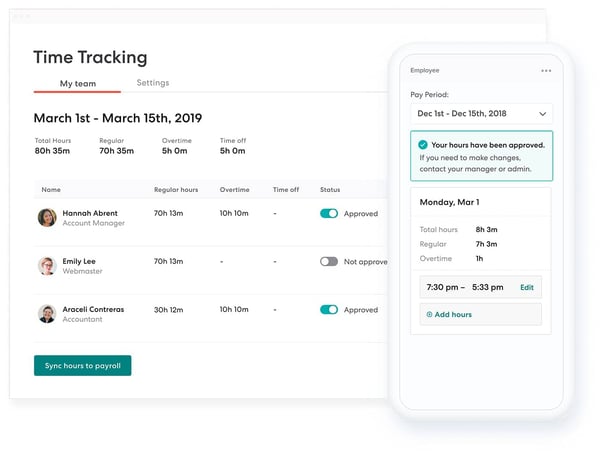
Gusto offers web, mobile app, and tablet kiosk clock-ins that sync directly with payroll. Employees can clock in from any web browser or the Gusto mobile app on iOS and Android, and the Time Kiosk turns any tablet into a time clock. Approved hours flow into Gusto Payroll, which helps reduce manual entry. Time tracking is available on Gusto’s Plus and Premium plans, so confirm current pricing before you compare costs.
Key features of Gusto’s time tracking system:
- Time Kiosk & Web Clock-ins: Any tablet can become a kiosk, or employees can log hours in-browser—perfect when half the team is remote.
- Gusto Wallet App: Lets staff clock in/out, track breaks, and view pay—all in one place.
- Third-Party Integrations: Plug into 7Shifts, Deputy, Homebase, or QuickBooks Time to add features like biometric punches or idle-time alerts.
- Payroll Auto-Sync: Hours flow straight into Gusto Payroll; small teams rarely need manual adjustments.
The platform integrates with several popular time-tracking apps, such as 7Shifts, Deputy, Homebase, and QuickBooks Time, enabling features like GPS tracking, biometric clock-ins, and idle time tracking.
Best For:
- Small to mid-sized businesses
- Teams with simple scheduling needs
- Remote or hybrid workforces that value ease of use over advanced features
Source: Gusto Time Tracking
What Time and Attendance Options Does ADP Offer?
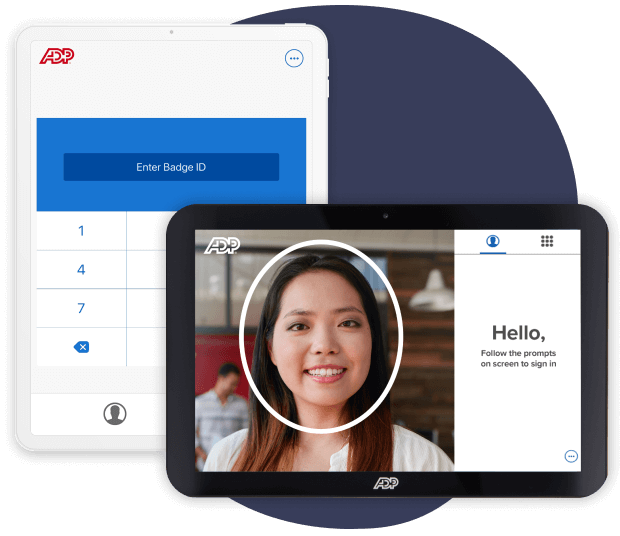
ADP offers kiosk hardware, a tablet kiosk app, and a mobile app, giving larger or more complex teams more ways to collect time. The ADP Kiosk is a mounted, always-powered device that supports badge-number punches, facial recognition, and an optional fingerprint scanner. The ADP Time Kiosk app turns a shared tablet into a timekeeping device, so you can skip dedicated hardware (confirm device compatibility with ADP). ADP’s mobile clocking lets employees punch in and out from their phones, with geo-fencing and geo-pinning available for location checks. ADP also lists optional voice commands on iOS devices. The kiosk is listed for customers using timekeeping in ADP Workforce Now and RUN Powered by ADP.
- ADP Kiosk (Hardware): Wall-mounted, rugged, supports PIN, face-ID, QR, or optional fingerprint scanner—great for industrial floors and high-security environments.
- ADP Time Kiosk App: Turns any iOS/Android tablet into the same clock without buying hardware, offering a budget-friendly alternative to dedicated hardware.
- ADP Mobile Solutions: Employees clock in/out, check schedules, request PTO; managers get alerts in real time with robust notification controls.
- Biometrics & Voice Commands: Biometric login cuts buddy-punching; voice clock-ins help food-service employees with messy hands or in environments where touching screens is impractical.
Best For:
- Mid-sized to enterprise organizations
- Multi-location businesses
- Industries with strict compliance requirements
- Companies needing advanced scheduling capabilities
Source: ADP Time & Attendance
Does Gusto Track Employee Location?
Yes, but only at the moment of a punch and only through the Gusto mobile app. When an employee who has opted in clocks in or out, the app records their location, and admins can see it on the timesheet. Admins can also set authorized workplaces so Gusto flags time tracked somewhere else. Location is not captured when employees clock in from a web browser, and Gusto cannot require employees to share their location. If an employee edits the hours on a timesheet, the location stamp is removed. For continuous tracking or more advanced location features, businesses would need to look at third-party integrations.
Does ADP Track Employee Location?
Yes, ADP Mobile Solutions app offers geo-fencing and geo-pinning. Geo-fencing confirms that employees are within a set distance of a work location when they clock in or out. Geo-pinning marks where they were at the time of the punch, so employers can see location violations. ADP’s kiosk options can also limit clock-ins to certain areas or IP addresses. Based on ADP’s published materials, location features are tied to clock events, and we did not find continuous live tracking listed as a built-in feature. If you need it, ask ADP directly or review third-party location apps in the ADP Marketplace.
Potential Issues with Gusto and GPS Tracking
Gusto's native time tracking, while user-friendly, has a more limited approach to GPS tracking compared to some dedicated time tracking systems or advanced integrations.
- Location Stamping at Punch Times: The Gusto Wallet app can capture an employee's location, but primarily at the specific times they clock in and clock out. This provides a location "stamp" for each punch, confirming where the action occurred.
- No Continuous Tracking: Gusto's core time tracking feature does not typically offer continuous GPS tracking throughout the employee's active shift. Businesses requiring ongoing location visibility for purposes like route optimization or detailed field team management would find this native feature insufficient.
- Requires Employee Opt-in: For location stamping to work, employees must enable location services for the Gusto Wallet app on their mobile devices. Gusto does not enforce location sharing; it's based on employee consent.
- Dependence on Third-Party Apps for Advanced Needs: Businesses needing more robust GPS functionalities, such as live tracking, geofencing alerts beyond clock-in/out, or detailed location history, would need to leverage one of the third-party time tracking applications that integrate with Gusto and offer these advanced features.
- App Reliability as a Factor: While generally well-regarded, any mobile app can occasionally experience technical issues. If an employee encounters a glitch with the Gusto Wallet app during clock-in or clock-out, it could potentially affect the accurate capture of the location stamp.
Employee Scheduling Capabilities: Keeping Your Workforce Aligned
Efficient scheduling is vital for managing labor costs and ensuring appropriate staffing levels. Both Gusto and ADP offer tools to help businesses create and manage employee schedules.
Key Features of Gusto's Integrated Scheduling Tools
Gusto provides integrated scheduling tools to streamline management, optimize costs, and enhance communication, with seamless integration into third-party apps.
- Efficient Schedule Creation: Develop and release employee schedules swiftly, cutting down on administrative tasks and minimizing mistakes.
- Instant Updates: Employees can access schedules, request leave, and exchange shifts from any location, receiving immediate alerts for any modifications.
- Optimized Labor Costs: Utilize reporting and analytics to monitor labor patterns, overtime, and staffing expenses, facilitating informed scheduling choices.
- Seamless Time Tracking: Evaluate scheduled hours against actual hours worked, providing detailed insights for compliance and payroll precision.
- Employee Self-Service: Employees can handle their availability, request leave, and view schedules online or through the Gusto Wallet app, reducing the need for managerial involvement.
- Automated Compliance: Time off and holidays automatically align with schedules, ensuring compliance and preventing scheduling conflicts.
Key Features of ADP's Advanced Scheduling Tools
ADP provides integrated web and mobile employee scheduling tools within its workforce management solutions like ADP Workforce Now® and ADP Timekeeping Plus Scheduling, enabling businesses to efficiently manage schedules, control labor costs, and improve compliance and productivity.
- Automated Scheduling and Shift Management: Create and adjust employee schedules easily, assigning shifts based on skills and availability while optimizing for balanced staffing.
- Self-Service and Flexibility: Employees can manage their schedules, time-off requests, and availability via mobile or web, while managers can approve requests and post open shifts.
- Real-Time Analytics and Cost Control: Access instant insights into schedule costs, actual vs. scheduled hours, and overtime, using predictive tools to forecast staffing needs and control labor expenses.
- Attendance and Compliance Monitoring: Track attendance, breaks, and tardiness with alerts for exceptions, ensuring automated compliance with all relevant policies.
- Integration with Payroll and HR: Seamlessly integrates with ADP payroll and HR systems, streamlining time tracking, payroll processing, and compliance with a single login.
- Mobile and Kiosk Options: Employees can clock in/out using mobile apps, web timesheets, or ADP Kiosks, with advanced features like geo-pinning and biometrics for accuracy and security.
ADP’s platforms, especially Workforce Now®, support integration with a wide range of third-party scheduling solutions, such as When I Work, Homebase, Deputy, 7shifts, Agendrix, and others. These integrations allow businesses to extend or tailor scheduling capabilities to their unique needs while keeping all workforce data connected with payroll and HR.
PTO and Leave Management Features: Simplifying Time Off
Managing paid time off and various types of leave is crucial for compliance and employee satisfaction. Both platforms offer tools to streamline this process.
Gusto's PTO and Leave Management
Gusto provides a straightforward system for managing employee time off.
- Customizable Policies: Businesses can create and manage various time off policies (vacation, sick leave, personal days, etc.) tailored to their needs and compliant with regulations.
- Employee Self-Service: Employees can easily request time off through the Gusto platform or app, viewing their available balances.
- Manager Approvals: Managers receive and can approve or deny time off requests within the system, maintaining a clear record of the process.
- Automatic Balance Updates: The system automatically calculates and updates employee time off balances based on accrual rules and approved requests.
- Payroll Integration: Approved time off is automatically integrated with payroll processing, ensuring accurate payment and record-keeping.
- Reporting: Basic reporting tools are available to track time off usage trends.
ADP's PTO and Leave Management Solutions
ADP offers multiple options for PTO and leave management, catering to different levels of complexity.
- ADP Workforce Management: This comprehensive platform includes integrated leave management, simplifying requesting, approving, and tracking leave balances.
- Time Off by HR Cloud for ADP Workforce Now Essential Time: An integrated app that automates and tracks various leave types in a shared calendar format, centralizing requests, approvals, and accruals.
- Absence Management: For more complex needs, this solution provides in-depth tools for managing planned and unplanned absences, tracking patterns, and assisting with compliance for regulations like FMLA.
- Scalability and Complexity: ADP's offerings are generally more scalable and can handle more intricate leave policies and compliance requirements often found in larger organizations.
ADP provides various time tracking methods, including wall-mounted kiosks, a kiosk app, and a mobile app. For mobile clock-ins, ADP employs geo-fencing to confirm that employees are within a designated range of an authorized work location when clocking in or out. Additionally, ADP utilizes geo-pinning to accurately record the employee's location at clock-in/out, enabling employers to identify any location discrepancies. ADP’s kiosk solutions can feature biometric authentication, such as facial recognition and fingerprint scanning, to deter "buddy punching." The ADP mobile app facilitates clocking in/out, schedule viewing, and time-off requests, with geo-fencing seamlessly integrated. ADP’s time and attendance data is directly integrated into payroll and HR systems, ensuring smooth integration and compliance.
What Do Real People Say About Gusto and ADP?
Let's take a look at what actual users have to say about using ADP and Gusto to manage time and attendance. Insights from current conversations on Reddit shed light on user experiences with these tools.
|
Feature |
Gusto |
ADP |
Best for |
|
Core audience |
Small to mid-sized businesses |
Larger, complex organizations |
Depends on company size |
|
Time tracking options |
Web-based, mobile app, partner integrations |
Kiosk hardware, tablet app, mobile app |
ADP for variety, Gusto for simplicity |
|
Location tracking |
Limited native capability, relies on integrations |
Built-in geo-fencing and GPS tagging |
ADP for location-critical businesses |
|
Scheduling |
Basic, easy shift swaps |
Advanced, automated skill matching |
ADP for complex scheduling needs |
|
PTO/Leave management |
Simple, automatic payroll integration |
Advanced, customizable compliance tools |
ADP for complex policies |
|
Ease of use |
Very user-friendly, minimal training needed |
More complex, longer learning curve |
Gusto for user experience |
|
Cost structure |
More transparent pricing, generally lower cost |
Custom quotes, higher but scalable |
Gusto for startups/SMBs |
|
Integration ecosystem |
Strong small business app connections |
Enterprise-grade integration capabilities |
Depends on existing tech stack |
Frequently Asked Questions (FAQs)
Is Gusto or ADP better for time tracking?
It depends on your business. Gusto is better for small to mid-sized businesses that want simple, payroll-connected time tracking, while ADP is better for larger or more complex organizations that need more clock-in methods, location controls, and scheduling depth.
Is Gusto easier to use than ADP for time tracking?
Generally, yes. Gusto is widely praised for its user-friendly interface, which suits small to mid-sized businesses with less complex needs. ADP is powerful and scalable but often has a steeper learning curve because of its extensive features.
Does Gusto offer continuous GPS tracking?
No. Gusto’s mobile app records a location stamp at the moment of clock-in and clock-out, not throughout the shift, and employees must opt in. For continuous tracking, businesses would need a third-party integration.
Can ADP continuously track employee location throughout a shift?
ADP’s mobile clocking uses geo-fencing and geo-pinning to verify location at clock-in and clock-out. We did not find continuous live tracking listed among ADP’s own location features, so businesses that need it should ask ADP or review third-party apps in the ADP Marketplace.
How much does Gusto time tracking cost?
Gusto’s time tracking features are available on its Plus and Premium plans, and pricing depends on the plan and the number of employees. Check Gusto’s current pricing page before you compare costs.
Which system is better for complex scheduling needs, Gusto or ADP?
ADP generally offers more advanced scheduling, including skill-based scheduling and real-time labor cost visibility, though availability varies by product. Gusto offers basic, easy-to-use scheduling that suits simpler staffing needs.
Can I use Gusto or ADP time tracking for remote employees?
Yes. Gusto supports clock-ins from any web browser or its mobile app, and ADP’s mobile clocking supports geo-fencing and geo-pinning for location checks. Remember that Gusto captures location only in the mobile app, not in a browser.
Is GPS time tracking legal for employers?
It can be, but rules vary by state. Employers should notify employees, limit tracking to working time, and obtain any consent their state requires. Biometric clock-ins such as fingerprint or facial recognition carry additional requirements in states like Illinois. This information is for educational purposes only and is not intended to replace legal counsel.
How do Gusto and ADP help with payroll compliance?
Both systems automate time tracking and integrate with payroll to reduce errors and help businesses keep the records labor laws like the FLSA require. ADP’s solutions often offer more in-depth tools for complex leave policies and industry-specific needs in larger organizations.
Choosing the Right Time and Attendance System for Your Business
When comparing the time tracking, scheduling, PTO, and leave management features of Gusto and ADP, it's clear that both platforms offer valuable solutions, but they are tailored to different business profiles and needs.
Gusto is often the better fit for: Small to medium-sized businesses prioritizing ease of use, a tightly integrated payroll and HR experience, straightforward time tracking and scheduling, and transparent pricing. Its native features are well-suited for businesses with less complex time and attendance requirements and those who benefit from a user-friendly interface for both admins and employees.
ADP is often the better fit for: Larger enterprises with complex organizational structures, diverse workforces, intricate labor rules, and advanced compliance needs. Businesses requiring a wide variety of time collection methods, sophisticated scheduling capabilities (like skill-based scheduling), detailed leave management, and robust reporting will likely find ADP's comprehensive platform more suitable and scalable.
Ultimately, the best choice hinges on your business's current size, growth plans, workforce complexity, and budget. By carefully evaluating features like location tracking, limitations, and costs, you can make an informed decision that streamlines your time and attendance, boosts accuracy, and supports your operational goals.
Choosing the right HCM partner is as crucial as the software itself. At Lift HCM, we're more than just a provider—we offer tailored time and attendance solutions designed to meet your specific needs, much like ADP and Gusto, but with personalized support.
Ready to find the perfect time and attendance solution tailored to your business? Discover how Lift HCM can simplify your operations and ensure compliance. Explore our comprehensive Time & Attendance solutions today or schedule a free, personalized consultation!