

.png?width=1672&height=941&name=Five%20Open%20Enrollment%20Mistakes(1).png)
Open enrollment can feel like a finish line. Employees make elections, forms get signed, and the plan year rolls over. Then, a few weeks later, an employee's paycheck shows the wrong deduction, a claim gets denied because a dependent was never added, or someone discovers that a required notice did not go out.
Most open enrollment mistakes are not dramatic. They are small gaps between HR, payroll, employees, carriers, and plan administrators that grow into benefits administration problems before anyone notices.
At Lift HCM, we manage benefits administration alongside payroll and HR for small and mid-sized employers across the country. We regularly see how a missed handoff during enrollment can affect deductions, coverage, compliance, and employee trust after the enrollment window closes.
This article explains five recurring open enrollment mistakes, why they happen, and what employers can do instead. You will also find an open enrollment notice table, a midyear benefits-change workflow, and a post-enrollment audit checklist.
Key Takeaways
-
Required benefits notices follow different rules and deadlines. There is no single universal open enrollment notice date.
-
Benefit elections should be reconciled against payroll deductions and carrier records before the first payroll of the new plan year.
-
HIPAA special enrollment deadlines and Section 125 midyear election rules are related, but they are not the same.
-
Repeated, plain-language communication can reduce confusion before employee elections are locked in.
-
A post-enrollment audit can identify common coverage and deduction errors before they affect a paycheck or claim.
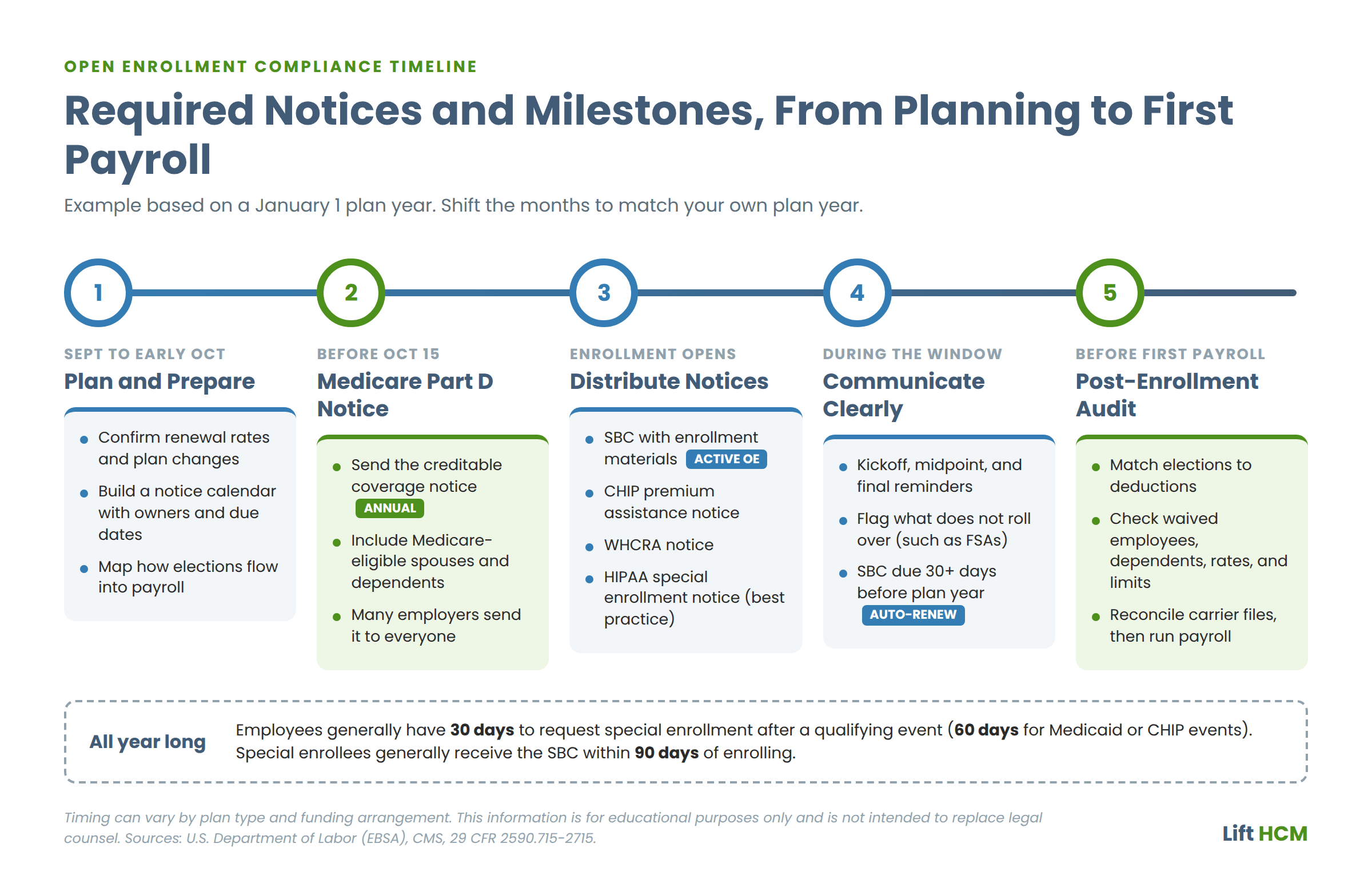
Table of Contents
What Is Benefits Administration During Open Enrollment?
Benefits administration during open enrollment is the set of tasks employers handle to let employees review, choose, and confirm their benefits for the coming plan year, and then carry those choices correctly into payroll and carrier systems.
The process may include preparing enrollment materials, distributing applicable notices, confirming employee eligibility, collecting elections, updating payroll deductions, transmitting enrollment information to carriers, and documenting completed actions.
Open enrollment may look like a single employee event, but it is usually a short project with several systems, owners, and deadlines. An error at any handoff can affect an employee long after the enrollment window ends.
Why Does Getting Open Enrollment Right Matter?
Getting open enrollment right matters because enrollment mistakes can turn into payroll, coverage, compliance, and employee-experience problems.
A missed notice can create compliance exposure. A deduction that does not match an election can reduce confidence in payroll. A dependent who was not added correctly may not discover the problem until a claim is submitted.
Unclear communication can also leave employees unsure about costs, coverage changes, or which elections must be made again. These problems often surface after enrollment closes, when corrections are more difficult and employees may have fewer options.
What Are the Most Common Open Enrollment Mistakes?
Five recurring open enrollment mistakes are missing applicable notice deadlines, failing to match payroll deductions to employee elections, using an unclear process for midyear benefit changes, communicating too little, and skipping a post-enrollment audit.
These mistakes are common because open enrollment requires information to move between people and systems on a tight schedule. A more deliberate process can prevent many of the problems that otherwise appear after the new plan year begins.
Mistake 1: Missing Required Notice Deadlines
Employers can miss notice deadlines because each notice has its own purpose, audience, trigger, and timing. There is no universal packet or delivery date that satisfies every requirement.
The notices that apply depend on factors such as the plan type, funding arrangement, benefits offered, employee locations, and covered population. Employers should confirm their specific requirements with their broker, carrier, plan administrator, benefits counsel, or another qualified adviser.
Open Enrollment Notice Timing at a Glance
| Notice | When It Generally Applies | Who Generally Receives It | General Timing |
|---|---|---|---|
| Summary of Benefits and Coverage, or SBC | A group health plan or issuer provides covered health benefits subject to the SBC rules | Participants and beneficiaries | With enrollment or open season materials when employees can elect or change coverage |
| SBC for automatic renewal | No renewal is required and there is no opportunity to change coverage options | Participants and beneficiaries | Generally no later than 30 days before the new plan or policy year, subject to limited exceptions |
| SBC for a special enrollee | An individual enrolls through a HIPAA special enrollment right | Special enrollee | No later than the date the Summary Plan Description is required, generally within 90 days after enrollment |
| HIPAA special enrollment notice | An eligible employee is first offered the opportunity to enroll in the group health plan | Employees eligible to enroll | At or before the first opportunity to enroll |
| Employer CHIP notice | The applicable Medicaid or CHIP premium assistance notice rules apply | Generally all employees, regardless of current enrollment or eligibility | Annually |
| Medicare Part D creditable coverage notice | Prescription drug coverage is offered and Medicare-eligible individuals may be covered | Medicare-eligible covered individuals, including applicable spouses and dependents | Before October 15 each year and at certain other required times |
| Women's Health and Cancer Rights Act notice | A plan covers medical and surgical benefits related to mastectomies | Participants and beneficiaries | At enrollment and annually afterward |
This table is a general reference, not a complete list of every notice that may apply. The U.S. Department of Labor's Reporting and Disclosure Guide for Employee Benefit Plans provides additional federal guidance.
Summary of Benefits and Coverage
The SBC explains a plan's benefits and coverage in a standard format. If a plan requires an active election or gives employees an opportunity to change coverage during open enrollment, the SBC is generally provided with the enrollment materials.
If there is no requirement to renew and no opportunity to change coverage options, the renewal may be treated as automatic. In that situation, the SBC is generally due no later than 30 days before the first day of the new plan or policy year. Special timing rules can apply when an insured policy has not been finalized by that date.
Special enrollees generally must receive the SBC no later than the date the Summary Plan Description is required, which is typically within 90 days after enrollment. An SBC also generally must be provided upon request as soon as practicable and no later than seven business days after the request.
See the Department of Labor's Summary of Benefits and Coverage resources for current templates and instructions.
Medicare Part D Creditable Coverage Notice
Employers that offer prescription drug coverage generally must tell Medicare-eligible covered individuals whether the coverage is creditable. The annual notice must be provided before October 15, which means employers should not wait until October 15 to send it.
The requirement can apply to Medicare-eligible employees, spouses, dependents, COBRA participants, disabled individuals, and retirees covered by the prescription drug plan. Because employers may not always know who is Medicare-eligible, some provide the notice to everyone enrolled in the prescription drug coverage.
The employee notice is not the only Medicare Part D disclosure employers may need to address. Plan sponsors generally must also complete the online disclosure to CMS within 60 days after the beginning of the plan year, within 30 days after terminating prescription drug coverage, or within 30 days after a change in creditable status.
2026 Medicare Part D Update: Employers should not assume that last year's creditable coverage determination still applies. For calendar year 2026 only, CMS permits non-Retiree Drug Subsidy group health plans to use either the existing or revised simplified determination methodology. Under the revised method, the coverage generally must be designed to pay at least 72% of participants' prescription drug expenses, compared with 60% under the existing method. Employers should confirm the plan's determination before distributing the notice.
Review the CMS 2026 Part D guidance or consult the plan's carrier, broker, or actuary.
Women's Health and Cancer Rights Act Notice
Group health plans that provide medical and surgical benefits for mastectomies generally must describe required reconstructive surgery and related coverage when an employee enrolls and once each year afterward.
The practical fix: Build one compliance calendar before enrollment begins. List each applicable notice, who should receive it, the internal owner, the delivery method, the due date, and where proof of delivery will be stored. If a broker, carrier, or third party prepares a notice, assign an internal owner to confirm that it was sent.
Mistake 2: Payroll Deductions That Do Not Match Employee Elections
Payroll deductions can stop matching employee elections when benefits and payroll use disconnected records or someone must re-enter elections manually after enrollment closes. Each handoff creates an opportunity for an outdated rate, incorrect coverage tier, missed employee, or tax-treatment error.
Common examples include:
- Coverage-tier errors: An employee elects family coverage, but payroll deducts the employee-only rate.
- Rate errors: New plan-year rates are not loaded, so payroll continues using the prior year's amounts.
- Tax-treatment errors: A pre-tax deduction is configured as post-tax, or the reverse.
- Timing errors: A deduction that should begin with the first payroll of the new plan year starts one or two pay periods late.
- Waiver errors: An employee waives coverage, but the prior deduction remains active.
These errors are often among the first benefits problems employees notice because they appear directly on the paycheck.
The practical fix: Reduce manual re-entry where possible. Before the first payroll is finalized, compare each employee's confirmed election with the payroll preview or register. Confirm the plan, coverage tier, deduction amount, tax treatment, and effective date.
Mistake 3: No Clear Process for Midyear Benefit Changes
Employers sometimes use “qualifying life event” as a broad label for any midyear benefits change. In practice, HIPAA special enrollment rights and Section 125 cafeteria plan election changes follow related but different rules.
HIPAA special enrollment may apply after events such as marriage, birth, adoption, placement for adoption, or loss of other coverage. It may also apply when an employee or dependent loses Medicaid or CHIP eligibility or becomes eligible for state premium assistance.
Employees and dependents generally must receive at least 30 days to request HIPAA special enrollment after most covered events. The period is generally at least 60 days following a loss of Medicaid or CHIP eligibility or a determination of eligibility for state premium assistance. State law may provide additional rights for insured plans.
Midyear changes to pre-tax elections also depend on the employer's Section 125 cafeteria plan document. A plan may permit certain election changes, but the employer should administer the written plan consistently rather than approving changes informally.
A Five-Step Midyear Benefits-Change Workflow
- Receive the request. Give employees one clear place to submit a request and provide any documentation permitted by the plan.
- Confirm the rule and deadline. Determine whether the request involves HIPAA special enrollment, a Section 125 election change, or another plan provision.
- Notify the carrier or administrator. Submit an approved enrollment or coverage change within the applicable administrative timeframe.
- Update payroll. Adjust deductions using the correct coverage tier, tax treatment, and effective date.
- Close the loop. Record carrier confirmation, verify the payroll update, and tell the employee when the change will appear.
The practical fix: Add this workflow to your HR administration process. Assign one owner to track the request until both coverage and payroll are confirmed.
Mistake 4: Weak Communication That Creates Confusion
Employees cannot make informed benefit elections if they do not understand what changed, what each option costs, or which decisions require action. A single email with several attachments may technically deliver information, but it may not help employees identify what matters to them.
Weak communication can contribute to employees defaulting into prior elections, overlooking valuable benefits, missing a deadline, or choosing coverage they do not fully understand. It can also create more questions after enrollment closes, when employees may have fewer options to make changes.
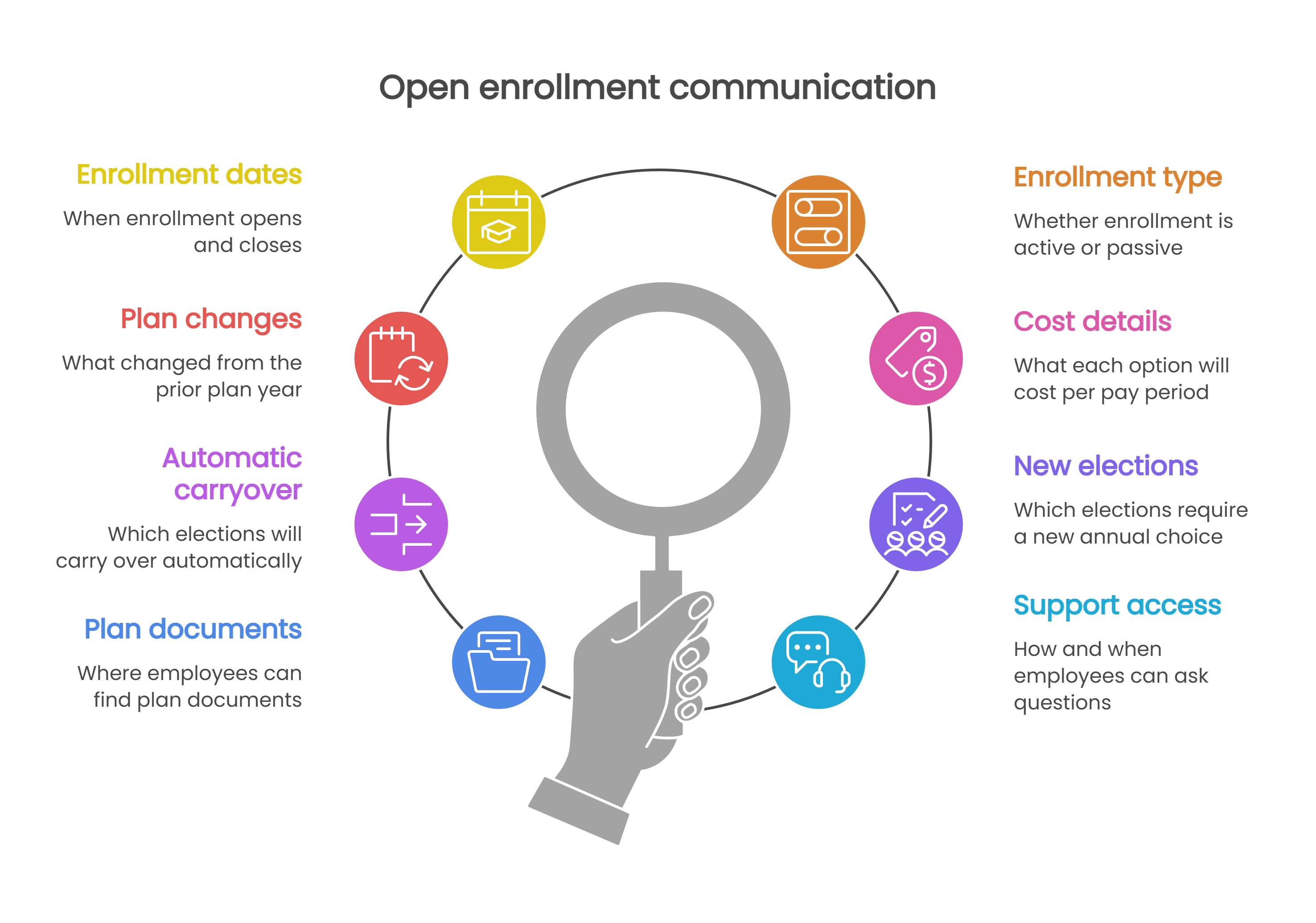
Open enrollment communication should clearly explain:
- When enrollment opens and closes
- Whether enrollment is active or passive
- What changed from the prior plan year
- What each option will cost per pay period
- Which elections will carry over automatically
- Which elections require a new annual choice
- Where employees can find plan documents
- How and when employees can ask questions
Health flexible spending account elections, for example, generally require a new election for each plan year even when other benefits roll over. Employers should confirm the rules that apply to their specific plan.
The practical fix: Communicate more than once. Send information before the window opens, at the midpoint, and several days before the deadline. Use plain language, lead with the actions employees must take, and provide a clear place to ask questions.
Mistake 5: Skipping a Post-Enrollment Audit
A post-enrollment audit compares what the employee elected, what the carrier recorded, and what payroll will deduct. Without this step, employers may not discover a problem until an employee reports an incorrect paycheck or encounters a coverage issue.
Post-Enrollment Audit Checklist
- Enrolled employees: Confirm each enrolled employee has the correct plan and payroll deduction.
- Waived employees: Confirm employees who waived coverage do not have an active deduction.
- Coverage tiers: Confirm employee-only, employee-plus-spouse, employee-plus-child, and family elections match across systems.
- Dependents: Confirm the dependent names and counts match the carrier record.
- Rates: Confirm the new plan-year employee and employer amounts are loaded correctly.
- Tax treatment: Confirm each deduction is configured as pre-tax or post-tax as intended.
- Contribution limits: Confirm applicable health FSA or HSA contribution elections and limits are loaded correctly.
- Effective dates: Confirm deductions and coverage begin on the correct date.
- Late changes: Confirm approved special enrollment or other midyear changes were captured.
- Carrier exceptions: Review rejected transmissions, missing records, or carrier confirmation reports.
For a repeatable audit, use a reconciliation file with the employee name or ID, elected plan, coverage tier, employee deduction, employer contribution, tax treatment, effective date, carrier confirmation, exception status, and assigned owner.
The practical fix: Make the audit a required open enrollment step and assign its owner before the enrollment window closes. Finish the first review before payroll is finalized, then confirm the deductions again after the first payroll posts.
How Can Employers Reduce Open Enrollment Errors?
Employers can reduce open enrollment errors by assigning ownership, documenting the handoffs between systems, and scheduling verification before the new plan year begins.
Start with these five steps:
- Build a notice calendar with each requirement, audience, owner, due date, delivery method, and proof of delivery.
- Map how an employee election becomes a carrier enrollment and payroll deduction.
- Document the process for HIPAA special enrollment and other permitted midyear election changes.
- Communicate dates, costs, required actions, and plan changes more than once.
- Reconcile employee elections, carrier records, and payroll deductions before the first payroll is finalized.
Many employers can improve these processes without immediately adding headcount. The larger opportunity is to clarify ownership, reduce manual handoffs, and make the audit part of the enrollment schedule.
What Should You Look for in Benefits Administration Software?
Benefits administration software should make enrollment easier for employees while giving HR and payroll teams a reliable way to move, verify, and report benefit information.
Software will not eliminate the employer's responsibility for plan administration or compliance. It can reduce repetitive work and make exceptions easier to identify when it connects the right records and workflows.
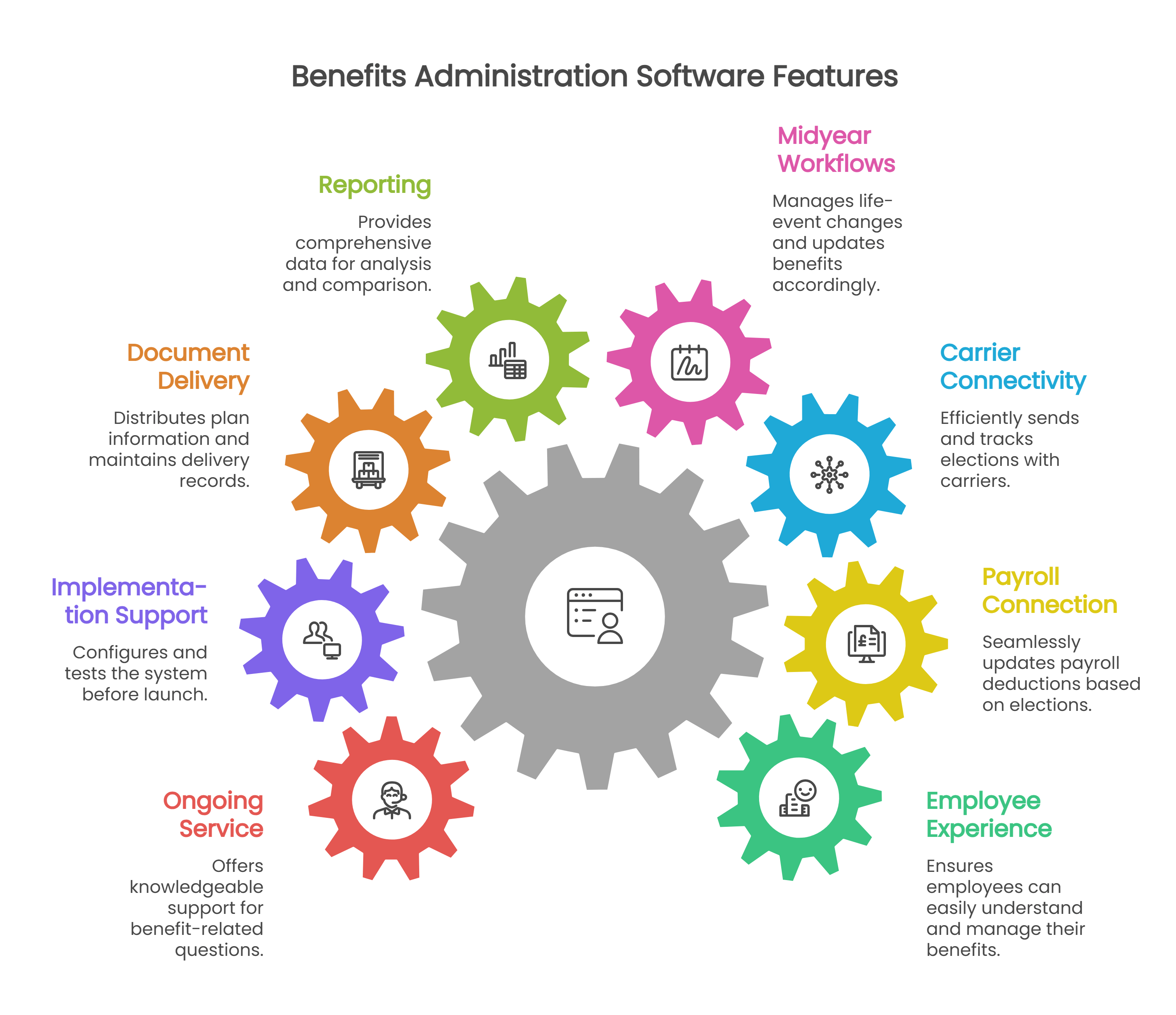
When evaluating options, consider:
- Employee experience: Can employees understand their options, see per-pay-period costs, and complete enrollment without extensive assistance?
- Payroll connection: Can confirmed elections update payroll deductions without unnecessary manual re-entry?
- Carrier connectivity: How are elections sent to carriers, and how are rejected or incomplete records identified?
- Midyear workflows: Can employees submit a life-event request and can HR document the review, approval, carrier update, and payroll change?
- Reporting: Can HR compare elections, deductions, effective dates, and carrier records in one report or export?
- Document delivery: Can the system distribute plan information and retain delivery records when appropriate?
- Implementation support: Who configures plan rules, rates, eligibility classes, deductions, and testing before launch?
- Ongoing service: When a coverage or deduction question arises, is there a knowledgeable person available to help investigate it?
Our guide to the best benefits administration software provides a broader evaluation framework. Employers should also examine whether a solution connects with their HR and payroll integrations or introduces another isolated system.
Benefits administration software may be worth evaluating when manual re-entry, recurring deduction corrections, limited reporting, or carrier discrepancies consume too much of the HR and payroll team's time. The right decision depends on workforce size, benefit complexity, existing systems, internal capacity, and cost.
Frequently Asked Questions
What Is the Most Common Open Enrollment Mistake?
There is no single mistake that affects every employer. A mismatch between an employee's confirmed election, carrier record, and payroll deduction is one of the most visible because it can affect both coverage and pay. Missed notices, poor communication, and incorrect eligibility records can be just as serious.
What Notices Do Employers Need to Send During Open Enrollment?
Required notices depend on the employer, plan design, funding arrangement, covered population, benefits offered, and employee locations. Common notices include the SBC, Employer CHIP Notice, WHCRA notice, Medicare Part D creditable or non-creditable coverage notice, and HIPAA special enrollment notice. Not every notice applies to every plan or follows the same delivery schedule.
When Is the Medicare Part D Creditable Coverage Notice Due?
The annual Medicare Part D creditable coverage notice generally must reach Medicare-eligible covered individuals before October 15. Additional delivery events may apply, including when a Medicare-eligible individual joins the plan or requests a copy. The plan sponsor may also have a separate online disclosure obligation to CMS.
How Long Do Employees Have to Request Special Enrollment?
Under federal HIPAA special enrollment rules, a plan generally must provide at least 30 days after most covered events for an employee or dependent to request enrollment. The period is generally at least 60 days following a loss of Medicaid or CHIP eligibility or a determination of eligibility for state premium assistance. Other midyear benefit changes depend on the plan document and applicable law.
Who Is Responsible When a Broker or Carrier Sends the Notices?
A broker, carrier, third-party administrator, or technology provider may help prepare or distribute a notice. Employers and plan administrators should still confirm who is legally responsible, whether the notice was delivered to the correct audience on time, and where proof of delivery is stored. Vendor assistance does not automatically transfer every compliance obligation.
How Should Employers Check Benefits Deductions After Enrollment?
Compare the final employee election file with the carrier confirmation and the payroll preview or register. Verify the plan, coverage tier, employee deduction, employer contribution, tax treatment, and effective date. Investigate every mismatch before payroll is finalized.
Is Benefits Administration Software Worth It for a Small Employer?
It may be worth evaluating when enrollment requires repeated manual entry, payroll deductions frequently need correction, carrier files generate unresolved errors, or HR cannot easily confirm what employees elected. A smaller employer with simple benefits and a reliable process may not need the same level of technology as an employer with multiple plans, eligibility classes, locations, or carriers.
Prevent Open Enrollment Problems Before They Reach Payroll
Open enrollment does not end when employees submit their elections. The process is complete when required notices have been handled, carrier records are confirmed, payroll deductions are accurate, employee questions are resolved, and exceptions have an assigned owner.
A notice calendar, documented midyear change process, repeated employee communication, and post-enrollment reconciliation can prevent many of the mistakes that otherwise surface through a paycheck or claim.
If benefit elections, carrier records, and payroll deductions still require multiple spreadsheets or manual updates, Lift HCM can help you evaluate where the process is breaking down. Learn more about our benefits administration solution, review our broader employee benefits enrollment and management guide, or contact Lift HCM to discuss your current workflow.
This information is for educational purposes only and is not intended as legal, tax, or benefits advice. Notice requirements, enrollment deadlines, and special enrollment rules can vary by plan type, funding arrangement, jurisdiction, and individual circumstances. Employers should confirm current requirements with their broker, carrier, plan administrator, benefits counsel, the U.S. Department of Labor's Employee Benefits Security Administration, CMS, or the applicable state insurance regulator.

.jpeg?width=1344&height=768&name=icons%20of%20benefits%20administration%20software%20for%202025(1).jpeg)
.jpg?width=1344&height=768&name=An%20image%20of%20a%20detailed%2c%20comprehensive%20guide%20to%20employee%20benefits%20enrollment%20and%20management%20in%202024%2c%20covering%20topics%20from%20types%20of%20benefits%20to%20future%20t-1(1).jpg)