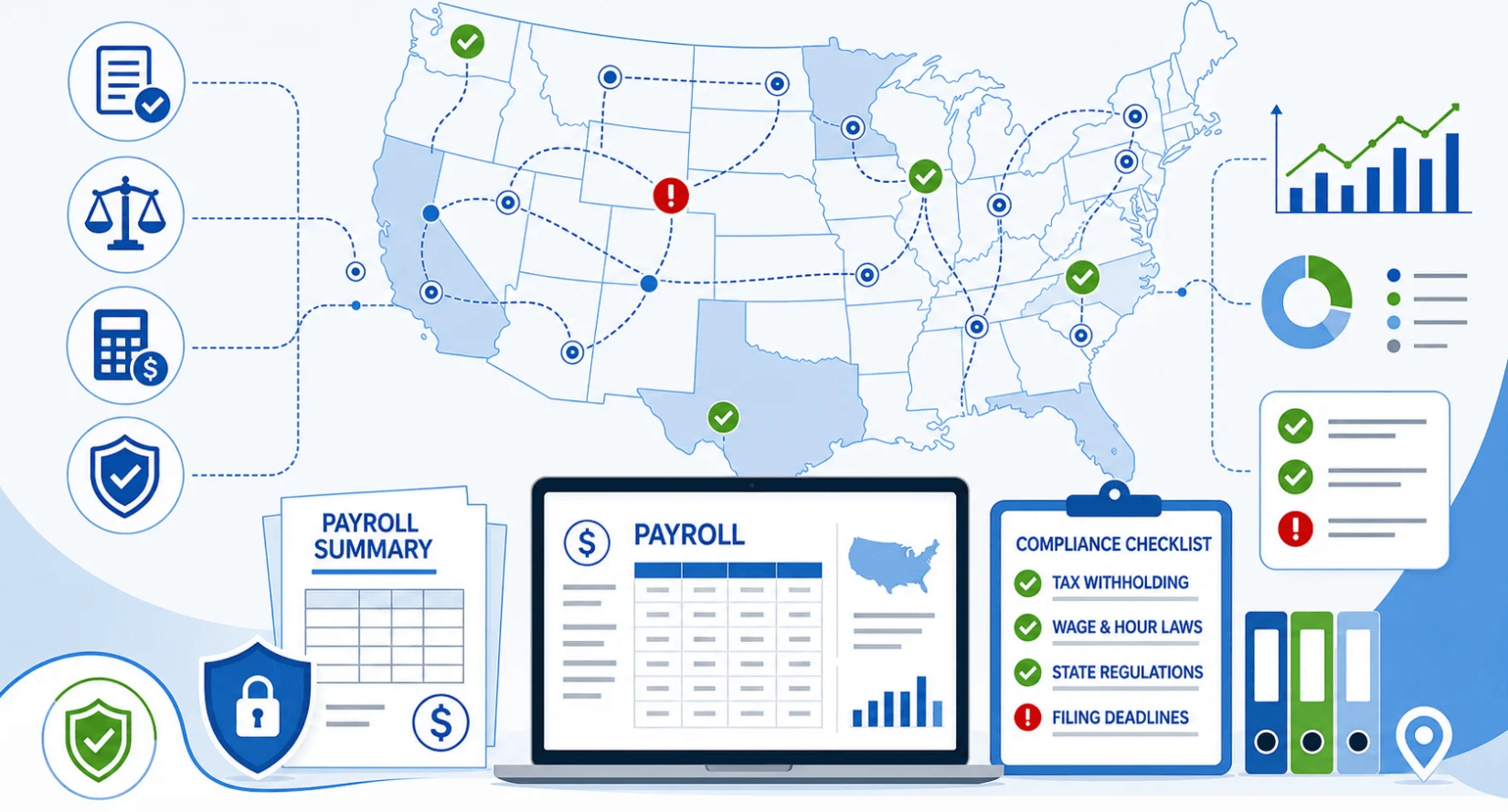


Overtime across multiple locations is based on an employee's total hours worked for the same employer in one workweek, not hours at any single location. When locations share an employer, hours generally combine before overtime is calculated, and hours over 40 in that workweek must be paid at 1.5 times the employee's regular rate.
Running payroll for a business with more than one location can feel tricky, especially when hours, pay rates, and payroll systems are split across sites.
At Lift HCM, we work with restaurants, healthcare groups, franchises, retailers, and professional services firms that share staff across locations, and we often see payroll systems that calculate overtime one location at a time instead of looking at the whole business. That gap can mean missed overtime pay and real compliance risk. This article walks through when hours must combine, how the math works when pay rates differ, and what to check before your next payroll run.
Key Takeaways
- Hours an employee works at multiple locations for the same employer generally combine within one workweek before overtime is calculated.
- A different location, department, job code, or payroll ID does not create a separate 40 hour threshold.
- When an employee works at more than one pay rate in the same week, the regular rate used for overtime is typically a weighted average of those rates.
- Paying an employee a salary does not exempt them from overtime; nonexempt salaried employees still need accurate weekly hours.
- Illinois follows the same weekly, combined hours approach as federal law, with a few differences employers should know.
- Employers should confirm their timekeeping and payroll systems combine hours automatically, since duplicate profiles and disconnected systems are where multi-location overtime mistakes usually start.
Table of Contents
-
How Does Illinois Handle Overtime Across Multiple Locations?
-
What Multi-Location Employers Need to Fix Before the Next Payroll Run
What Happens When an Employee Works at Multiple Locations?
When a nonexempt employee works at multiple locations for the same employer, all hours worked during the same workweek generally need to be counted together. Moving from Location A to Location B, changing departments, clocking into a different job, or using a separate location code does not reset the overtime calculation.
Under the Fair Labor Standards Act, overtime is based on hours worked in a workweek. Unless an exemption applies, covered employees must receive overtime pay for hours worked over 40 in a workweek at not less than one and one half times their regular rate of pay.
When Must Hours From Different Locations Be Combined?
Hours from different locations generally must be combined when the employee is working for the same employer during the same workweek. This includes shared employees between locations, employees who pick up shifts at another branch, and employees who perform different types of work for the same organization.
The analysis can become more complicated when legally separate businesses share workers, ownership, management, scheduling, payroll practices, or operations. In some situations, multiple businesses may be considered joint employers, which can require the employee's hours to be combined for overtime purposes.
This is an area worth watching. The U.S. Department of Labor proposed a new rule in April 2026 that would create a single, nationwide standard for joint employer status under federal wage and hour law, the first regulatory guidance on this topic since the prior rule was rescinded in 2021. The rule had not been finalized as of this writing, so employers should treat joint employer determinations as fact specific for now and revisit this analysis once a final rule is published.
Because ownership structures and employment relationships can vary, employers should not rely only on entity names, EINs, location codes, or internal payroll setup. The system should reflect the actual work relationship and the employer's legal obligation.
How Is Overtime Calculated Across Multiple Locations?
Multi-location employee overtime starts with one core question: how many total hours did the nonexempt employee work for the employer during the established workweek? Once total hours are confirmed, the employer can determine whether overtime applies and calculate the employee's regular rate.
Example 1: The Same Rate at Both Locations
An employee works 25 hours at Location A and 20 hours at Location B in the same workweek. The employee earns $18 per hour at both locations. Because the employee worked 45 total hours for the same employer, 5 hours are overtime hours. The regular rate is $18 per hour, so overtime is calculated at 1.5 times that rate for the overtime hours.
Example 2: Different Hourly Rates
If an employee works at two or more rates in the same workweek, the regular rate is generally the weighted average of those rates. For example, if an employee works 30 hours at $20 per hour and 15 hours at $16 per hour, the straight-time earnings are $840. Divide $840 by 45 total hours, and the weighted average regular rate is $18.67 per hour. The overtime premium is then based on that regular rate.
Example 3: Salary Plus Additional Shifts
A nonexempt employee may be paid a salary, but that salary does not automatically make the employee exempt from overtime. If a salaried nonexempt employee also picks up hourly shifts at another location, the employer still needs accurate weekly hours and a compliant regular-rate calculation.
Example 4: Bonuses, Commissions, or Other Compensation
Some bonuses, commissions, shift differentials, and other forms of compensation may need to be included in the regular rate. That means overtime may involve more than hourly wages alone. Employers should review how payroll treats additional earnings before finalizing overtime.

What If the Employee Has Different Payroll IDs?
A different payroll ID, employee profile, location code, department assignment, or job code does not determine whether hours must be combined. Those are internal administrative tools. They do not override the employer's overtime obligation.
This is where multi-location payroll mistakes often happen. One employee may appear as two records, one in each location. If those records do not connect before payroll is calculated, overtime may be missed even though the employee worked more than 40 total hours.
Can a Nonexempt Employee Be Paid a Salary?
Yes. A nonexempt employee can be paid a salary, but salary is a payment method, not an automatic overtime exemption. Employers still need to track all hours worked, confirm whether the employee is properly classified, and calculate overtime when weekly hours exceed the applicable threshold.
This is especially important for managers, assistant managers, administrative employees, and other workers who may receive a fixed salary but do not meet the requirements for an overtime exemption. Job titles alone do not determine exempt or nonexempt status.
What Happens When Employees Do Not Record Every Hour?
Employers also need to pay attention to unrecorded work. Federal guidance treats work the employer knows or has reason to believe is being performed as compensable time, even if the work was not specifically requested. That can include pre-shift work, post-shift work, off-site work, correcting errors, preparing records, or finishing tasks after clocking out.
A policy against unauthorized work does not erase the obligation to pay for work that occurred. Management is expected to enforce timekeeping procedures and prevent unauthorized work from happening, rather than accepting the benefit of the work and excluding the time from payroll.
Who Should Verify Hours Before Payroll?
Accurate overtime across multiple locations is not only a payroll issue. It depends on employees recording time correctly, managers reviewing exceptions, HR maintaining accurate employee setup, and leadership making sure the process works across every location.
|
Role |
Primary Responsibility |
|
Employee |
Record all working time under the employer's procedure. |
|
Location Manager |
Review missed punches, transfers, schedule exceptions, and work performed outside scheduled hours. |
|
HR or Operations |
Maintain classifications, policies, location assignments, and shared employee processes. |
|
Payroll |
Confirm that all approved hours are combined before calculating pay. |
|
Leadership |
Make sure systems and processes support accurate reporting across all locations. |
What Should Employers Review Before Running Payroll?
Before the next payroll is processed, review whether your system and process can catch the following issues:
- Duplicate employee profiles across locations
- Separate payroll IDs for the same employee
- Hours split between locations, departments, or job codes
- Different pay rates within the same workweek
- Missed transfers between jobs or locations
- Unrecorded pre-shift or post-shift work
- Salary classifications for nonexempt employees
- Managers included in tip pools
- Manual timecard changes without review
- Payroll and timekeeping systems that do not share data

How Does Illinois Handle Overtime Across Multiple Locations?
Illinois generally follows the same principle as federal law: overtime is based on total hours worked for the employer in a workweek, not hours at any single location. The Illinois Minimum Wage Law (820 ILCS 105/4a) requires nonexempt employees to be paid one and one half times their regular rate for hours worked over 40 in a workweek, and the Illinois Department of Labor applies that threshold on a weekly, combined basis.
A few differences are worth knowing if you operate in Illinois. The Illinois Minimum Wage Law applies to virtually any employer with at least one employee in the state, a broader standard than the federal law's revenue threshold. Illinois also does not recognize the federal highly compensated employee exemption, so a salaried employee who would be exempt under federal rules alone may still be entitled to overtime under Illinois law. When federal and Illinois requirements differ, the standard more favorable to the employee generally applies.
💡 Want to learn more about Illinois specific compliance? Check out The Complete Illinois Employer Compliance Guide 2026 .
Multi-location employers with sites in Chicago or Cook County have an added layer to track: some Illinois municipalities set their own minimum wage floors on top of the state rate, which can vary by location even though the overtime calculation itself still follows the same statewide, combined hours approach. Employers operating across several Illinois jurisdictions should confirm which wage floor applies at each site, separate from the overtime combination question this article covers.
Common Questions About Multi-Location Overtime
Does Working at Another Location Restart the 40 Hour Workweek?
No. If the locations are operated by the same employer, hours generally need to be combined during the established workweek. The employee does not get a separate 40 hour threshold for each location.
What If the Employee Earns Different Rates at Each Location?
The overtime calculation usually needs to use the employee's regular rate for the workweek, which may be a weighted average when the employee works at multiple rates. That is why overtime should be calculated based on the full workweek, not one location at a time.
Can an Employee Be Salaried and Still Earn Overtime?
Yes. A salary does not automatically make an employee exempt. If the employee is nonexempt, the employer still needs to track weekly hours and pay overtime when required.
Who Is Responsible When an Employee Fails to Clock In?
The employee should follow the employer's timekeeping procedure, but the employer still needs a process for reviewing missed punches, correcting known errors, and paying for work it knows or has reason to believe was performed.
Can Two Related Businesses Treat the Employee's Hours Separately?
Sometimes, but not always. If the businesses are truly separate employers, the analysis may be different. If they share control over the employee's work, scheduling, management, ownership, or operations, joint employment issues may arise and the hours may need to be combined. Federal guidance on this question is in flux: the Department of Labor proposed a new joint employer rule in April 2026 that was not yet final as of this writing, so employers should watch for updates rather than relying on a single fixed test.
Does Illinois Have Its Own Overtime Threshold for Multiple Locations?
No. Illinois applies the same weekly, combined hours approach as federal law, using the same 40 hour threshold. The differences are in employer coverage and exemptions, not in how multi-location hours are combined.
What Multi-Location Employers Need to Fix Before the Next Payroll Run
Multi-location overtime mistakes are rarely intentional. They usually come from systems that were never designed to look at an employee's total hours across every site they work.
You have seen how a duplicate profile, a second location code, or a disconnected timekeeping system can hide overtime that is legally owed, even when every location's numbers look correct on their own.
Next step: before your next payroll run, review whether your timekeeping and payroll systems combine employee hours across locations, departments, and job codes automatically, and confirm the review steps above are happening consistently.
At Lift HCM, we help multi-location employers audit their timekeeping and payroll setup, close the gaps that lead to missed overtime, and build a process that catches these issues before payroll is finalized, not after.
This article is for general informational purposes only and is not legal advice. Overtime and joint employer rules can vary by state and are subject to change. Employers should confirm current requirements with their state labor department or qualified legal counsel before making compliance decisions.
Topics: